THE CLASSIC COLLECTION✦The psychology of the criminalCLASSIC FREE BOOKS
The psychology of the criminal
Leo Markun
THE CLASSIC COLLECTION · 1927
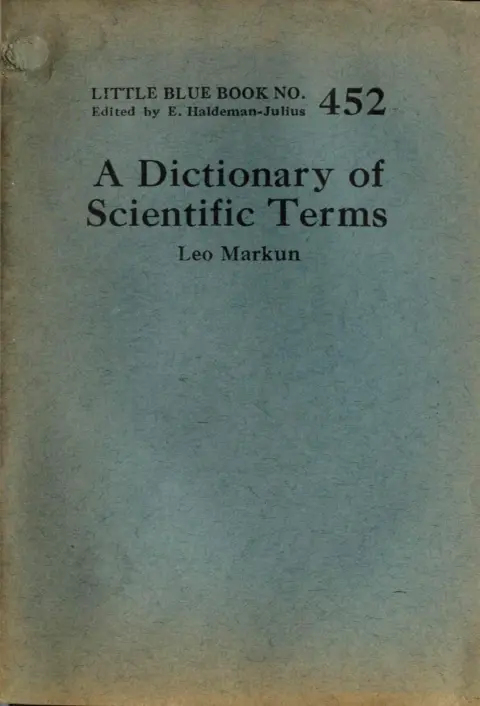
A dictionary of scientific terms by Leo Markun is a compact scientific reference compiled in the early 20th century. It is a dictionary designed for general readers and students, offering brief, accessible explanations of terminology across physics, chemistry, biology, and related disciplines; its likely topic is clarifying scientific vocabulary and method.
The preface sets a modest scope, stressing clarity for non-specialists, noting disagreements over meanings, and including boundary terms that test what counts as science (such as common sense, philosophy, theology, superstition). The main text is an alphabetical glossary from Abasia to Zymurgy, covering taxonomy, anatomy, geology and geological eras, elements and symbols, units and instruments, mathematical and physical concepts, and core ideas in evolution, genetics, psychology, and astronomy. Entries are concise and practical, often giving plural forms, variant spellings, prefixes and roots, and cross-disciplinary notes, with occasional viewpointed remarks on scientific method (hypothesis, theory, law), contested notions (instinct, ether, vitalism), and the value of metrics and standards. The result is a quick-reference guide aimed at orienting readers to essential meanings and usage across the scientific lexicon.
Introduction adapted from the source catalogue; source summaries may be automatically generated.
Free to read · English · 11,972 words · No account needed
MAKE TIME FOR A GOOD BOOK
On by default. Untick to stop anonymous reading totals. Each page counts after 10 seconds in view. How this works.
Anonymous counting is on unless you have switched it off.
Articulation. A joint, as between bones or parts of plants, especially between parts which may separate at any time.
Ascendant. Rising toward the zenith.
Asexual. Without sex.
Assay. A sort of analysis, especially of metals.
Association. Mental connection. The word has also three or four meanings in chemistry, which cannot be explained briefly.
Asteroid. A minor planet.
Astronomy. The science of the heavenly bodies.
Astrophysics. The science which deals with the constitution of the heavenly bodies. It is a branch of astronomy.
Atmosphere. The gaseous envelope about a heavenly body. Especially the air which surrounds the earth. As a measurement, a pressure of fifteen pounds per square inch.
Atom. The smallest particle of an element that enters into combination. According to old definitions, it is indivisible.
Aurora. A luminous atmospheric phenomenon. The aurora borealis radiates from the north magnetic pole, the aurora australis from the south magnetic pole of the earth.
Avogadro’s Hypothesis. The assumption that equal volumes of gases contain equal numbers of molecules if conditions of temperature and pressure are the same. It appears to be close to the truth.
Axiom. A truth which is considered self-evident.
Bacillus. One of a sort of rod-shaped bacteria. Loosely, any bacterium. Plural: bacilli. The Oxford English Dictionary distinguishes bacillus from bacterium, “with which it agrees in its rodlike form, and characterized by its larger size and mode of reproduction.”
Bacterium. More familiar in plural: bacteria. A group of vegetable microörganisms. Not all cause disease.
Barbarian. Of a civilization intermediate between one which is called savage and the most complex forms.
Barium. A silver-white element, classed as a metal. Symbol: Ba.
Barometer. An instrument used to measure atmospheric pressure, and thus to predict storms or determine altitudes.
Base. A substance which can neutralize acids to form a salt. The term includes alkalis. Part of an organ (of a plant or animal) attached to another organ which is more central.
Batrachia. An order of amphibians which have no tails in the adult
stage.
Battery. A system of cells (sometimes used for a single cell) which changes chemical energy into electricity.
Becquerel rays. Rays emitted by radium and other substances which are susceptible to deflection by electricity and which electrically charge other bodies.
Behaviorism. Watson’s psychological system. Opposed to introspective psychology, and it emphasizes the physiology of human behavior.
Bessemer steel. Steel made from cast iron by a process which burns out carbon, sulphur, and phosphorus.
Beta rays. Becquerel rays which are apparently identical with cathode
rays.
Bichloride. A compound in which there are two atoms of chlorine in
the molecule.
Biennial. A plant that rises one year and flowers, fructifies, and
dies the next.
Binary. Composed of two elements.
Your reading position is saved on this browser. Take it to another device with a library code. Reading pages adapt to text, rather than matching a printed edition.
BEHIND THE BOOK
This eBook is for the use of anyone anywhere in the United States and most other parts of the world at no cost and with almost no restrictions whatsoever. You may copy it, give it away or re-use it under the terms of the Project Gutenberg License included with this eBook or online at www.gutenberg.org. If you are not located in the United States, you will have to check the laws of the country where you are located before using this eBook. Read the source licence.
The original source file, including credits and licence, is retained by this library. Request an original-format copy at no charge. Please include the book title and Project Gutenberg identifier #77721.
KEEP YOUR CURIOSITY GOING

John Muir

Asa Gray
Asa Gray

Florence Nightingale
Elizabeth Robins Pennell
Denison Olmsted