THE CLASSIC COLLECTION✦The psychology of the criminalCLASSIC FREE BOOKS
The psychology of the criminal
Leo Markun
THE CLASSIC COLLECTION · 1927
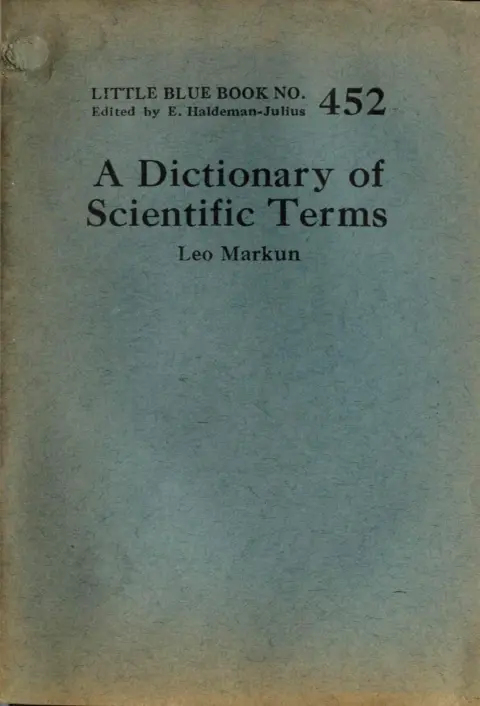
A dictionary of scientific terms by Leo Markun is a compact scientific reference compiled in the early 20th century. It is a dictionary designed for general readers and students, offering brief, accessible explanations of terminology across physics, chemistry, biology, and related disciplines; its likely topic is clarifying scientific vocabulary and method.
The preface sets a modest scope, stressing clarity for non-specialists, noting disagreements over meanings, and including boundary terms that test what counts as science (such as common sense, philosophy, theology, superstition). The main text is an alphabetical glossary from Abasia to Zymurgy, covering taxonomy, anatomy, geology and geological eras, elements and symbols, units and instruments, mathematical and physical concepts, and core ideas in evolution, genetics, psychology, and astronomy. Entries are concise and practical, often giving plural forms, variant spellings, prefixes and roots, and cross-disciplinary notes, with occasional viewpointed remarks on scientific method (hypothesis, theory, law), contested notions (instinct, ether, vitalism), and the value of metrics and standards. The result is a quick-reference guide aimed at orienting readers to essential meanings and usage across the scientific lexicon.
Introduction adapted from the source catalogue; source summaries may be automatically generated.
Free to read · English · 11,972 words · No account needed
MAKE TIME FOR A GOOD BOOK
On by default. Untick to stop anonymous reading totals. Each page counts after 10 seconds in view. How this works.
Anonymous counting is on unless you have switched it off.
Overtone. A tone produced by secondary vibrations, as of segments of
a piano wire.
Ovum. An egg or female germ. Plural: ova.
Oxidize. Combine with oxygen.
Oxygen. An important gaseous element. Symbol: O. About one-fifth of
the air is oxygen.
Paleo-. In many combinations, old, ancient. Also: palæo-, palaeo-.
Paleozoic. Of the oldest geological periods. More usually, of the era between the Mesozoic and the Pre-cambrian. The words designating geological eras have been used differently by various scientists.
Paleontology. The science dealing with life in former geological periods, with species now extinct but made manifest by fossil remains.
Palladium. A metallic element of the platinum group. Symbol: Pd.
Parallax. The apparent displacement of an object caused by the actual change in the position of the observer, or by the assumption of two different points of observation. The parallax is expressed in degrees of an angle.
Paralogy. Mental illness.
Parasite. A plant or animal that derives nourishment or shelter from another upon which, with which, or within which it lives.
Parthenogenesis. Reproduction without the union of male and female.
Pascal’s Law. The law formulated by Pascal which is fundamental for the mechanics of fluids: A fluid under pressure exerts equal force upon equal areas of surface.
Pelagian or pelagic. Relating to the open sea. Pelagic organisms are those which do not approach the shore.
Penology. The study of punishment for crime. If this science were studied scientifically, perhaps it would cease to exist.
Perennial. Lasting for several years; specifically, lasting for more
than two years.
Phagocyte. A leucocyte which consumes disease-producing organisms.
Phase. The aspect of the moon or of a planet depending on the amount of illumination. Position of variation with regard to a real or assumed starting-point. An individual chemical in a mixture.
Phenomenon. Probably more familiar in the plural: phenomena.
Something which is perceived by the senses. An event of scientific
interest.
Philology. The science of language. The philologists have been inclined recently to extend their science, so that it deals with meaning, with folklore or traditional beliefs, and with various other subjects which are more or less closely related to language.
Philosophy. Literally: the love of wisdom. Former: the sum of knowledge, a complete system of knowledge, sometimes with emphasis upon its use in regulating human conduct. Philosophy is now primarily ethical. Durant insists that the growth of the various sciences makes it all the more necessary to be concerned with philosophy, which directs the proper use of knowledge. Religion, incidentally, is concerned chiefly with the field indicated for philosophy, not with the ground covered by the various sciences.
Phonology. The study of sounds in speech.
Phosphorus. A non-metallic element. Symbol: P.
Your reading position is saved on this browser. Take it to another device with a library code. Reading pages adapt to text, rather than matching a printed edition.
BEHIND THE BOOK
This eBook is for the use of anyone anywhere in the United States and most other parts of the world at no cost and with almost no restrictions whatsoever. You may copy it, give it away or re-use it under the terms of the Project Gutenberg License included with this eBook or online at www.gutenberg.org. If you are not located in the United States, you will have to check the laws of the country where you are located before using this eBook. Read the source licence.
The original source file, including credits and licence, is retained by this library. Request an original-format copy at no charge. Please include the book title and Project Gutenberg identifier #77721.
KEEP YOUR CURIOSITY GOING

John Muir

Asa Gray
Asa Gray

Florence Nightingale
Elizabeth Robins Pennell
Denison Olmsted