THE CLASSIC COLLECTION✦The psychology of the criminalCLASSIC FREE BOOKS
The psychology of the criminal
Leo Markun
THE CLASSIC COLLECTION · 1927
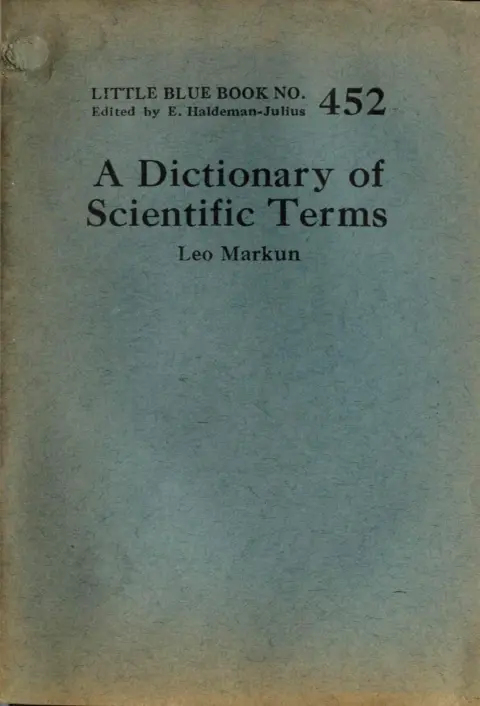
A dictionary of scientific terms by Leo Markun is a compact scientific reference compiled in the early 20th century. It is a dictionary designed for general readers and students, offering brief, accessible explanations of terminology across physics, chemistry, biology, and related disciplines; its likely topic is clarifying scientific vocabulary and method.
The preface sets a modest scope, stressing clarity for non-specialists, noting disagreements over meanings, and including boundary terms that test what counts as science (such as common sense, philosophy, theology, superstition). The main text is an alphabetical glossary from Abasia to Zymurgy, covering taxonomy, anatomy, geology and geological eras, elements and symbols, units and instruments, mathematical and physical concepts, and core ideas in evolution, genetics, psychology, and astronomy. Entries are concise and practical, often giving plural forms, variant spellings, prefixes and roots, and cross-disciplinary notes, with occasional viewpointed remarks on scientific method (hypothesis, theory, law), contested notions (instinct, ether, vitalism), and the value of metrics and standards. The result is a quick-reference guide aimed at orienting readers to essential meanings and usage across the scientific lexicon.
Introduction adapted from the source catalogue; source summaries may be automatically generated.
Free to read · English · 11,972 words · No account needed
MAKE TIME FOR A GOOD BOOK
On by default. Untick to stop anonymous reading totals. Each page counts after 10 seconds in view. How this works.
Anonymous counting is on unless you have switched it off.
Evergreen. A tree or shrub which has green leaves in all seasons.
Evolution. Development, change. In biology, the development of a race or species by gradual change from another type. The Theory of Evolution contradicts the notion that every type was originally created in the form which it now has.
Experiment. An event (or, in the case of the verb: to bring about an event) designed for observation, in order that an unknown fact or principle may be brought to light, or simply to instruct.
Explain. To reduce a phenomenon to the terms of a general principle.
To bring into a system.
Fact. Something which is true. If only a single investigator has reported a certain circumstance or condition, it is not likely to be considered a fact by scientists.
Factor. A substance which takes part in a chemical reaction.
Facula. A bright spot or streak on the sun.
Fahrenheit. A thermometric scale, in common household use, but employed for scientific purposes far less frequently than the Centigrade scale. The boiling point of water is 212 degrees and the freezing point is 32 degrees above zero.
Fair. As used by the American Weather Bureau, without rain, snow, or
hail.
Feces. Excrement.
Fecundate. Impregnate, fertilize, make fruitful.
Female. Bearing fruit or offspring, pistillate.
Ferment. To cause an organic substance to change or to work (used of organic substances), because of the activity of yeast, or of certain other living organisms or substances derived from them.
Filament. The part of the stamen that supports the anther. The conductor in an incandescent electric light.
Fish. A member of a class of vertebrate and cold-blooded animals having gills and usually fins and scales.
Flocculus. A mass in the atmosphere of the sun resembling wool or
clouds.
Florescence. The time or condition of flowering.
Flower. The reproductive organ in a plant which contains one or more pistils or stamens or both, and typically a corolla and calyx. To flower: to blossom or produce flowers.
Fluid. Moving readily. The fluids include the liquids, the gases,
perhaps the ether of space.
Fluorescence. The colored light produced in some transparent bodies by the action of ultra-violet rays. The property some substances have of emitting light when exposed to certain rays.
Fluorine. A gaseous element. Symbol: F.
Focus. The point at which rays meet after reflection or refraction.
Converging-point.
Force. That which changes or tends to change the motion of a body
upon which it acts.
Foreconscious. Mental processes of which we are aware only under special conditions. Of a nature between conscious and unconscious.
Forensic. Used in law-courts.
Formula. A symbolic statement, as in mathematics or chemistry.
Your reading position is saved on this browser. Take it to another device with a library code. Reading pages adapt to text, rather than matching a printed edition.
BEHIND THE BOOK
This eBook is for the use of anyone anywhere in the United States and most other parts of the world at no cost and with almost no restrictions whatsoever. You may copy it, give it away or re-use it under the terms of the Project Gutenberg License included with this eBook or online at www.gutenberg.org. If you are not located in the United States, you will have to check the laws of the country where you are located before using this eBook. Read the source licence.
The original source file, including credits and licence, is retained by this library. Request an original-format copy at no charge. Please include the book title and Project Gutenberg identifier #77721.
KEEP YOUR CURIOSITY GOING

John Muir

Asa Gray
Asa Gray

Florence Nightingale
Elizabeth Robins Pennell
Denison Olmsted