THE CLASSIC COLLECTION✦The psychology of the criminalCLASSIC FREE BOOKS
The psychology of the criminal
Leo Markun
THE CLASSIC COLLECTION · 1927
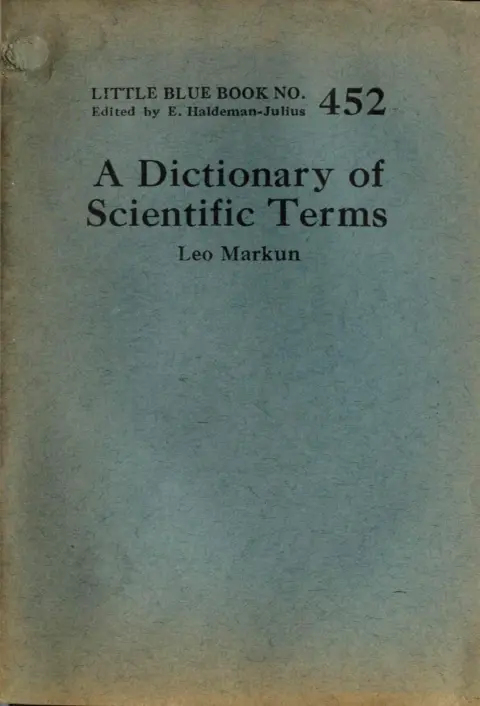
A dictionary of scientific terms by Leo Markun is a compact scientific reference compiled in the early 20th century. It is a dictionary designed for general readers and students, offering brief, accessible explanations of terminology across physics, chemistry, biology, and related disciplines; its likely topic is clarifying scientific vocabulary and method.
The preface sets a modest scope, stressing clarity for non-specialists, noting disagreements over meanings, and including boundary terms that test what counts as science (such as common sense, philosophy, theology, superstition). The main text is an alphabetical glossary from Abasia to Zymurgy, covering taxonomy, anatomy, geology and geological eras, elements and symbols, units and instruments, mathematical and physical concepts, and core ideas in evolution, genetics, psychology, and astronomy. Entries are concise and practical, often giving plural forms, variant spellings, prefixes and roots, and cross-disciplinary notes, with occasional viewpointed remarks on scientific method (hypothesis, theory, law), contested notions (instinct, ether, vitalism), and the value of metrics and standards. The result is a quick-reference guide aimed at orienting readers to essential meanings and usage across the scientific lexicon.
Introduction adapted from the source catalogue; source summaries may be automatically generated.
Free to read · English · 11,972 words · No account needed
MAKE TIME FOR A GOOD BOOK
On by default. Untick to stop anonymous reading totals. Each page counts after 10 seconds in view. How this works.
Anonymous counting is on unless you have switched it off.
Abort. Have premature delivery of a child. Remain undeveloped or
sterile, or dwindle away.
Absolute. Pure. The absolute, philosophically speaking, is final and
total reality.
Absorption. Disappearance through incorporation in something else. The solution of a gas in a liquid is called absorption. Rays of light may be absorbed in some mediums.
Abstract. Theoretical, aside from particular instances.
Abulia. Weakness of will.
Abyssal. Relating to the depths of the sea.
Acaulescent. Apparently stemless.
Acceleration. Rate of increase of velocity per time unit. Rate of change of the velocity of a chemical reaction. The acceleration of a star is the time it gains daily over the sun.
Accident. A property which is not essential to our conception of a
subject.
Achene. A small, dry, indehiscent, one-seeded fruit.
Achromatic. Colorless, transmitting light without decomposing it.
Acid. A substance that neutralizes and is neutralized by a base, and which contains hydrogen. A compound that produces hydrogen ions when it decomposes in aqueous solution.
Actinium. A radioactive substance, believed to be an element.
Actinozoan. One of a class of coelenterates including the corals.
Aculeate. Having a sting, prickly.
Acuminate. Tapering to a point.
Adiabatic. Maintaining a constant temperature.
Adrenalin. A crystalline substance obtained from suprarenal extract.
Adsorption. The condensation of dissolved substances on the surface
of a liquid or solid.
Adventitious. Not in the usual place, as a root.
Aerial. Atmospheric.
Affect. Disease, emotional complex.
Afferent. Conducting inward.
Agoraphobia. The morbid fear of public places.
Agronomics. The science of crop production. The scientific management
of land.
Agrostology. The study of the grasses.
Air. The atmosphere, a gaseous substance of which oxygen and nitrogen are the principal constituents.
Air pump. A pump for forcing air into, or taking it out of, hollow
places.
Albino. An animal, especially a human being, characterized by the congenital absence of coloring pigment in the skin, hair, and eyes. The typical albino has very light skin and hair and pink eyes.
Albumen. A substance, usually edible, found between the skin embryo
of seeds.
Albumin. A class of proteids found in blood serum, milk, and muscle.
Alcohol. Ethyl alcohol, the substance which causes intoxication, and a whole class of substances which are similar to it. They are hydroxides of organic radicals.
Alga. Seaweed. Chiefly used in the plural: algae.
Alkali. Caustic hydroxides which form soluble soaps with fatty acids and turn red litmus paper blue.
Allotropy. Variation of physical properties without change of substance. Carbon, for example, may exist as lampblack, graphite, or the diamond.
Alloy. A mixture (not a compound) of metals.
Alluvium. The deposit of earth and other materials by the mechanical action of running water. More familiar is the adjective: alluvial.
Your reading position is saved on this browser. Take it to another device with a library code. Reading pages adapt to text, rather than matching a printed edition.
BEHIND THE BOOK
This eBook is for the use of anyone anywhere in the United States and most other parts of the world at no cost and with almost no restrictions whatsoever. You may copy it, give it away or re-use it under the terms of the Project Gutenberg License included with this eBook or online at www.gutenberg.org. If you are not located in the United States, you will have to check the laws of the country where you are located before using this eBook. Read the source licence.
The original source file, including credits and licence, is retained by this library. Request an original-format copy at no charge. Please include the book title and Project Gutenberg identifier #77721.
KEEP YOUR CURIOSITY GOING

John Muir

Asa Gray
Asa Gray

Florence Nightingale
Elizabeth Robins Pennell
Denison Olmsted