
The Writing of News A Handbook with Chapters on Newspaper Correspondence and Copy Reading
Charles G. (Charles Griffith) Ross
THE CLASSIC COLLECTION · 1906
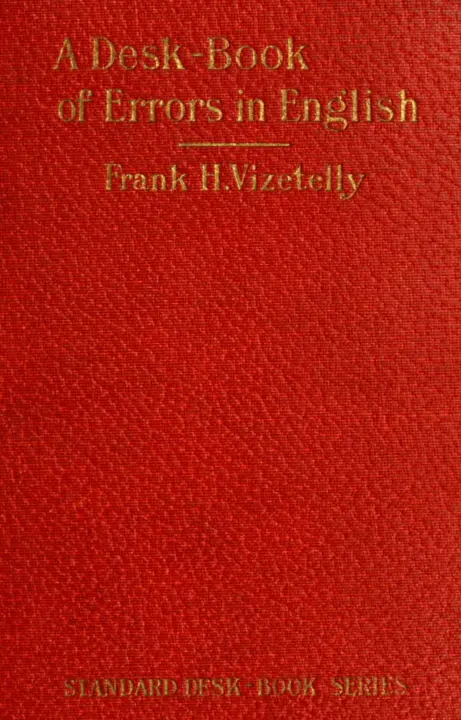
"A Desk-Book of Errors in English" by Frank H. Vizetelly is a reference guide focused on correcting common mistakes and misconceptions in English language usage, likely written in the early 20th century. The book aims to improve the reader's command of English by highlighting errors in grammar, colloquialisms, and slang that should be avoided. This no-nonsense guide is tailored for anyone seeking to refine their spoken or written communication skills. The opening of the work sets the stage by discussing the pervasive misuse of the English language in everyday communication, emphasizing the impact of colloquialisms and illiteracy on grammar. Vizetelly expresses gratitude towards the publishers and addresses the need for clarity amidst a culture where casual speech has become dominant. He articulates a vision of preserving the "Well of English undefiled," where he encourages readers to be mindful of word choice and grammar in order to foster refined diction. The preface is rich in context and presents the author’s sincere intent to guide individuals in avoiding common linguistic pitfalls.
Introduction adapted from the source catalogue; source summaries may be automatically generated.
Free to read · English · 52,993 words · No account needed
MAKE TIME FOR A GOOD BOOK
On by default. Untick to stop anonymous reading totals. Each page counts after 10 seconds in view. How this works.
Anonymous counting is on unless you have switched it off.
~exemplary~ should not be used for “excellent.” That which is exemplary serves as a model or an example worthy of imitation: that which is excellent possesses distinctive merit or excels that which is good or praiseworthy.
~exodus~: Sometimes misused for ~exit~ or ~departure~. Do not say “I made a hasty exodus”; say, rather, “My exit (or departure) was hasty.”
~expect~ is commonly misused for think, believe, suppose; also for suspect. Expect refers to the future, not to the past or present, usually with the implication of interest or desire. Yet “I expect it is,” or even “I expect it was,” is very common.
~expect likely~, ~expect probably~. The STANDARD DICTIONARY says of these careless locutions, it is not the expectancy, but the future event, that is likely or probable. One may say “I think it is likely,” “I think it [the act, event, or the like] probable,” or “It seems likely” or “probable.” When another person’s expectancy is matter of conjecture, one may say “You probably expect to live many years”; i. e., “I think it probable that you expect,” etc.; but “Probably you expect,” etc., would be better.
~face the music~: Slang for to confront with boldness anything of an unpleasant character or any task especially difficult: a metonymic but inelegant phrase.
~fade away~: In modern parlance a slang phrase first introduced by Thackeray (Vanity Fair, ch. 60, p. 540), and meaning “disappear or vanish mysteriously.” The phrase is in good usage, however, in the sense of “to pass away gradually; vanish; die out;” as, “religious animosity would of itself fade away” (MACAULAY, Hist. of England, vol. 2, p. 134).
~faint~, ~feint~, and ~feign~ all come from the French, feindre, which is derived from the Latin, fingo, shape. The first two, similarly pronounced, have very different significations. Faint means a sudden loss of consciousness or swoon; feint signifies a deceptive move or pretense. To feign is to make a false show of; pretend.
~fake~: Slang term for imposition; fraud; also, fictitious or manufactured news. Expressive but inelegant.
~fakement~: Slang for an act of fraud. Less desirable than preceding
and equally inelegant.
~fanatic~. Compare ENTHUSIAST.
~farewell~: When separated by a pronoun farewell is written as two words; as, fare you well. Exception has been taken to Byron’s pathetic lines
Fare thee well, and if for ever,
Then for ever, fare thee well;
but this is hypercriticism for here the pronoun is nothing but the
Anglo-Saxon dative.
~farther~, ~further~: Farther should be used to designate longitudinal distance; further to signify quantity or degree. Thus, “How much farther have we to go?” “Proceed no further along that course.”
Your reading position is saved on this browser. Take it to another device with a library code. Reading pages adapt to text, rather than matching a printed edition.
BEHIND THE BOOK
This eBook is for the use of anyone anywhere in the United States and most other parts of the world at no cost and with almost no restrictions whatsoever. You may copy it, give it away or re-use it under the terms of the Project Gutenberg License included with this eBook or online at www.gutenberg.org. If you are not located in the United States, you will have to check the laws of the country where you are located before using this eBook. Read the source licence.
The original source file, including credits and licence, is retained by this library. Request an original-format copy at no charge. Please include the book title and Project Gutenberg identifier #48907.
KEEP YOUR CURIOSITY GOING
Charles G. (Charles Griffith) Ross
Hannah Webster Foster

Emily Lawless
Edwin Hamlin Carr

Charles De Lano Hine
Andrew Ure