
The Writing of News A Handbook with Chapters on Newspaper Correspondence and Copy Reading
Charles G. (Charles Griffith) Ross
THE CLASSIC COLLECTION · 1906
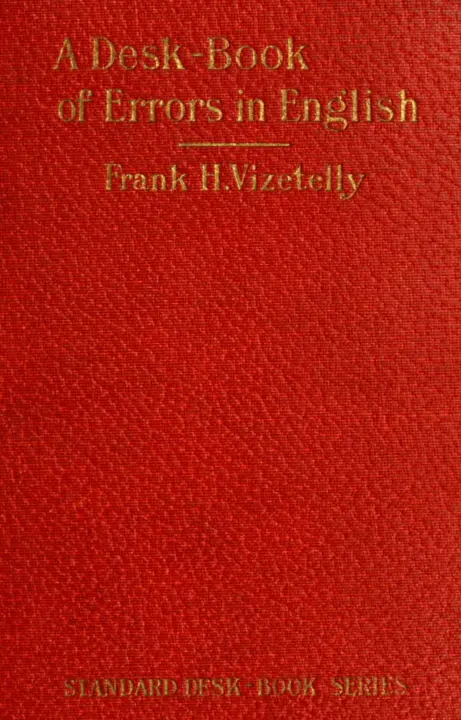
"A Desk-Book of Errors in English" by Frank H. Vizetelly is a reference guide focused on correcting common mistakes and misconceptions in English language usage, likely written in the early 20th century. The book aims to improve the reader's command of English by highlighting errors in grammar, colloquialisms, and slang that should be avoided. This no-nonsense guide is tailored for anyone seeking to refine their spoken or written communication skills. The opening of the work sets the stage by discussing the pervasive misuse of the English language in everyday communication, emphasizing the impact of colloquialisms and illiteracy on grammar. Vizetelly expresses gratitude towards the publishers and addresses the need for clarity amidst a culture where casual speech has become dominant. He articulates a vision of preserving the "Well of English undefiled," where he encourages readers to be mindful of word choice and grammar in order to foster refined diction. The preface is rich in context and presents the author’s sincere intent to guide individuals in avoiding common linguistic pitfalls.
Introduction adapted from the source catalogue; source summaries may be automatically generated.
Free to read · English · 52,993 words · No account needed
MAKE TIME FOR A GOOD BOOK
On by default. Untick to stop anonymous reading totals. Each page counts after 10 seconds in view. How this works.
Anonymous counting is on unless you have switched it off.
~cereal~, a word derived from Ceres, the goddess of corn. It has nothing in common, save the sound, with serial, which fitly describes a literary publication in parts issued successively (Lat. series, sere join). Exercise care in spelling these words.
~cession~, from Latin of cedo, yield, meaning surrender, must not be confounded with session, from Latin sedeo, sit, as used in the expression a session of court.
~character~, ~reputation~: These are not synonymous terms. Character is what one is; reputation is that which one is thought to be. Character includes both natural and acquired traits; reputation designates only those traits acquired as by contact with one’s fellow men. Holland in Gold Foil (p. 219) makes the following distinction: “Character lives in a man; reputation outside of him.”
~chargeable~: Do not spell this word chargable. Remember its components are charge + able and the “e” is retained before the second “a.”
~cherubim~ and ~seraphim~: Do not use these plurals as singulars. There is no such thing as a cherubim.
~chew the rag~: A low phrase sometimes used as an equivalent for “wrangle;” as, “stop chewing the rag,” meaning, “cease wrangling.” The use of expressions of this kind can not be too severely condemned.
~childlike~, ~childish~: There is a distinction between these words. The one is used in a good sense, the other is spoken in derogation.
~chin music~: A low phrase sometimes used as an equivalent for “talk,” but not uttered by persons of refinement.
~chuck-full~ is the American colloquial form of choke- or chock-full, but this form finds no literary favor, and indeed the expression is far from elegant, both in sense and sound.
~circus~: This word should not be used as a synonym of “frolic;” as such it is a vulgar perversion.
~cite~, from the French citer (Latin cito, frequentative of cieo, call), means “mention by name, summon” and has no relationship with site, similarly pronounced, which means “local position,” and is derived from Lat. situa, pp. of sino, put.
~citizen~: Not to be used for person, except when civic relations are referred to. “All citizens are entitled to the protection of the law,” but not “Ten citizens were walking up the street,” unless reference is had to some civic relation, as when opposed to soldiers, policemen, residents of the country, or the like.
~claim~: “He claimed that the discovery was his,” “I claim that this is true,” etc. Incorrect if the meaning is simply assert or maintain; but correct if the meaning is assert with readiness to maintain, and confidence that the thing asserted can be maintained, with the added idea that it makes for the advantage or side of him who asserts and maintains it.
Your reading position is saved on this browser. Take it to another device with a library code. Reading pages adapt to text, rather than matching a printed edition.
BEHIND THE BOOK
This eBook is for the use of anyone anywhere in the United States and most other parts of the world at no cost and with almost no restrictions whatsoever. You may copy it, give it away or re-use it under the terms of the Project Gutenberg License included with this eBook or online at www.gutenberg.org. If you are not located in the United States, you will have to check the laws of the country where you are located before using this eBook. Read the source licence.
The original source file, including credits and licence, is retained by this library. Request an original-format copy at no charge. Please include the book title and Project Gutenberg identifier #48907.
KEEP YOUR CURIOSITY GOING
Charles G. (Charles Griffith) Ross
Hannah Webster Foster

Emily Lawless
Edwin Hamlin Carr

Charles De Lano Hine
Andrew Ure