
The Writing of News A Handbook with Chapters on Newspaper Correspondence and Copy Reading
Charles G. (Charles Griffith) Ross
THE CLASSIC COLLECTION · 1906
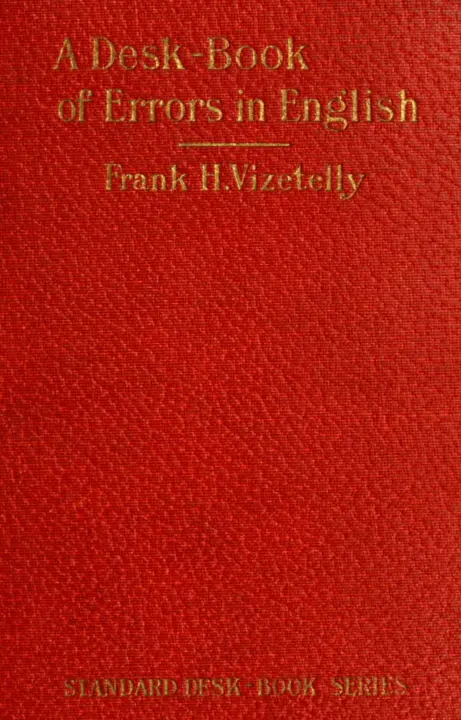
"A Desk-Book of Errors in English" by Frank H. Vizetelly is a reference guide focused on correcting common mistakes and misconceptions in English language usage, likely written in the early 20th century. The book aims to improve the reader's command of English by highlighting errors in grammar, colloquialisms, and slang that should be avoided. This no-nonsense guide is tailored for anyone seeking to refine their spoken or written communication skills. The opening of the work sets the stage by discussing the pervasive misuse of the English language in everyday communication, emphasizing the impact of colloquialisms and illiteracy on grammar. Vizetelly expresses gratitude towards the publishers and addresses the need for clarity amidst a culture where casual speech has become dominant. He articulates a vision of preserving the "Well of English undefiled," where he encourages readers to be mindful of word choice and grammar in order to foster refined diction. The preface is rich in context and presents the author’s sincere intent to guide individuals in avoiding common linguistic pitfalls.
Introduction adapted from the source catalogue; source summaries may be automatically generated.
Free to read · English · 52,993 words · No account needed
MAKE TIME FOR A GOOD BOOK
On by default. Untick to stop anonymous reading totals. Each page counts after 10 seconds in view. How this works.
Anonymous counting is on unless you have switched it off.
Obviously, when one says, “I am surprised,” he uses an expression exactly equivalent to “I am struck with astonishment,” which is the equivalent of “I am astonished.”
~at~: Commonly but erroneously used for to, as an intensive in such phrases as “Where have you been at?” “Where are you going at?” Used also occasionally to denote place: as, “Where does he live at?” Wherever used in such connections the word is redundant.
~at all~: These words, supposed to have an intensive effect, are frequently unnecessarily introduced. “It doesn’t rain at all,” would be just as expressive if written “It doesn’t rain.”
~at auction~: In England this expression is known as an Americanism. There, goods are put up to auction and are sold by it--that is by offering them to the highest bidder. “At private sale” also is peculiar to America.
~at best~: An erroneous form for “at the best.”
~at~, ~in~: Always in a country; either at or in a city, town, or village; at, if the place is regarded as a point; in, if it is inclusive; as, “We arrived at Paris;” “He lives in London.”
~at length~: The assumption that at length means the same as ~at last~, and is therefore superfluous, is an error. Both at length and at last presuppose long waiting; but at last views what comes after the waiting as a finality; at length views it as intermediate with reference to action or state that continues, or to results that are yet to follow; as, “I have invited him often, and at length he is coming”; “I have invited him often, and at last he has come.”
At length is used also of space; as, “He wrote me at length” (that is, fully or in detail). At last is used of time; as, “He came back at last.”
~at that~: A vulgarism of speech, sometimes defended on the ground that the phrase is elliptical, the omitted word or phrase being computation, showing, or feature of the case. Avoid the usage, however.
~at you~: As a substitute for with you this is an unpardonable vulgarism, as in the sentence “I am angry at (for with) you.”
~audience~, ~spectator~: An audience is a number of persons assembled to listen to a play, lecture, debate, etc.; a spectator is an eye-witness as of a pageant, panorama, etc.
~aught~, ~ought~: The former means anything whatever, any (even the smallest) part; the latter, as a noun, is a corruption of naught, a cipher. Naught is of course not aught, that is, not anything, thus nothing, and hence the figure 0, a cipher. Careful speakers do not replace this word by ought.
Your reading position is saved on this browser. Take it to another device with a library code. Reading pages adapt to text, rather than matching a printed edition.
BEHIND THE BOOK
This eBook is for the use of anyone anywhere in the United States and most other parts of the world at no cost and with almost no restrictions whatsoever. You may copy it, give it away or re-use it under the terms of the Project Gutenberg License included with this eBook or online at www.gutenberg.org. If you are not located in the United States, you will have to check the laws of the country where you are located before using this eBook. Read the source licence.
The original source file, including credits and licence, is retained by this library. Request an original-format copy at no charge. Please include the book title and Project Gutenberg identifier #48907.
KEEP YOUR CURIOSITY GOING
Charles G. (Charles Griffith) Ross
Hannah Webster Foster

Emily Lawless
Edwin Hamlin Carr

Charles De Lano Hine
Andrew Ure