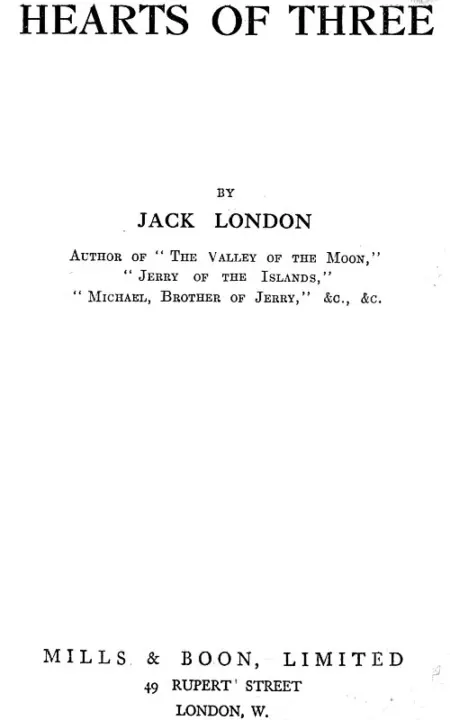
Hearts of three
Jack London
THE CLASSIC COLLECTION · 1902
"A Daughter of the Snows" by Jack London is a novel written in the early 20th century that explores themes of adventure, survival, and personal growth against the backdrop of the Klondike Gold Rush. The story centers on the character Frona Welse, who embarks on a journey to her family's log house in Alaska, navigating the chaos of gold-rushers and the struggles they face. The opening of the novel sets the scene aboard a steamer overrun with eager gold-seekers, where Frona is introduced as a determined and spirited woman, ready to confront the challenges ahead. She interacts with various characters, including the first officer, who expresses sympathy for her situation, and Del Bishop, a ferryman who becomes her guide. Frona navigates the bustling landscape, brimming with men fighting for their stakes in the gold rush, while reminiscing about her childhood in the area. As she arrives at her destination, she begins to recognize the remnants of her past amid the stark transformations brought about by the influx of prospectors and the relentless pursuit of wealth, establishing her connection to the land and her determination to thrive in it.
Introduction adapted from the source catalogue; source summaries may be automatically generated.
Free to read · English · 86,627 words · No account needed
MAKE TIME FOR A GOOD BOOK
On by default. Untick to stop anonymous reading totals. Each page counts after 10 seconds in view. How this works.
Anonymous counting is on unless you have switched it off.
"No. Take her,"--Frona was thinking quickly,--"no; bring her up
here."
"Much better--"
"Go!"
How-ha grunted, and yielded up the obedience she could not withhold; though, as she went down the stairs to the door, in a tenebrous, glimmering way she wondered that the accident of white skin or swart made master or servant as the case might be.
In the one sweep of vision, Lucile took in Frona smiling with extended hand in the foreground, the dainty dressing-table, the simple finery, the thousand girlish evidences; and with the sweet wholesomeness of it pervading her nostrils, her own girlhood rose up and smote her. Then she turned a bleak eye and cold ear on outward things.
"I am glad you came," Frona was saying. "I have so wanted to see you again, and--but do get that heavy parka off, please. How thick it is, and what splendid fur and workmanship!"
"Yes, from Siberia." A present from St. Vincent, Lucile felt like adding, but said instead, "The Siberians have not yet learned to scamp their work, you know."
She sank down into the low-seated rocker with a native grace which could not escape the beauty-loving eye of the girl, and with proud-poised head and silent tongue listened to Frona as the minutes ticked away, and observed with impersonal amusement Frona's painful toil at making conversation.
"What has she come for?" Frona asked herself, as she talked on furs and weather and indifferent things.
"If you do not say something, Lucile, I shall get nervous, soon," she ventured at last in desperation. "Has anything happened?"
Lucile went over to the mirror and picked up, from among the trinkets beneath, a tiny open-work miniature of Frona. "This is you? How old were you?"
"Sixteen."
"A sylph, but a cold northern one."
"The blood warms late with us," Frona reproved; "but is--"
"None the less warm for that," Lucile laughed. "And how old are you
now?"
"Twenty."
"Twenty," Lucile repeated, slowly. "Twenty," and resumed her seat. "You are twenty. And I am twenty-four."
"So little difference as that!"
"But our blood warms early." Lucile voiced her reproach across the unfathomable gulf which four years could not plumb.
Frona could hardly hide her vexation. Lucile went over and looked at the miniature again and returned.
"What do you think of love?" she asked abruptly, her face softening
unheralded into a smile.
"Love?" the girl quavered.
"Yes, love. What do you know about it? What do you think of it?"
A flood of definitions, glowing and rosy, sped to her tongue, but Frona swept them aside and answered, "Love is immolation."
"Very good--sacrifice. And, now, does it pay?"
Your reading position is saved on this browser. Take it to another device with a library code. Reading pages adapt to text, rather than matching a printed edition.
Jack London
Jack London
Jack London
Jack London
BEHIND THE BOOK
This eBook is for the use of anyone anywhere in the United States and most other parts of the world at no cost and with almost no restrictions whatsoever. You may copy it, give it away or re-use it under the terms of the Project Gutenberg License included with this eBook or online at www.gutenberg.org. If you are not located in the United States, you will have to check the laws of the country where you are located before using this eBook. Read the source licence.
The original source file, including credits and licence, is retained by this library. Request an original-format copy at no charge. Please include the book title and Project Gutenberg identifier #14654.
KEEP YOUR CURIOSITY GOING
Coulson Kernahan

Maurice Baring
Frances Wright
Cécile Tormay

Frederic Jesup Stimson

W. H. P. (William Henry Pope) Jarvis