THE CLASSIC COLLECTION✦My diaries, being a personal narrative of events 1888-1914, Part 2 (1900-1914)CLASSIC FREE BOOKS
My diaries, being a personal narrative of events 1888-1914, Part 2 (1900-1914)
Wilfrid Scawen Blunt
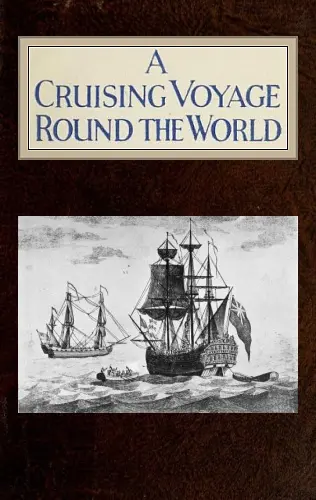
THE CLASSIC COLLECTION · 1712
"A Cruising Voyage Round the World" by Woodes Rogers is a historical account written in the early 18th century. The book chronicles Rogers's remarkable voyage on two ships, the "Duke" and "Dutchess", as they set out to explore the South Seas and engage in privateering during a time of intense maritime competition and conflict. The narrative not only details the expedition's adventures and challenges but also provides insight into the life and character of Rogers, a significant figure in British maritime history. The opening of "A Cruising Voyage Round the World" introduces Captain Woodes Rogers as he prepares for a notable expedition in 1708, aiming to disrupt the lucrative South Sea trade dominated by France and Spain. His foresight leads him to gather a skilled crew, including the experienced Captain William Dampier, and organize two ships to sail from Bristol. The narrative unfolds with the preparations for the journey, the initial challenges faced by the crew—including mutiny and illness—and their eventual encounters with treasure ships and capture of prizes, setting the stage for a dramatic tale of adventure, resilience, and naval exploits that highlights the spirit of the age.
Introduction adapted from the source catalogue; source summaries may be automatically generated.
Free to read · English · 160,581 words · No account needed
MAKE TIME FOR A GOOD BOOK
On by default. Untick to stop anonymous reading totals. Each page counts after 10 seconds in view. How this works.
Anonymous counting is on unless you have switched it off.
[123] Basil Ringrose, a friend of Dampier, joined the Buccaneers in the Gulf of Darien, 1680. His “Journal,” the MS. of which is in the British Museum, was published in the second volume of the “Hist. of the Buccaneers,” 1685. He was killed in action in Feb., 1686.
[124] John Watling “an old privateer and a stout seaman,” was appointed to command the Buccaneers in Jan., 1681, at Juan Fernandez. Quitting the island in a hurry a Mosquito Indian, named William, was left behind. Watling was killed in action at the end of the month. Dampier visited the island March 22, 1684, and rescued the Indian.
[125] Anson, who visited the island in 1741, records that “the first goat that was killed at their landing had its ears slit, whence we concluded that he had doubtless been formerly under the power of Selkirk. This was indeed an animal of most venerable aspect, dignified with an exceeding majestic beard.”
[126] Perriers, commonly known as Pattereras or Pedereros; a small
breach-loading swivel-gun.
[127] Thomas Stradling, formerly Lieutenant of this vessel.
[128] A charge consisting of a number of missiles (pieces of iron, stones, etc.) fired together; similar to case shot.
[129] Grapling or Grapnel; a sort of small anchor fitted with four or
five flukes, or claws.
[130] A small kind of mortar invented by the celebrated engineer, Baron Coehorn, to throw small shells or grenades.
[131] A large species of Tunny fish, similar to the Bonito or striped
Tunney.
[132] It was not until Rogers returned to England that he learnt that Simon Hatley, after losing company of the Duke and Dutchess, sailed to the coast of Peru, and after great privations, surrendered to the Spaniards. He afterwards returned to England, and served as Shelvocke’s second Captain in his “Voyage round the World,” 1719-22. An incident in this voyage--the shooting of a black Albatross by Hatley--has been immortalized in Coleridge’s “Ancient Mariner.”
[133] Edward Davis, chosen to command the Buccaneers in the South Sea
in 1684.
[134] The operation of heaving a ship down on one side by strong purchase on the masts, so that the bottom may be cleaned.
[135] Cut-water or Knee of the Head; the foremost part of a ship’s
prow.
[136] He died October 28, 1708.
[137] Captain Swann, one of the most redoubtable pirates of the Pacific, with whom Dampier served, 1685-86. In the latter year Dampier took advantage of a mutiny to abandon Swann and thirty-six of his crew at Mindanao, in the Philippines.
[138] He had been appointed Lord High Admiral of England on Anne’s
accession.
[139] In merchant ships the lazaretto was the fore part of the lower deck, parted off for the storage of provisions and stores.
[140] See note page 25.
Your reading position is saved on this browser. Take it to another device with a library code. Reading pages adapt to text, rather than matching a printed edition.
BEHIND THE BOOK
This eBook is for the use of anyone anywhere in the United States and most other parts of the world at no cost and with almost no restrictions whatsoever. You may copy it, give it away or re-use it under the terms of the Project Gutenberg License included with this eBook or online at www.gutenberg.org. If you are not located in the United States, you will have to check the laws of the country where you are located before using this eBook. Read the source licence.
The original source file, including credits and licence, is retained by this library. Request an original-format copy at no charge. Please include the book title and Project Gutenberg identifier #55538.
KEEP YOUR CURIOSITY GOING
Wilfrid Scawen Blunt
Wilfrid Scawen Blunt

E. W. (Edgar Watson) Howe
Cécile Tormay

Moritz Busch
John L. Ransom