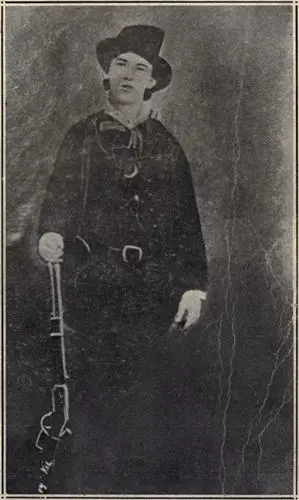
History of “Billy the Kid”
Charles A. Siringo
THE CLASSIC COLLECTION · 1912
"A cowboy detective" by Charles A. Siringo is a memoir written in the early 20th century. It traces a cowboy-turned-operative through decades of undercover work with a prominent detective agency across the American West and beyond, recounting labor strife, mine wars, train robberies, and outlaw hunting in a blunt, plainspoken style.
The opening of the memoir sets a factual, unvarnished tone: a preface explains delays due to former employers’ objections and the use of some fictitious names, stressing that these are true adventures, not fiction. Siringo sketches his Texas cowboy youth, his proximity to the Chicago Haymarket riot, a fortuitous push toward detective work (via a blind phrenologist and a bank introduction), a brief jailing after a circus fracas, and his first cases—including the anarchist trials, Irish National League surveillance, and city “shadowing”—before moving to Denver. He then recounts infiltrating an armed uprising in Colorado’s Archuleta County (narrowly escaping a lynching and defusing a planned massacre), pursuing a Wells Fargo thief through Mexico (with vivid asides on earthquakes, bullfights, and a relic grabbed from Santa Anna’s grave), and seizing the Bassick mine against a threatened mob. Further early episodes include probing a Ute “war” he deems a murder spree, riding incognito as “Dull Knife” in a Denver cowboy tournament, and penetrating a Wyoming outlaw camp by faking a crippling injury to learn the fate of a condemned killer; grand-jury indictments follow, later undercut by local politics. The excerpt closes as he embeds himself—shackled as a “prisoner”—among Denver & Rio Grande holdup suspects in a Gunnison jail, using close confinement to pry loose confessions amid grim reminders of past inmates.
Introduction adapted from the source catalogue; source summaries may be automatically generated.
Free to read · English · 149,772 words · No account needed
MAKE TIME FOR A GOOD BOOK
On by default. Untick to stop anonymous reading totals. Each page counts after 10 seconds in view. How this works.
Anonymous counting is on unless you have switched it off.
After the riot the city was all excitement, and I commenced to wish that I were a detective so as to help ferret out the thrower of the bomb and his backers. I knew very little about the detective business, though I had spent part of 1881 and 1882 doing secret work for Texas cattlemen against cattle thieves in western Texas and New Mexico. This had given me a taste for the work, and I liked it. Besides, I had been told by a blind phrenologist that I was “cut out” for a detective. At that time I didn’t believe in phrenology, but this man being as blind as a bat and telling so many truths about people I knew, convinced me that there was something besides wind and graft in phrenology. Had this man not been blind, I would have attributed his knowledge to his ability to read faces.
It was in the year 1884. I lived in Caldwell, Kansas, a cattle town on the border of Kansas and the Indian Territory. Circulars were scattered broadcast over the town announcing the coming of this noted phrenologist. After supper, on the evening of his arrival, many leading citizens turned out to hear him lecture at the Leland Hotel. He stood in the center of a large parlor, holding to the back of an empty chair. He was a fine-looking old man, regardless of the fact that both eyes were out. After making a few preliminary remarks on phrenology, he called for some one to come forward and have his head examined. The audience began calling for our popular city marshal, Henry Brown, who had only been marshal a short time, but who had won glory and a new gold star by killing several men, including an Indian chief, “Spotted Horse,” who had taken on more “firewater” than he could carry. Brown hesitated quite awhile about having his head “felt.” He knew better than any one else in the audience as to what was in his head and he didn’t want to risk having his faults told. He finally went out and sat down in the chair. But it was soon made plain by the color of his face that he regretted going. He stuck it out though, and heard some very uncomplimentary remarks said against himself. I knew that the phrenologist was telling the truth, because I had known Henry Brown when he was a member of the notorious “Billy the Kid’s” outlaw gang in the Panhandle of Texas, and the Territory of New Mexico. I first became acquainted with him through introduction by “Billy the Kid” in the fall of 1878. I had just returned to the Panhandle from Chicago, where I had been with a shipment of fat steers, and had found “Billy the Kid” and his gang camped at the L X ranch where I was employed as one of the cowboy foremen. I presented “Billy the Kid” with a fine meerschaum cigar holder, which I had bought in Chicago, and he in turn presented me with a book containing his autograph. He also introduced me to several of his men, one of them being Henry Brown. During that winter Brown and a half-breed Indian quit “the Kid’s” outlaw gang and went to the Indian Territory, and I lost track of him until I met him wearing an officer’s star in Caldwell, Kansas. He begged me to not give him away as he intended to reform and lead an honorable life. But I regretted afterwards that I didn’t tell the citizens of Caldwell of his past record. For, while acting as city marshal of Caldwell, and while wearing his star, he rode into Medicine Lodge, a nearby town, with his chief deputy, Ben Wheeler, and two cowboys, and in broad daylight held up the Medicine Lodge Bank and killed the bank president, Wiley Pain, and his cashier. After a lively chase by the citizens of Medicine Lodge the four robbers were caught and jailed. That night when the mob opened the jail door to hang them, Brown and Wheeler made a break for liberty, knocking men down as they ran. Brown was killed with a charge of buckshot and Wheeler and the two cowboys were hung to a nearby tree.
Your reading position is saved on this browser. Take it to another device with a library code. Reading pages adapt to text, rather than matching a printed edition.
Charles A. Siringo
BEHIND THE BOOK
This eBook is for the use of anyone anywhere in the United States and most other parts of the world at no cost and with almost no restrictions whatsoever. You may copy it, give it away or re-use it under the terms of the Project Gutenberg License included with this eBook or online at www.gutenberg.org. If you are not located in the United States, you will have to check the laws of the country where you are located before using this eBook. Read the source licence.
The original source file, including credits and licence, is retained by this library. Request an original-format copy at no charge. Please include the book title and Project Gutenberg identifier #77835.
KEEP YOUR CURIOSITY GOING
John L. Ransom

Herman W. Mudgett

Harriet Monroe
Daniel Dulany Addison
Charles Lanman

Harold Rosher