
Letters to a Friend, Written to Mrs. Ezra S. Carr, 1866-1879
John Muir
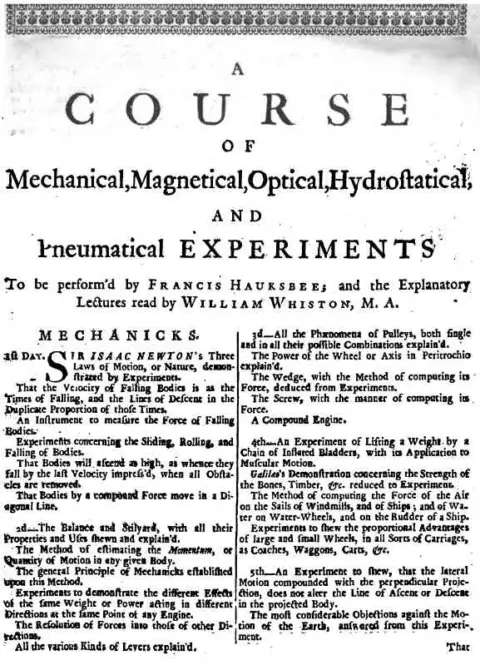
THE CLASSIC COLLECTION · 1713
"A Course of Mechanical, Magnetical, Optical, Hydrostatical and Pneumatical Experiments" by Francis Hauksbee is a scientific publication written in the early 18th century. The work presents a series of experiments and demonstrations related to various scientific principles, including mechanics and optics. It aims to elucidate natural philosophy concepts, primarily focusing on the laws of physics as demonstrated through practical experimentation. The opening of the text introduces readers to various experiments conducted over multiple days, beginning with the foundational laws of motion established by Sir Isaac Newton. Hauksbee outlines experiments designed to observe the behavior of falling bodies, utilize levers and pulleys, and explore the properties of gravity and forces in motion. Further, there are detailed explanations of subsequent days focusing on magnetism, optics, hydrostatics, and pneumatics, including experiments that illustrate principles such as the reflection and refraction of light and the behaviors of fluids in various conditions. Overall, the beginning sets a rigorous and systematic approach to understanding these scientific phenomena through experimentation.
Introduction adapted from the source catalogue; source summaries may be automatically generated.
Free to read · English · 16,639 words · No account needed
MAKE TIME FOR A GOOD BOOK
On by default. Untick to stop anonymous reading totals. Each page counts after 10 seconds in view. How this works.
Anonymous counting is on unless you have switched it off.
Fig. 4. Is Archimedes's Spiral Pump C D, made of only a Cylinder, with a hollow Spiral Tube wreath'd about it; where the Fluid partly descending, and partly ascending, all the way, makes its flowing along the more easy, till upon its Arrival at the Top it runs out at C.
Fig. 5. Is the whole Apparatus of the Hydrostatical Balance. The Glass Bubble G is heavier than all Fluids but Quicksilver, and is to be put into all those Fluids: The Bulk of Water in ours is 830 Grains Troy. If when pois'd in Water it sink more by any Number of Grains, that Number of Grains substracted from; if less, added to those 830, do by their Proportion to 830 give the Specifick Gravity of all such Fluids to Water. I K is the Glass Bucket, which in Air is in Æquilibrio with the Scale E: And because when it is let into Water, it will be no longer an Equipoise to the opposite Scale, but lighter; the Scale R is to be added to the Part H, by which the Bucket is suspended, and that will restore the Æquilibrium in Water. By this Solids and Quicksilver are weighed first in Air, and then in Water: The Difference of which Weights being the Weight of an equal Bulk of Water, by its Proportion to the first Weight in Air, gives the Specifick Gravity of the Solid compared with Water: And if that Difference still divide the Weight in Air, for all sort of Bodies, we may have a Table of the Specifick Gravities of the Solids; as by dividing 830 by the Sum or Difference of the other Fluids, we may have a like Table of the Specifick Gravity of Fluids, such an one as here presented the Reader.
A TABLE of the Specifick Gravities of several Solid and Fluid Bodies.
Fine Gold 19,640 Calculus Humanus 1,700 Standard Gold 18,888 Oyl of Vitriol 1,700 Quicksilver 14,000 Oyl of Tartar 1,550 Lead 11,325 Bezoar 1,500 Fine Silver 11,091 Honey 1,450 Standard Silver 10,535 Gum Arabick 1,375 Bismuth 9,700 Spirit of Nitre 1,315 Copper 9,000 Aqua Fortis 1,300 Cast Brass 8,000 Serum of Human Blood 1,190 Steel } Soft 7,738 Pitch 1,150 the same } Hard 7,704 Spirit of Salt 1,130 Piece } Spring Temper 7,809 Spirit of Urine 1,120 Iron 7,645 Human Blood 1,040 Tin 7,320 Amber 1,040 Glass of Antimony 5,280 Milk 1,030 A Pseudo Topaz 4,270 Urine 1,030 A Diamond 3,400 Dry Box-Wood 1,030 Clear Crystal Glass 3,150 Sea-Water 1,030 Iceland Crystal 2,720 Common Water 1,000 Fine Marble 2,700 Camphire 0,996 Rock Crystal 2,650 Bees-Wax 0,955 Common Green Glass 2,620 Lynseed Oyl 0,932 Stone of a mean Gravity 2,500 Dry Oak 0,925 Sal Gemmæ 2,143 Oyl Olive 0,913 Brick 2,000 Spirit of Turpentine 0,874 Nitre 1,900 Rectified Spirit of Wine 0,866 Alabaster 1,875 Dry Ash 0,800 Dry Ivory 1,825 Dry Maple 0,755 Brimstone 1,800 Dry Elm 0,600 Dantzick Vitriol 1,715 Dry Firr 0,550 Allom 1,714 Cork 0,240 Borax 1,714 Air 0,001 ¼
[[Plate I. Pneumaticks]]
An Explication of the First PLATE.
Your reading position is saved on this browser. Take it to another device with a library code. Reading pages adapt to text, rather than matching a printed edition.
BEHIND THE BOOK
This eBook is for the use of anyone anywhere in the United States and most other parts of the world at no cost and with almost no restrictions whatsoever. You may copy it, give it away or re-use it under the terms of the Project Gutenberg License included with this eBook or online at www.gutenberg.org. If you are not located in the United States, you will have to check the laws of the country where you are located before using this eBook. Read the source licence.
The original source file, including credits and licence, is retained by this library. Request an original-format copy at no charge. Please include the book title and Project Gutenberg identifier #44019.
KEEP YOUR CURIOSITY GOING
John Muir

Asa Gray
Asa Gray

Florence Nightingale
Elizabeth Robins Pennell
Denison Olmsted