
Letters to a Friend, Written to Mrs. Ezra S. Carr, 1866-1879
John Muir
THE CLASSIC COLLECTION · 1713
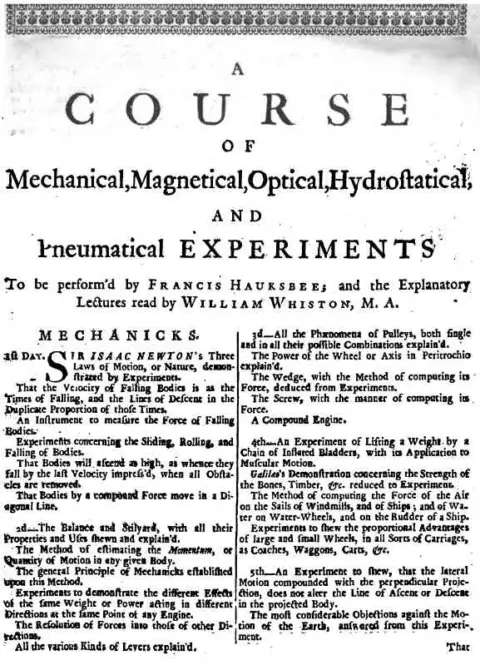
"A Course of Mechanical, Magnetical, Optical, Hydrostatical and Pneumatical Experiments" by Francis Hauksbee is a scientific publication written in the early 18th century. The work presents a series of experiments and demonstrations related to various scientific principles, including mechanics and optics. It aims to elucidate natural philosophy concepts, primarily focusing on the laws of physics as demonstrated through practical experimentation. The opening of the text introduces readers to various experiments conducted over multiple days, beginning with the foundational laws of motion established by Sir Isaac Newton. Hauksbee outlines experiments designed to observe the behavior of falling bodies, utilize levers and pulleys, and explore the properties of gravity and forces in motion. Further, there are detailed explanations of subsequent days focusing on magnetism, optics, hydrostatics, and pneumatics, including experiments that illustrate principles such as the reflection and refraction of light and the behaviors of fluids in various conditions. Overall, the beginning sets a rigorous and systematic approach to understanding these scientific phenomena through experimentation.
Introduction adapted from the source catalogue; source summaries may be automatically generated.
Free to read · English · 16,639 words · No account needed
MAKE TIME FOR A GOOD BOOK
On by default. Untick to stop anonymous reading totals. Each page counts after 10 seconds in view. How this works.
Anonymous counting is on unless you have switched it off.
7th—The Laws of Motion in the Collision of Hard and Elastick Bodies.
Experiments concerning the Centrifugal and Centripetal Forces of Solid and Fluid Bodies in Motion.
Experiments in order to estimate the Centrifugal Forces of Solid Bodies.
8th Day. Attractive and Directive Powers of Loadstones.
The Form or Position of Filings of Iron at the Poles and Equator of a
Loadstone.
Magnetick Power acts thro' all Bodies but Iron.
The Attraction of different, and Repulse of corresponding Poles.
The manner of touching and untouching of Needles.
The Law of Magnetick Attraction discover'd.
9th—The Phænomena of Terrella, or Spherical Loadstones.
The Direction of Magnetick Needles on the Surfaces of Terrella nearly
towards the Poles.
Their Variation East and West.
The Inclinatory or Dipping-Needle, with the Law of the Alteration of that Inclination on the Surface of a Terrella.
The Terrestrial Magnetism consider'd.
The Application of the Dipping-Needle to the Discovery of the Longitude and Latitude of Places by Land and Sea.
10th Day. Experiments to demonstrate, that in the Rays of Light the Angle of Incidence is equal to the Angle of Reflection in all Sorts of Surfaces.
The Method of tracing the reflected Rays of Light from Plain, Convex, Concave, and Cylindrical Superficies, with all their wonderful Properties and Uses, shew'd and explain'd.
11th—Sir Is. Newton's Reflecting Telescope exhibited, and its Construction explained; together with some Specimens of its Uses in observing the Planets and Fixed Stars.
12th—Experiments to shew the Manner of Refraction.
The Sines of the Angles of Incidence and Refraction, shewn to be (at all Degrees of Incidence) in a constant Proportion to each other.
An Instrument to measure the Refraction of Fluids.
The Method of tracing the Refracted Rays of Light thro' Plain, Convex, and
Concave Superficies.
13th—An artificial Eye, in which all the Coats and Humours are curiously
represented.
The Dissection of the Eye.
The Explication of Vision by the naked Eye, deduced from Experiments.
14th—All the Effects, Properties, and Uses of Plain, Convex, and Concave Glasses, both single and combin'd in Telescopes and Microscopes, shew'd and explain'd.
Several Kinds of Microscopes and Telescopes, with the Manner of applying them to their respective Objects; together with a Specimen of the Uses of such Microscopes and Telescopes.
A Multiplying Glass.
The Magick Lanthorn.
15th—A particular Apparatus to manifest and measure the Refraction of
Air.
The Camera Obscura.
The Theory of Light and Colours, as delivered by Sir Isaac Newton, demonstrated by several of his principal Experiments.
The Archbishop of Spalato's Experiment, which discovered the Cause of
the Rainbow.
Your reading position is saved on this browser. Take it to another device with a library code. Reading pages adapt to text, rather than matching a printed edition.
BEHIND THE BOOK
This eBook is for the use of anyone anywhere in the United States and most other parts of the world at no cost and with almost no restrictions whatsoever. You may copy it, give it away or re-use it under the terms of the Project Gutenberg License included with this eBook or online at www.gutenberg.org. If you are not located in the United States, you will have to check the laws of the country where you are located before using this eBook. Read the source licence.
The original source file, including credits and licence, is retained by this library. Request an original-format copy at no charge. Please include the book title and Project Gutenberg identifier #44019.
KEEP YOUR CURIOSITY GOING
John Muir

Asa Gray
Asa Gray

Florence Nightingale
Elizabeth Robins Pennell
Denison Olmsted