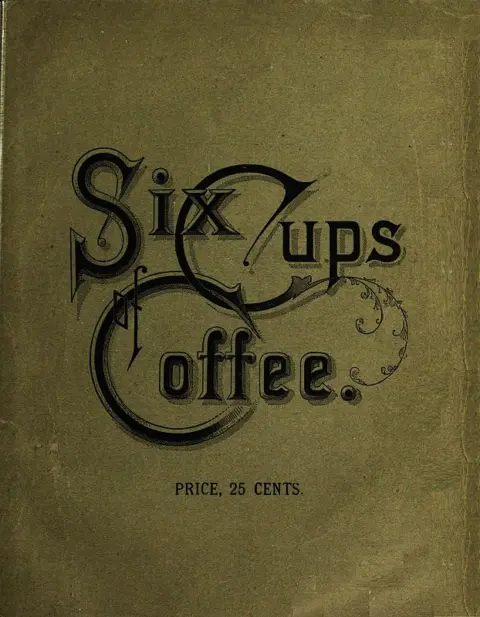
Six Cups of Coffee Prepared for the Public Palate by the Best Authorities on Coffee Making
Maria Parloa & Helen Campbell & Juliet Corson & Marion Harland & Mary J. (Mary Johnson) Lincoln & Catherine Owen & Hester M. (Hester Martha) Poole
THE CLASSIC COLLECTION · 1887
"A Course of Lectures on the Principles of Domestic Economy and Cookery" by Miss Juliet Corson is a practical guide on domestic economy and cooking techniques written in the late 19th century. The work captures a series of lectures delivered to women attending the University of Minnesota to better equip them for home management and culinary skills. The lectures cover a wide range of topics from the preparation of basic dishes to advanced cooking methods, aiming to enhance the audience's knowledge in domestic responsibilities. The beginning of the text outlines the structure and intent of Corson's lectures, aimed particularly at two groups: experienced housekeepers seeking to refine their cooking skills and young women balancing education with home duties. Corson explains the methodology of her classes, emphasizing hands-on learning where dishes are prepared and tasted in real-time. She introduces fundamental recipes like soup stock, boiled salmon with cream sauce, and various methods for preparing vegetables, clearly laying the foundations for her teachings in domestic cookery throughout the series. The opening portion establishes a relatable and instructional tone, encouraging active participation and discussion among the attendees.
Introduction adapted from the source catalogue; source summaries may be automatically generated.
Free to read · English · 51,329 words · No account needed
MAKE TIME FOR A GOOD BOOK
On by default. Untick to stop anonymous reading totals. Each page counts after 10 seconds in view. How this works.
Anonymous counting is on unless you have switched it off.
A cupful of boiled salmon separated from the skin and bone and rubbed through a sieve with a potato masher, mixed with a quart of cream soup, gives you cream of salmon. Any of the ladies who have seen cream sauce made will understand the making of the cream soup. Put a slice of salmon that will make a cupful, over the fire in enough boiling water to cover it, with a heaping tablespoonful of salt, and boil it until the flakes separate. That will be perhaps ten minutes. Watch it a little. When the flakes separate drain it, take away the skin and bones and put it into a fine colander or stout wire sieve, and rub it through with a potato masher.
Question. Do you use canned salmon?
MISS CORSON. Yes, you can use canned salmon. That is already cooked, and you simply would rub it through the sieve. The fresh salmon is to be boiled in salted water. If you use canned salmon you do not need to boil it. After the salmon is rubbed through the sieve it is called puree or pulp of salmon.
Now to make a quart of cream soup: For each quart of soup put in the sauce pan a heaping tablespoonful of butter, a heaping tablespoonful of flour; put them over the fire and stir them until they are quite smooth. Then begin to add hot milk, half a cupful at a time, stirring each half cupful smoothly with the butter and flour before you add any more, till you have added a quart, or if milk is scarce a pint of milk and a pint of water. If you haven't any milk at all, a quart of water. That gives you a white soup, if you add simply water; if you add milk it is called cream soup. If you are very fortunate and have lots of cream, in place of some of the milk, use cream, and then you will have genuine cream soup. After the milk or water is all added, then season the soup palatably with salt and pepper--white pepper. I have told you about white pepper. It is to be had at all the grocery stores; it costs no more than black pepper and is very much nicer for any white soup or white sauce. Salt and pepper to taste, and a very little grated nutmeg; a quarter of a saltspoonful, a little pinch of grated nutmeg. After the soup is seasoned stir in the salmon. I have told you already how to prepare the salmon. Stir the soup constantly until it boils for a couple of minutes. By that time you will find that the salmon is stirred smoothly all through it. Then it will be ready to serve, and it is very good. You can use any other kind of fish in the same way, and your soup will take its name from the fish that you use. Halibut or codfish, trout or any fish. Only remember if you want the soup to be white you must use the white part of the fish. For instance, if you had a large dark fish you would want to take off the brown parts and use only the white parts. Otherwise the brown parts of the fish will color the soup. You can use cream soup as the basis for vegetable soups that are very nice. Prepare the vegetables in the same way; boil them, and rub them through a sieve with a potato masher. Then stir them into the cream soup. Use asparagus, celery, cucumbers, green peas, string beans, Jerusalem artichokes,--those little root artichokes,--any vegetable, in fact, varying the quantity of vegetable in this way. You will find that some vegetables will give a much more decided flavor than others. For instance, celery has a very strong flavor, and cucumbers have rather a decided flavor. You want to use enough vegetables to flavor the soup, if it is a white vegetable. If it is a vegetable that has a decided color like carrots, for instance, or beets,--by the way, beets make a delicious soup, and a very pretty one is made with spinach,--you want to use enough to color the soup. The beets, boiled so that all the color is preserved, and then rubbed through a sieve, make a very pretty soup. One of our New York pupils calls it a "pink velvet soup." Spinach makes a very nice green soup if it is properly boiled. We shall try to get some spinach for one of the lessons. We have puree of spinach on our list, and if we can get any spinach I will show you how to boil it so as to keep its color.
Your reading position is saved on this browser. Take it to another device with a library code. Reading pages adapt to text, rather than matching a printed edition.
Maria Parloa & Helen Campbell & Juliet Corson & Marion Harland & Mary J. (Mary Johnson) Lincoln & Catherine Owen & Hester M. (Hester Martha) Poole
Juliet Corson
Juliet Corson
BEHIND THE BOOK
This eBook is for the use of anyone anywhere in the United States and most other parts of the world at no cost and with almost no restrictions whatsoever. You may copy it, give it away or re-use it under the terms of the Project Gutenberg License included with this eBook or online at www.gutenberg.org. If you are not located in the United States, you will have to check the laws of the country where you are located before using this eBook. Read the source licence.
The original source file, including credits and licence, is retained by this library. Request an original-format copy at no charge. Please include the book title and Project Gutenberg identifier #35567.
KEEP YOUR CURIOSITY GOING

Charles G. (Charles Griffith) Ross
Hannah Webster Foster

Emily Lawless
Edwin Hamlin Carr

Charles De Lano Hine
Andrew Ure