
In the Name of the People
Arthur W. Marchmont
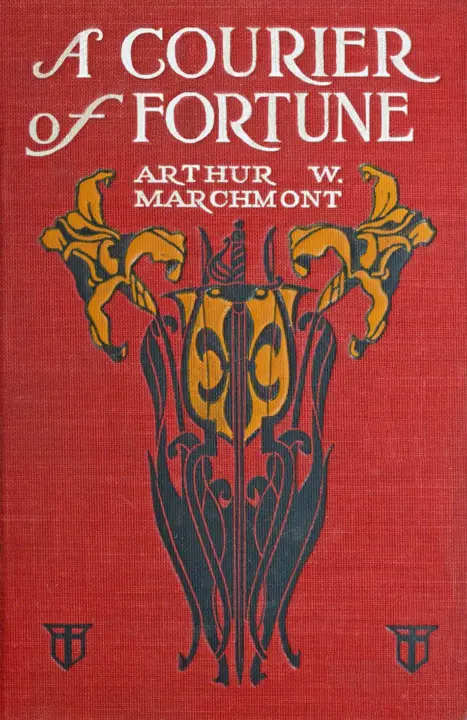
THE CLASSIC COLLECTION · 1904
"A Courier of Fortune" by Arthur W. Marchmont is a historical novel written in the early 20th century. The story unfolds in a tumultuous setting, likely during a period of political unrest, and follows the protagonist, Gerard de Cobalt, a young nobleman who assumes a false identity while embroiled in a conspiracy against a tyrannical governor, the Duke de Rochelle. As tensions rise in the town of Morvaix, Gerard's actions intertwine with the lives of several key characters, including the spirited Gabrielle de Malincourt, whose impending marriage to Gerard complicates matters further. The opening of "A Courier of Fortune" sets the stage by introducing a heated scene in the market place of Morvaix, where townsfolk are agitated over the governor's oppressive policies. Gerard, hiding his true identity, observes the excitement and soon meets with his companions, Pascal and Dubois, to strategize against the governor's cruelty, particularly in response to a recent murder of a local smith who protested a new food tax. As the plot progresses, relationships begin to develop, particularly between Gerard and Gabrielle, proving that the stakes are high both in matters of political intrigue and personal romance. The tension mounts as darker schemes unfold, hinting at betrayal and the struggle for justice in the face of tyranny.
Introduction adapted from the source catalogue; source summaries may be automatically generated.
Free to read · English · 112,125 words · No account needed
MAKE TIME FOR A GOOD BOOK
On by default. Untick to stop anonymous reading totals. Each page counts after 10 seconds in view. How this works.
Anonymous counting is on unless you have switched it off.
“I meant no taunt, and spoke only my mind as friend to friend,” said
Pascal.
“The Governor is coming now,” put in Dubois.
“We had better not be seen longer together. Where shall I find you at
need?”
“The Duke has lodged Pascal and myself in his castle,” answered Dubois, and the two were turning away when Gerard exclaimed, in a tone of excitement--
“See, Dubois, see, that man riding by the side of the Governor. Do you
recognize him?”
“It is that villain, de Proballe.”
“The old rat, so it is,” declared Pascal. “If there is devil’s work to be done in Morvaix he’ll be in it. Paris was too hot for him. I thought he was in hell by now. By the saints, he is long overdue.”
Gerard did not wait to hear the conclusion of the speech, but mingling with the crowd watched the proceedings with close interest.
It was a very strong force of soldiery, both horse and foot, that gathered in the market place round the statue, large enough to brush away like so many flies the crowd of citizens, who fell back hushed and awe-stricken before the muskets and halberds which were used with much wilful violence.
The Governor of the city, the Duke Charles de Rochelle, seated on his charger, a magnificent coal black Flemish animal, drew up in the centre of the cleared space, and gazed with amused contemptuousness upon the shrinking burghers.
He made a striking centre-piece. Short and slight of figure, yet suggesting suppleness and strength, his fifty years sat lightly on him. His fair hair had scarce a touch of grey, and his pointed auburn beard and flowing moustache might have belonged to a man twenty years his junior. His features, strong and regular, would have been handsome but for the small close-set grey eyes, whose cold, hawk-like glitter was rendered additionally repulsive by a strong cast.
“The eyes of a wild beast,” thought Gerard, who had been watching him intently. “Well named the Tiger.”
At a signal from the Governor, the herald stepped forward amid a blare of trumpets and read the proclamation. The people listened in dead silence; but at the close, loud murmurs broke out which even the presence of the soldiery could not wholly check.
“It means starvation to us,” cried one lusty voice, and a powerful fellow, a smith, wielding the heavy hammer of his trade, broke through the ring of the soldiers and made as if to approach the Governor.
“What dog is this that dares to bay?” It was the Duke who spoke.
Your reading position is saved on this browser. Take it to another device with a library code. Reading pages adapt to text, rather than matching a printed edition.
Arthur W. Marchmont
Arthur W. Marchmont
Arthur W. Marchmont

Arthur W. Marchmont
BEHIND THE BOOK
This eBook is for the use of anyone anywhere in the United States and most other parts of the world at no cost and with almost no restrictions whatsoever. You may copy it, give it away or re-use it under the terms of the Project Gutenberg License included with this eBook or online at www.gutenberg.org. If you are not located in the United States, you will have to check the laws of the country where you are located before using this eBook. Read the source licence.
The original source file, including credits and licence, is retained by this library. Request an original-format copy at no charge. Please include the book title and Project Gutenberg identifier #67731.
KEEP YOUR CURIOSITY GOING
Cécile Tormay

Moritz Busch
Coulson Kernahan
John L. Ransom

Maurice Baring
Frances Wright