
In the Name of the People
Arthur W. Marchmont
THE CLASSIC COLLECTION · 1904
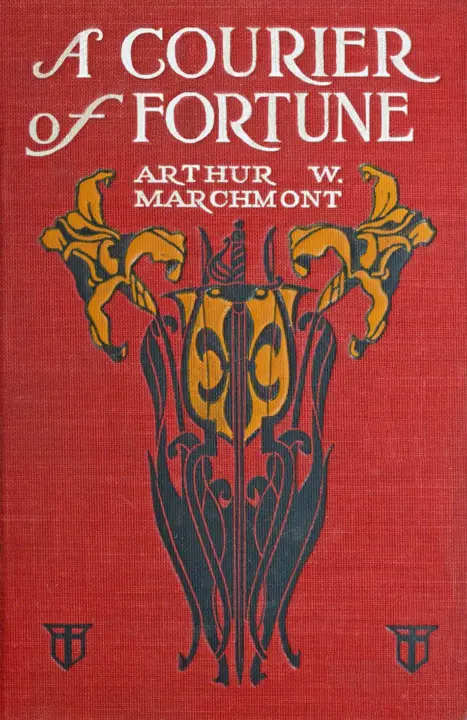
"A Courier of Fortune" by Arthur W. Marchmont is a historical novel written in the early 20th century. The story unfolds in a tumultuous setting, likely during a period of political unrest, and follows the protagonist, Gerard de Cobalt, a young nobleman who assumes a false identity while embroiled in a conspiracy against a tyrannical governor, the Duke de Rochelle. As tensions rise in the town of Morvaix, Gerard's actions intertwine with the lives of several key characters, including the spirited Gabrielle de Malincourt, whose impending marriage to Gerard complicates matters further. The opening of "A Courier of Fortune" sets the stage by introducing a heated scene in the market place of Morvaix, where townsfolk are agitated over the governor's oppressive policies. Gerard, hiding his true identity, observes the excitement and soon meets with his companions, Pascal and Dubois, to strategize against the governor's cruelty, particularly in response to a recent murder of a local smith who protested a new food tax. As the plot progresses, relationships begin to develop, particularly between Gerard and Gabrielle, proving that the stakes are high both in matters of political intrigue and personal romance. The tension mounts as darker schemes unfold, hinting at betrayal and the struggle for justice in the face of tyranny.
Introduction adapted from the source catalogue; source summaries may be automatically generated.
Free to read · English · 112,125 words · No account needed
MAKE TIME FOR A GOOD BOOK
On by default. Untick to stop anonymous reading totals. Each page counts after 10 seconds in view. How this works.
Anonymous counting is on unless you have switched it off.
“You are already assured of it, monsieur, for I know the offence will
be but a trifle.”
“You must not trust all men, Gabrielle,” put in Lucette briskly.
“Yet unwittingly I may have offended. It was I who instigated the baiting of M. de Proballe and the scurvy knave he calls his secretary. I knew when he would leave, and set on Babillon to frighten him. I have heard it was against your wish, and would not have you blame your citizens for the act of a rough Bourbon soldier.”
“What happened to them?” asked Lucette. And when Pascal told her of Dauban’s treatment, she laughed and clapped her hands.
“May I tack a condition to my pardon, monsieur?” asked Gabrielle,
smiling.
“Were I one of your cautious burghers, I would urge that the condition
be first specified.”
“It is that you do not leave with the Bourbon forces to-morrow, but remain to be a friend and help to us all.”
“Then I pray you undo the tacking. Remember how sad a place Morvaix must ever be in my memory.”
“Sad?” exclaimed Lucette. “Monsieur!”
“I mean because of my many bereavements here.”
“Bereavements, monsieur?” said Gabrielle, with a frown of perplexity.
“Bereavements truly; what else? ’Twas here in Morvaix I lost my wife, after a union of but a few minutes; and after that my newly betrothed was snatched from me by inexorable fate.”
They both laughed, and Lucette said--
“Then you are desolate?”
“In truth could I be otherwise? I am always, and in earnest what Gerard was in masquerade for a few hours--a courier of fortune; and without the hope that the fortune I chased may prove as charming and delightful.”
“I would you could have stayed, monsieur; and I thank you for your pretty compliments,” said Gabrielle, smiling and blushing.
“You go to Paris, monsieur, I understand,” said Lucette. “Doubtless there you will find consolation.”
“In Paris there may be distractions, even if not consolation,” he
answered gaily.
“Try to persuade him to remain, Lucette,” said Gabrielle, going into
the house.
“Why will you not remain, M. Pascal?” asked Lucette half nervously and more seriously than usual with her.
“Is not the answer there, with her, Lucette, and here perhaps with you?” He spoke lightly, but his eyes were serious.
“I am not sure that I understand you.”
“And I am sure there is no need that you should. They will be a happy pair, I hope with all my heart; as I hope indeed that you will be happy with M. St. Jean--a prince of worthy fellows--even if a trifle disposed to jealousy. I have had much talk with him in the last few days.”
Your reading position is saved on this browser. Take it to another device with a library code. Reading pages adapt to text, rather than matching a printed edition.
Arthur W. Marchmont
Arthur W. Marchmont
Arthur W. Marchmont

Arthur W. Marchmont
BEHIND THE BOOK
This eBook is for the use of anyone anywhere in the United States and most other parts of the world at no cost and with almost no restrictions whatsoever. You may copy it, give it away or re-use it under the terms of the Project Gutenberg License included with this eBook or online at www.gutenberg.org. If you are not located in the United States, you will have to check the laws of the country where you are located before using this eBook. Read the source licence.
The original source file, including credits and licence, is retained by this library. Request an original-format copy at no charge. Please include the book title and Project Gutenberg identifier #67731.
KEEP YOUR CURIOSITY GOING
Cécile Tormay

Moritz Busch
Coulson Kernahan
John L. Ransom

Maurice Baring
Frances Wright