
In the Name of the People
Arthur W. Marchmont
THE CLASSIC COLLECTION · 1904
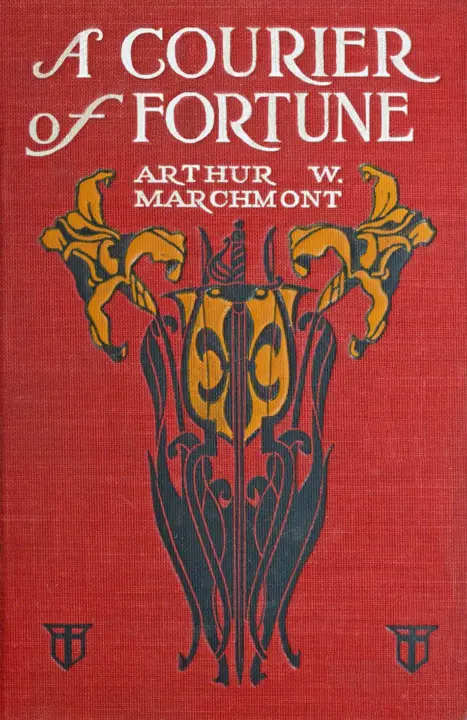
"A Courier of Fortune" by Arthur W. Marchmont is a historical novel written in the early 20th century. The story unfolds in a tumultuous setting, likely during a period of political unrest, and follows the protagonist, Gerard de Cobalt, a young nobleman who assumes a false identity while embroiled in a conspiracy against a tyrannical governor, the Duke de Rochelle. As tensions rise in the town of Morvaix, Gerard's actions intertwine with the lives of several key characters, including the spirited Gabrielle de Malincourt, whose impending marriage to Gerard complicates matters further. The opening of "A Courier of Fortune" sets the stage by introducing a heated scene in the market place of Morvaix, where townsfolk are agitated over the governor's oppressive policies. Gerard, hiding his true identity, observes the excitement and soon meets with his companions, Pascal and Dubois, to strategize against the governor's cruelty, particularly in response to a recent murder of a local smith who protested a new food tax. As the plot progresses, relationships begin to develop, particularly between Gerard and Gabrielle, proving that the stakes are high both in matters of political intrigue and personal romance. The tension mounts as darker schemes unfold, hinting at betrayal and the struggle for justice in the face of tyranny.
Introduction adapted from the source catalogue; source summaries may be automatically generated.
Free to read · English · 112,125 words · No account needed
MAKE TIME FOR A GOOD BOOK
On by default. Untick to stop anonymous reading totals. Each page counts after 10 seconds in view. How this works.
Anonymous counting is on unless you have switched it off.
“Their presence here is in accord with half my present purpose, most noble lord. I have deemed it best that they should be tried before you, illustrious Bourbon’s son, that you should know their crimes and yourself decree their punishment, you being, as I know you to be, the essence of justice and purity itself.”
At this de Proballe laughed audibly; and the sneer passed round the courtiers. It was he who had suggested to the Governor this mocking masquerade and the burlesque treatment of Gerard, and the irony of the scene delighted him.
But Gerard gave not a sign that he even saw the sneer.
“It was well arranged, my lord,” he said gravely. “And the other part
in your purpose?”
“Is a personal affair, personal to the lady at your side and myself.” His look conveyed his meaning, and Gabrielle flinched.
“I think I know your meaning,” answered Gerard with unmoved composure, “and shall be glad to assist in furthering such a matter. But first, the prisoners. What is the charge and the evidence?”
De Proballe stepped forward here.
“Most noble and puissant lord Gerard of Bourbon,” he began with an insolent air, when Gerard interrupted him.
“Stay,” he said, with an imperious gesture. “I will not hear the Baron de Proballe. I know him to be incapable of telling the truth.”
De Proballe fell back at this insult, and in a voice vibrating with
passion exclaimed--
“Will your lordship endure this insolence longer?”
But the Governor was rarely troubled when any one other than himself was humiliated. He was now, in truth, rather inclined to rejoice at de Proballe’s discomfiture, and replied with more than a dash of contempt--
“We must not forget, monsieur, that the lord Gerard comes from Paris with special knowledge we do not possess in Morvaix;” and the favourites round, taking their cue from this tone, sneered one to another with significant shrugs and glances.
“The evidence, my lord?” said Gerard with a show of impatience.
The Governor called up one of his officers then, who spoke of the affray in the market place; and Gerard, under cover of a desire to get at the truth, questioned him at considerable length, and so consumed much invaluable time. Two other officers followed, and some of the soldiers who had been injured by the crowd.
Having prolonged the matter as long as practicable, Gerald said--
“There is one point on which none of the witnesses have spoken. The provocation which drove the people to revolt? I would hear that.”
“There was none,” answered the Governor, who was now wearying of the farce. “And, moreover, these proceedings have lasted long enough.”
Your reading position is saved on this browser. Take it to another device with a library code. Reading pages adapt to text, rather than matching a printed edition.
Arthur W. Marchmont
Arthur W. Marchmont
Arthur W. Marchmont

Arthur W. Marchmont
BEHIND THE BOOK
This eBook is for the use of anyone anywhere in the United States and most other parts of the world at no cost and with almost no restrictions whatsoever. You may copy it, give it away or re-use it under the terms of the Project Gutenberg License included with this eBook or online at www.gutenberg.org. If you are not located in the United States, you will have to check the laws of the country where you are located before using this eBook. Read the source licence.
The original source file, including credits and licence, is retained by this library. Request an original-format copy at no charge. Please include the book title and Project Gutenberg identifier #67731.
KEEP YOUR CURIOSITY GOING
Cécile Tormay

Moritz Busch
Coulson Kernahan
John L. Ransom

Maurice Baring
Frances Wright