
Last letters from the living dead man
David Patterson (Spirit) Hatch
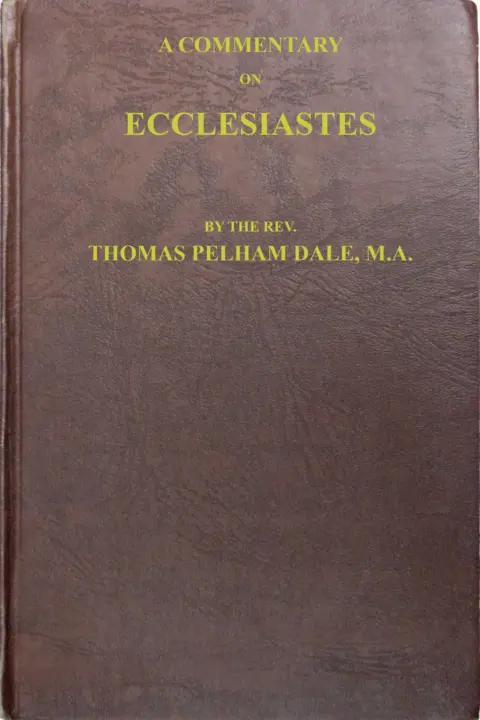
THE CLASSIC COLLECTION · 1873
"A Commentary on Ecclesiastes" by Thomas Pelham Dale is a theological commentary written in the late 19th century. This scholarly work delves into the Book of Ecclesiastes, utilizing an in-depth examination of both the original Hebrew text and its translation in the Septuagint (LXX). The commentary aims to clarify the complex themes of vanity and the human condition as reflected in Ecclesiastes while emphasizing the significance of different translations and interpretations. The opening of the commentary introduces the author's intentions and methodologies. Dale emphasizes the importance of a careful analysis of the LXX, arguing that its unique interpretations deserve serious consideration rather than dismissal as mere errors. He shares insights into the authorship of Ecclesiastes, traditionally attributed to Solomon, while acknowledging modern debates regarding its true authorship. The introduction sets the stage for a detailed exploration of the text, wherein the author reveals his obsession with understanding the seemingly futile nature of human existence and the divine's role in it, laying the groundwork for a more nuanced discussion that unfolds throughout the commentary.
Introduction adapted from the source catalogue; source summaries may be automatically generated.
Free to read · English · 79,575 words · No account needed
MAKE TIME FOR A GOOD BOOK
On by default. Untick to stop anonymous reading totals. Each page counts after 10 seconds in view. How this works.
Anonymous counting is on unless you have switched it off.
(23, 24.) =All this= (the Masorets point זֹה feminine, equivalent to neuter) =have I tried with wisdom; I said I will be wise= (with ה paragogic, and Taylor in his note observes that this form is optative, and expresses a strong desire [Lange, Commmentary on Old Testament, American edition]; might it not with truth be said that it is the abstract idea of which the verb is the concrete, ‘I shall be wisdomed’?), =but that was far from me= (but notice again רחוקה, agreeing no doubt with חכמה understood, but not the less an abstract on that account: it was farness or distance itself from me――‘beyond my reach’ is the meaning), =a distant= thing, =what= is it =which it will be= (that is, that he could not reach by wisdom to discern what the future might be), =and deep, deep= (‘doubly deep,’ very emphatic), =who will find it out?= (as these questions expect the answer, No, they are equivalent to ‘a distant thing! is not it, the future, indeed? and a vast depth which none can discover.’)
This concludes this part of the discourse, as is evident from the formula, ‘I turned round, I and my heart,’ with which the following passage begins; that which is to succeed is a personal experience of another kind.
25 ¹I applied mine heart │ To come to another point then, to know, and to search, and │ in my own experience of to seek out wisdom, and the │ knowledge and investigation: I reason of things, and to │ mean the discovery of wise and know the wickedness of folly, │ prudent experiments by which even of foolishness and │ one may recognise wickedness madness: │ as folly, and false-prudence │ as mad disappointment. ¹ Hebrew I and my heart │ compassed. │
(25.) =I turned round= (to do something, as this formula always implies), =I and my heart= (for we have here a confession) =to know= and =to investigate= (that is in order to know, etc., the prepositions being repeated) =and seek= (without a preposition; the distinction seems to be that the seeking is to be the consequence of the above investigation) =wisdom and device= (חשבון is exclusively a Koheleth word, and occurs verse 27, ix. 10, only, it is thus not easy to determine its precise meaning, but it is probably, as Moses Stuart points out, the opposite of הללות; and if so, it will be something reasonable, in the sense of wise or well-formed and successful plan, as its opposite is an ill-formed and disappointing one; thus השבונות――occurs only here, verse 29, and 2 Chronicles xxvi. 15, where it is used to denote Asa’s engines of war――is evidently ‘efficient contrivances.’ To know wisdom and a device, then, in this sense, is ‘wisdom how to obtain a reasonable or proper result; and, on the other hand, to discover the opposite.’ With this accords what follows), =and to know= (as this is repeated it is equivalent to, and so to know) =wickedness= (as) =folly= (כֶסֶל――the only instance of the occurrence of this form in Ecclesiastes――compare Job viii. 14, xxxi. 24, where we find that ‘expectation’ is the meaning, though not necessarily in a bad sense, yet clearly so here. The LXX. render ἀσεβοῦς ἀφροσύνην [which E. X. alter to εὐφροσύνην], ‘the folly of a wicked person’) =and the false wisdom= (plural form in ות――with the article) =follies= (הוללות, as we have seen, compare chapter i. 17, of the disappointing kind. The LXX. render here ὀχληρίαν, ‘trouble,’ and περιφοράν, ‘madness,’ with καὶ ‘and,’ which is so far wrong, as there is no conjunction in the original. The meaning of this passage it is no doubt difficult to discover, but if we are right in the above analysis the interpretation must be as follows: ‘I turned myself round, I and my heart――(or, my own personal experience) to know and to investigate, and so seek, wisdom and well-formed plans: and so to recognise a wicked folly; and [a series of] falsely-wise acts, [which were] disappointing follies.’ The punctuation represents the accents, the larger distinctive accents being represented by the longer pauses. The Syriac reads (‡ Syriac phrase), ‘to know the wickedness of the fool, and folly and adultery,’ which coincides with the above; a reason for the peculiar rendering ‘adultery’ will appear presently).
Your reading position is saved on this browser. Take it to another device with a library code. Reading pages adapt to text, rather than matching a printed edition.
BEHIND THE BOOK
This eBook is for the use of anyone anywhere in the United States and most other parts of the world at no cost and with almost no restrictions whatsoever. You may copy it, give it away or re-use it under the terms of the Project Gutenberg License included with this eBook or online at www.gutenberg.org. If you are not located in the United States, you will have to check the laws of the country where you are located before using this eBook. Read the source licence.
The original source file, including credits and licence, is retained by this library. Request an original-format copy at no charge. Please include the book title and Project Gutenberg identifier #72761.
KEEP YOUR CURIOSITY GOING
David Patterson (Spirit) Hatch

David Patterson (Spirit) Hatch

David Patterson (Spirit) Hatch
Edwin Abbott Abbott
Richard Watson
T. G. (Theophilus Gould) Steward