
Last letters from the living dead man
David Patterson (Spirit) Hatch
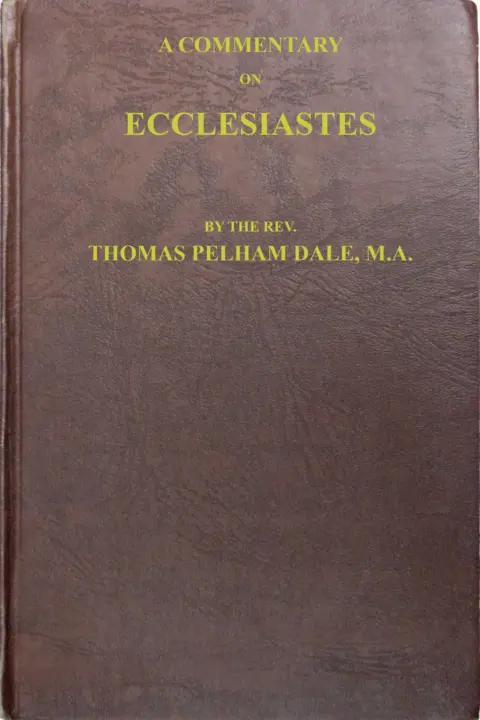
THE CLASSIC COLLECTION · 1873
"A Commentary on Ecclesiastes" by Thomas Pelham Dale is a theological commentary written in the late 19th century. This scholarly work delves into the Book of Ecclesiastes, utilizing an in-depth examination of both the original Hebrew text and its translation in the Septuagint (LXX). The commentary aims to clarify the complex themes of vanity and the human condition as reflected in Ecclesiastes while emphasizing the significance of different translations and interpretations. The opening of the commentary introduces the author's intentions and methodologies. Dale emphasizes the importance of a careful analysis of the LXX, arguing that its unique interpretations deserve serious consideration rather than dismissal as mere errors. He shares insights into the authorship of Ecclesiastes, traditionally attributed to Solomon, while acknowledging modern debates regarding its true authorship. The introduction sets the stage for a detailed exploration of the text, wherein the author reveals his obsession with understanding the seemingly futile nature of human existence and the divine's role in it, laying the groundwork for a more nuanced discussion that unfolds throughout the commentary.
Introduction adapted from the source catalogue; source summaries may be automatically generated.
Free to read · English · 79,575 words · No account needed
MAKE TIME FOR A GOOD BOOK
On by default. Untick to stop anonymous reading totals. Each page counts after 10 seconds in view. How this works.
Anonymous counting is on unless you have switched it off.
We must observe that all these versions, without exception, omit to notice כבר, which everywhere else is noted by ἤδη, being content with τὰ ὅσα or σὺν τὰ ὅσα. The explanation of these difficulties seems to be that המלך was probably intended to be equivocal. It is, to say the least, not impossible that it had, even in Solomon’s time, the meaning of ‘counsel,’ which attaches to it as a usual signification in Aramaic; if so, המלך means the counsel, and of course has the idea of rule as well. Castell gives as the meaning of (‡ Syriac word), ‘Intellectum, Consilium dedit,’ vel ‘inivit,’ ‘Consultavit,’ ‘Promisit,’ ‘Pollicitus est;’ thus we must understand it to mean, ‘plans formed and intended to be carried out.’ The question then which Koheleth asks is this, ‘Who is the man who will enter upon――as we say, carry out――his plans with respect to that which in the present moment he makes them or devises them;’ in other words, can he carry out what he now devises, and can any man do this out of the number of human creatures who make these plans? This is the reason of the distributive plural which the best recensions of the LXX. preserve. The equivoke involved in the meaning ‘king’ is obvious. Koheleth himself is, of course, the king: could any one do better than he? It must be allowed that this meaning makes excellent sense with the context, and violates no Hebrew grammar. If, however, I have failed in giving a real interpretation of this most difficult passage, I may be excused a conjecture which is as plausible as many that have been advanced on this point. The corruptions of the old versions may be explained by the fact that the equivoke was lost so soon as readers ceased to have the Hebrew text before them, and hence the attempt to better their text. This most obscure passage may perhaps receive some light from a further discussion of the word כבר and other forms derived from the same root. The feminine or abstract occurs Genesis xxxv. 16, xlviii. 7, and 2 Kings v. 19, joined with ארץ, rendered in the Authorized Version a ‘little’ way. The verb occurs in hiphil, Job xxxv. 16, xxxvi. 31, translated ‘multiplied,’ ‘in abundance;’ and in the hiphil form, with the characteristic jud̄ inserted――Job viii. 2, xv. 10, etc.; Isaiah x. 13, xvii. 12, etc.――in the sense of ‘full of years,’ ‘overflowing,’ and the like. A diligent comparison of these meanings shows that ‘fulness,’ in the sense of ‘completeness,’ must be the root-meaning; and hence, when applied to time, the LXX. render ἤδη, ‘already.’ With this meaning agree also the Arabic and Syriac, see Fuerst, Lexicon, s. voc. The meaning then of the word is, the ‘complete present.’ With regard to the use of the root מלך in the sense of counsel, it occurs once in Hebrew, viz. Nehemiah v. 7, and once in biblical Chaldee, Daniel iv. 27 (24). This meaning is common, as remarked in the note, in Aramaic. The fair inference from this is, that the root-meaning of the Hebrew word is ‘to counsel,’ just as the root-meaning of the word Apostle is ‘one sent.’ These senses are just what the context requires. Koheleth turns round to see wisdom in comparison with, or contradistinction to, false hopes and false prudence, and asks how the man, that is, humanity, can tell the one from the other. His words are ‘what is,’ not ‘who is the man,’ etc., equivalent to――‘in what way can humanity enter upon the results of the counsel,’ ‘or the king,’――the equivoke being, we believe, intentional, and the contracted relative giving a conditional turn to the sentence――‘with respect to that which at present he performs it.’ It would have been better if the word =with= had been printed in the notes with a small letter, as the division hardly amounts to a period, though the connexion is not close. The suffix of the verb refers back through the relative pronoun to counsel, and might be well rendered into English thus――‘In respect of which he at present takes that counsel.’ The LXX., contrary to their custom, omit ἤδη, because it is perhaps sufficiently included in ἐπελεύσεται, or because τὰ ὅσα ἤδη ἐποίησαν αὐτήν would not have been intelligible. It is evident this all squares with the context. Koheleth, as Solomon, discovered that with all his wisdom he could not practically discern the difference between this true wisdom and that false prudence which led him to accumulate only to be disappointed in his successor.
Your reading position is saved on this browser. Take it to another device with a library code. Reading pages adapt to text, rather than matching a printed edition.
BEHIND THE BOOK
This eBook is for the use of anyone anywhere in the United States and most other parts of the world at no cost and with almost no restrictions whatsoever. You may copy it, give it away or re-use it under the terms of the Project Gutenberg License included with this eBook or online at www.gutenberg.org. If you are not located in the United States, you will have to check the laws of the country where you are located before using this eBook. Read the source licence.
The original source file, including credits and licence, is retained by this library. Request an original-format copy at no charge. Please include the book title and Project Gutenberg identifier #72761.
KEEP YOUR CURIOSITY GOING
David Patterson (Spirit) Hatch

David Patterson (Spirit) Hatch

David Patterson (Spirit) Hatch
Edwin Abbott Abbott
Richard Watson
T. G. (Theophilus Gould) Steward