
Last letters from the living dead man
David Patterson (Spirit) Hatch
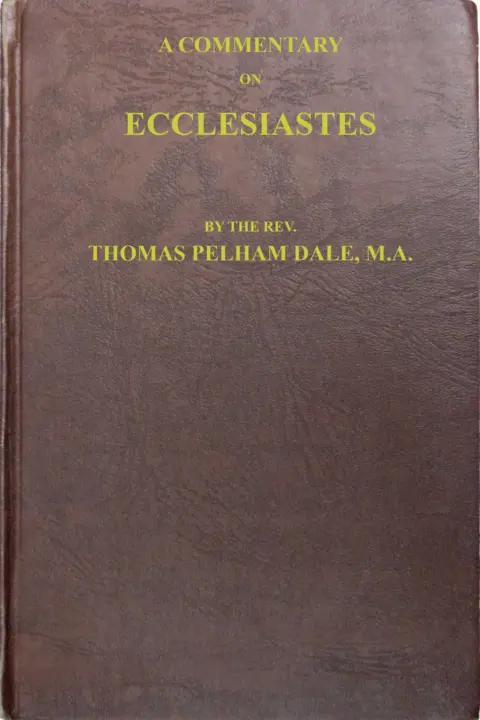
THE CLASSIC COLLECTION · 1873
"A Commentary on Ecclesiastes" by Thomas Pelham Dale is a theological commentary written in the late 19th century. This scholarly work delves into the Book of Ecclesiastes, utilizing an in-depth examination of both the original Hebrew text and its translation in the Septuagint (LXX). The commentary aims to clarify the complex themes of vanity and the human condition as reflected in Ecclesiastes while emphasizing the significance of different translations and interpretations. The opening of the commentary introduces the author's intentions and methodologies. Dale emphasizes the importance of a careful analysis of the LXX, arguing that its unique interpretations deserve serious consideration rather than dismissal as mere errors. He shares insights into the authorship of Ecclesiastes, traditionally attributed to Solomon, while acknowledging modern debates regarding its true authorship. The introduction sets the stage for a detailed exploration of the text, wherein the author reveals his obsession with understanding the seemingly futile nature of human existence and the divine's role in it, laying the groundwork for a more nuanced discussion that unfolds throughout the commentary.
Introduction adapted from the source catalogue; source summaries may be automatically generated.
Free to read · English · 79,575 words · No account needed
MAKE TIME FOR A GOOD BOOK
On by default. Untick to stop anonymous reading totals. Each page counts after 10 seconds in view. How this works.
Anonymous counting is on unless you have switched it off.
(9.) =And for the rest= (for now is to be added something over and above, to form a supplement to what went before; compare 1 Kings xiv. 19 both for the Hebrew and Greek. As the word וְיֹתֵ֕ר stands first, it is the subject: whether we point it as noun or participle will not make much difference to the sense, but the Masoretic pointing is best; they also, with great taste, put a large distinctive accent on the word. The meaning is, ‘there is something yet to be added;’) =that he was= (the contract-relative with subject verb) even a =Koheleth= (i.e. a preacher or gatherer) who was =wise, yet= (the LXX. render καὶ ὅτι, ‘nevertheless,’ but their rendering is very remarkable and we will discuss it at length presently) =taught knowledge= (and in the sense so common in this book, of the knowledge how to act under a given set of circumstances) =with respect to the people= (not as usually understood that he taught the people knowledge, but taught knowledge with regard to the people, the collected body of humanity; compare chapter iv. 16) =and he gave heed, and he sought out= (Deuteronomy xiii. 4; Psalms cxxxix. 1) =an order= (chapter i. 15, viii. 18; this is the third time of occurrence of this root, which is peculiar to this book. The Masorets point as piel pret., it might however be a noun, as the LXX. render it, and we shall see reason presently for adopting this interpretation) =of parables the many.=
10 The Preacher sought to │ The Preacher, indeed, sought find out ¹acceptable words: │ to discover the reasons for a and that which was written │ providence, but what he has was upright, even words of │ written is the real matter of truth. │ truth. │ ¹ Hebrew words of delight. │
(10.) =Sought Koheleth to find words of providence= (דבר and חפץ, both in their usual technical senses) =and written= (full participial form) =uprightness, words of truth.= (The passage is very obscure; the LXX. render καὶ περισσὸν ὅτι ἐγένετο ὁ ἐκκλησιαστὴς σοφὸς [καὶ] ὅτι ἐδίδαξεν γνῶσιν σὺν τὸν ἄνθροπον καὶ οὖς ἐξιχνιάσεται κόσμιον παραβολῶν. Πολλὰ, κ.τ.λ. ‘and for the rest, because the Preacher was wise, and because he taught knowledge with respect to the man, and his ear will trace out the orderly arrangement of parables.’ Now, some curious features in this rendering deserve notice――the word κόσμιον occurs 1 Timothy ii. 9, and iii. 2; it is used as a neuter, ‘orderliness.’ Again, את העם is rendered σὺν τὸν ἄνθρωπον. B. omits and A² includes in brackets the καὶ, so marked, in the text; A² reads ἔτι; F.X. omit σὺν; F. reads [for ἄνθρωπον] λαὸν; E. ἐξιχνίασε; and D. κόσμον. Thus it appears probable that the LXX. read יחקר and as this future follows the past, we have the sense of the imperfect: they also translated σὺν τὸν ἄνθρωπον, because they considered העם as used generically――see chapter iv. 16, and in the same sense. If, however, the Hebrew text were altered, which would be done simply by lengthening the jud י into van ו, the rendering of the LXX. would become unintelligible, and hence the variations, especially that of E. Then אזן, which is really nominative to יחקר, and emphatic as standing before it, came to be regarded as a verb and pointed piel, the only instance of such pointing that occurs, and then accenting וְחִקֵּ֔ר with zakeph, the Masorets made these two words a parenthesis, and pointed תִּקֵּן as a piel pret., instead of a noun as do the LXX.; they then make הרבה singular agree with the plural משלים, which would, according to the usage of this book, be distributive. On the whole, however, it seems very probable that the LXX. have preserved the right reading, or at least the meaning of the passage; this meaning is, ‘and for the rest, because Koheleth was a wise man, still he taught knowledge with respect to the people, and his ear [i.e. judgment, for the word contains the idea of weighing as in a balance] was seeking out an orderly meaning [or solution] of parables;’ by parables he means doubtless the mysterious facts cited. The next verse takes this thought up thus: ‘Very much sought Koheleth in order to find words of providence――and written correctly words of truth.’ If the reading were really וכתוב, and not, as we may conjecture, יכתוב, we should then read ‘he was writing,’ which it must be confessed makes excellent sense. The LXX. render here [καὶ] γεγραμμένον εὐθύτητος λόγους ἀληθείας, in the accusative, governed by ἐζήτησεν, and the meaning is therefore, ‘sought ... a thing written of right [even] words of truth.’ This agrees altogether with the context, and also is cognate with what follows).
Your reading position is saved on this browser. Take it to another device with a library code. Reading pages adapt to text, rather than matching a printed edition.
BEHIND THE BOOK
This eBook is for the use of anyone anywhere in the United States and most other parts of the world at no cost and with almost no restrictions whatsoever. You may copy it, give it away or re-use it under the terms of the Project Gutenberg License included with this eBook or online at www.gutenberg.org. If you are not located in the United States, you will have to check the laws of the country where you are located before using this eBook. Read the source licence.
The original source file, including credits and licence, is retained by this library. Request an original-format copy at no charge. Please include the book title and Project Gutenberg identifier #72761.
KEEP YOUR CURIOSITY GOING
David Patterson (Spirit) Hatch

David Patterson (Spirit) Hatch

David Patterson (Spirit) Hatch
Edwin Abbott Abbott
Richard Watson
T. G. (Theophilus Gould) Steward