
Last letters from the living dead man
David Patterson (Spirit) Hatch
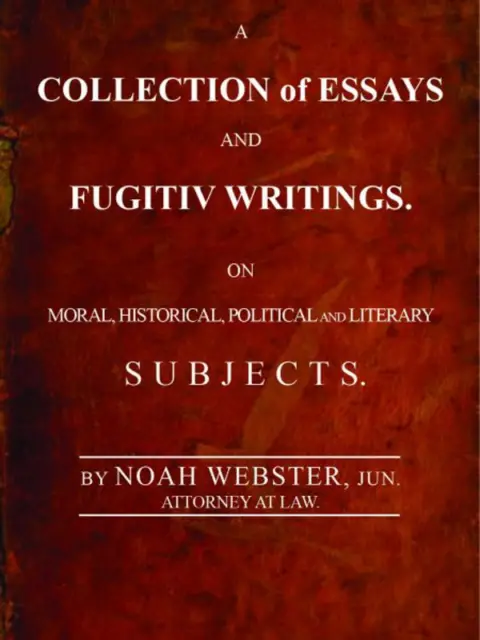
THE CLASSIC COLLECTION · 1790
"A Collection of Essays and Fugitiv Writings" by Noah Webster is a compilation of essays focusing on moral, historical, political, and literary subjects, written in the late 18th century. The collection aims to address significant issues faced by America in its revolutionary period, reflecting on the principles of government, education, and societal values. Webster's works are intended to encourage a spirit of inquiry and virtue among readers, particularly in the context of the emerging American identity. The opening of this collection begins with a preface where the author emphasizes the importance of addressing educational methods and moral character formation in America. Webster critiques existing educational practices, particularly highlighting the excessive focus on ancient languages at the expense of practical knowledge and the study of English. He argues for a systematic improvement in education that emphasizes both ethical and civic knowledge tailored to the needs of a republican society. This opening section sets the stage for a broader discussion on how education can shape the morals and governance of a new nation, showcasing Webster's commitment to fostering an informed and virtuous populace.
Introduction adapted from the source catalogue; source summaries may be automatically generated.
Free to read · English · 143,390 words · No account needed
MAKE TIME FOR A GOOD BOOK
On by default. Untick to stop anonymous reading totals. Each page counts after 10 seconds in view. How this works.
Anonymous counting is on unless you have switched it off.
[32] It is a capital defect in some of the States, that the government is so organized as not to admit subordinate acts of legislation in small districts. In these States, every little collection of people in a village must petition the Legislature for liberty to lay out a highway or build a bridge; an affair in which the State at large has very little interest, and of the necessity and utility of which the Legislature are not suitable judges. This occasions much trouble for the State; it is a needless expense. A State should be divided into inferior corporations, veiled with powers competent to all acts of local police. What right have the inhabitants of Suffolk to interfere in the building of a bridge in Montgomery?[a] Who are the most competent judges of a local convenience; the whole State, or the inhabitants of the particular district?
[a] This was written in New York.
If the collectiv sense of a State is the basis of law, and that sense can be known officially no where but in an Assembly of all the people or of their Representativs; or in other words, if there can be no such thing as a collection of sentiments made in any other manner, than by a Convention of the whole people or their Delegates, where is the right of instructing Representativs? The sense of the people, taken in small meetings, without a general knowlege of the objections, and reasonings of the whole State, ought not to be considered as the true sense of the State; for not being possessed of the best general information, the people often form wrong opinions of their own interest. Had I the journals of the several Legislatures in America, I would prove to every man's satisfaction, that most of the schemes for paper money, tender laws, suspension of laws for the recovery of debts, and most of the destructiv measures which have been pursued by the States, have originated in towns and counties, and been carried by positiv instructions from constituents to Representativs. The freemen, in these cases, have wrong ideas of their own interest; their error, in the first instance, is ascribeable merely to ignorance, or a want of that just information, which they themselves would obtain in a General Assembly.[33] The right therefore of prescribing rules to govern the votes of Representativs, which is so often assumed, frequently amounts to a right of doing infinite mischief, with the best intentions. There is perhaps no case in which the people at large are so capable of knowing and pursuing their own interest, as their Delegates are when assembled for consultation and debate. But the practice of giving binding instructions to Representativs, if it has any foundation, is built on this maxim, that the constituents, on a view of their local interests, and either with none, or very imperfect information, are better judges of the propriety of a law, and of the general good, than the most judicious men are (for such generally are the Representativs) after attending to the best official information from every quarter, and after a full discussion of the subject in an Assembly, where clashing interests conspire to detect error, and suggest improvements. This maxim is obviously false; and a practice built on it, cannot fail to produce laws, inaccurate, contradictory, capricious and subversive of the first rights of men. Perhaps no country, except America, ever experienced the fatal effects of this practice, and I blush to remark, what candor itself must avow, that few arbitrary governments, have in so short a period, exhibited so many legal infractions of sacred right; so many public invasions of private property; so many wanton abuses of legislativ powers! Yet the people are generally honest; and as well informed as the people of any country. Their errors proceed from ignorance; from false maxims of governments. The people attempt to legislate without the necessary qualifications for lawgivers; yes, they legislate at home! and while this practice subsists, our public measures will be often weak, imperfect, and changeable; and sometimes extremely iniquitous. From these considerations, it appears that the powers of a Representativ should be wholly discretionary when he acts as a Legislator; but as an agent for a town or small society, he may have positiv instructions. His constituents, in the last case, are competent to instruct him, because they are the whole body concerned; but in the first instance, they are but a part of the State, and not competent to judge fully of the interest of the whole.
Your reading position is saved on this browser. Take it to another device with a library code. Reading pages adapt to text, rather than matching a printed edition.
BEHIND THE BOOK
This eBook is for the use of anyone anywhere in the United States and most other parts of the world at no cost and with almost no restrictions whatsoever. You may copy it, give it away or re-use it under the terms of the Project Gutenberg License included with this eBook or online at www.gutenberg.org. If you are not located in the United States, you will have to check the laws of the country where you are located before using this eBook. Read the source licence.
The original source file, including credits and licence, is retained by this library. Request an original-format copy at no charge. Please include the book title and Project Gutenberg identifier #44416.
KEEP YOUR CURIOSITY GOING
David Patterson (Spirit) Hatch

David Patterson (Spirit) Hatch

David Patterson (Spirit) Hatch
Cécile Tormay

Moritz Busch
John L. Ransom