
Last letters from the living dead man
David Patterson (Spirit) Hatch
THE CLASSIC COLLECTION · 1790
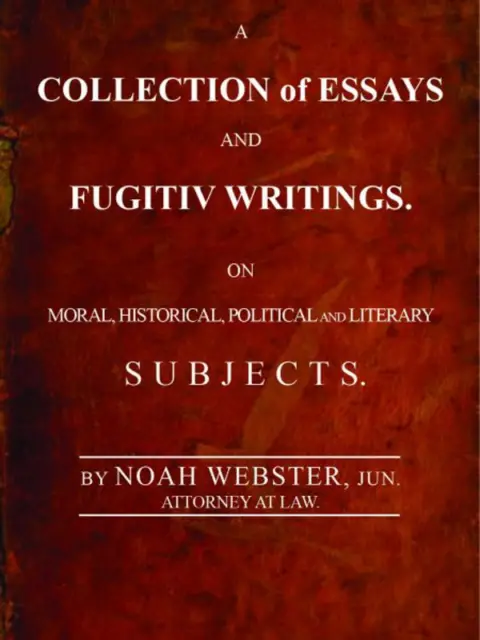
"A Collection of Essays and Fugitiv Writings" by Noah Webster is a compilation of essays focusing on moral, historical, political, and literary subjects, written in the late 18th century. The collection aims to address significant issues faced by America in its revolutionary period, reflecting on the principles of government, education, and societal values. Webster's works are intended to encourage a spirit of inquiry and virtue among readers, particularly in the context of the emerging American identity. The opening of this collection begins with a preface where the author emphasizes the importance of addressing educational methods and moral character formation in America. Webster critiques existing educational practices, particularly highlighting the excessive focus on ancient languages at the expense of practical knowledge and the study of English. He argues for a systematic improvement in education that emphasizes both ethical and civic knowledge tailored to the needs of a republican society. This opening section sets the stage for a broader discussion on how education can shape the morals and governance of a new nation, showcasing Webster's commitment to fostering an informed and virtuous populace.
Introduction adapted from the source catalogue; source summaries may be automatically generated.
Free to read · English · 143,390 words · No account needed
MAKE TIME FOR A GOOD BOOK
On by default. Untick to stop anonymous reading totals. Each page counts after 10 seconds in view. How this works.
Anonymous counting is on unless you have switched it off.
The basis of a democratic and a republican form of government, iz, a fundamental law, favoring an equal or rather a general distribution of property. It iz not necessary nor possible that every citizen should hav exactly an equal portion of land and goods, but the laws of such a state should require an equal distribution of intestate estates, and bar all perpetuities. Such laws occasion constant revolutions of property, and thus hold out to all men equal motivs to vigilance and industry. They excite emulation, by giving every citizen an equal chance of being rich and respectable.
In no one particular do the American states differ from European nations more widely, than in the rules which regulate the tenure and distribution of lands. This circumstance alone wil, for ages at leest, prezerve a government in the united states, very different from any which now exists or can arize in Europe.
In New England, intestate estates desend to all the children or other heirs in equal portions, except to the oldest son, who haz two shares. This exception in favor of the oldest son, waz copied from the levitical code, which waz made the basis of the first New England institutions. The legislature of Massachusetts, at their May session, 1789, abolished that absurd exception; and nothing but inveterate habit keeps it alive in the other states.[152]
[152] Lands in Connecticut desend to the heirs in the following manner: First to children, and if none, then to brothers and sisters or their legal representativs of the whole blud; then to parents; then to brothers and sisters of the half blud; then to next of kin, the whole blud taking the preference when of equal degree with the half blud.
In consequence of theze laws, the peeple of New England enjoy an equality of condition, unknown in any other part of the world. To the same cause may be ascribed the rapid population of theze states; for estates by division are kept small, by which meens every man iz obliged to labor, and labor iz the direct cause of population. For the same reezon, the peeple of theze states, feel and exert the pride of independence. Their equality makes them mild and condesending, capable of being convinced and guverned by persuasion; but their independence renders them irritable and obstinate in resisting force and oppression. A man by associating familiarly with them, may eezily coax them into hiz views, but if he assumes any airs of superiority, he iz treeted with az little respect az a servant. The principal inconvenience arizing from theze dispositions iz, that a man who happens to be a little distinguished for hiz property or superior education iz ever exposed to their envy, and the tung of slander iz bizzy in backbiting him. In this manner, they oppoze distinctions of rank, with great success. This however iz a private inconvenience; but there iz an evil, arising from this jealousy, which deeply affects their guvernment. Averse to distinctions, and reddy to humble superiority, they become the dupes of a set of artful men, who, with small talents for business and no regard for the public interest, are always familiar with every class of peeple, slyly hinting something to the disadvantage of great and honest men, and pretending to be frends to the public welfare. The peeple are thus guverned at times by the most unqualified men among them. If a man wil shake hands with every one he meets, attend church constantly, and assume a goodly countenance; if he wil not swear or play cards, he may arrive to the first offices in the guvernment, without one single talent for the proper discharge of hiz duty; he may even defraud the public revenu and be accused of it on the most indubitable evidence, yet by laying hiz hand on hiz brest, casting hiz eyes to heaven, and calling God to witness hiz innocence, he may wipe away the popular suspicions, and be a fairer candidate for preferment than before hiz accusation. So far az the harts of the peeple are concerned, the disposition here mentioned iz a high recommendation, for it proves them mild, unsuspecting and humane: But guvernment suffers a material injury from this turn of mind; and were it not for a few men who are boldly honest, and indefatigable in detecting impositions on the public, the guvernment of theze states would always be, az it often iz, in the hands of the weekest, or wickedest of the citizens.
Your reading position is saved on this browser. Take it to another device with a library code. Reading pages adapt to text, rather than matching a printed edition.
BEHIND THE BOOK
This eBook is for the use of anyone anywhere in the United States and most other parts of the world at no cost and with almost no restrictions whatsoever. You may copy it, give it away or re-use it under the terms of the Project Gutenberg License included with this eBook or online at www.gutenberg.org. If you are not located in the United States, you will have to check the laws of the country where you are located before using this eBook. Read the source licence.
The original source file, including credits and licence, is retained by this library. Request an original-format copy at no charge. Please include the book title and Project Gutenberg identifier #44416.
KEEP YOUR CURIOSITY GOING
David Patterson (Spirit) Hatch

David Patterson (Spirit) Hatch

David Patterson (Spirit) Hatch
Cécile Tormay

Moritz Busch
John L. Ransom