
Last letters from the living dead man
David Patterson (Spirit) Hatch
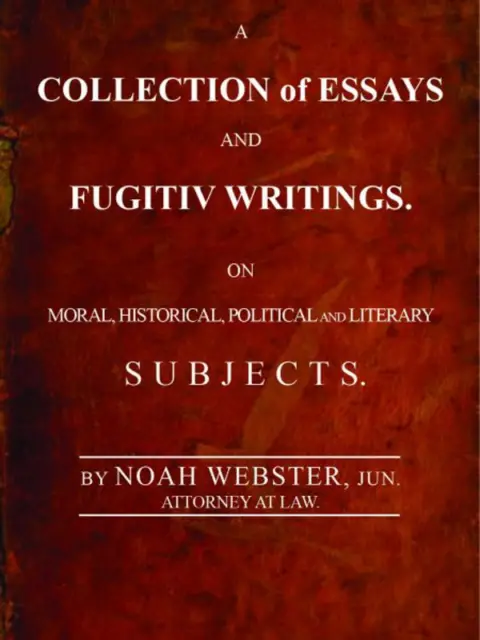
THE CLASSIC COLLECTION · 1790
"A Collection of Essays and Fugitiv Writings" by Noah Webster is a compilation of essays focusing on moral, historical, political, and literary subjects, written in the late 18th century. The collection aims to address significant issues faced by America in its revolutionary period, reflecting on the principles of government, education, and societal values. Webster's works are intended to encourage a spirit of inquiry and virtue among readers, particularly in the context of the emerging American identity. The opening of this collection begins with a preface where the author emphasizes the importance of addressing educational methods and moral character formation in America. Webster critiques existing educational practices, particularly highlighting the excessive focus on ancient languages at the expense of practical knowledge and the study of English. He argues for a systematic improvement in education that emphasizes both ethical and civic knowledge tailored to the needs of a republican society. This opening section sets the stage for a broader discussion on how education can shape the morals and governance of a new nation, showcasing Webster's commitment to fostering an informed and virtuous populace.
Introduction adapted from the source catalogue; source summaries may be automatically generated.
Free to read · English · 143,390 words · No account needed
MAKE TIME FOR A GOOD BOOK
On by default. Untick to stop anonymous reading totals. Each page counts after 10 seconds in view. How this works.
Anonymous counting is on unless you have switched it off.
No man can entertain a more cordial detestation of the smallest disposition to annoy the peace of mind and disturb the tranquillity of mankind, than myself; the design of existence here is to sooth the evils, and multiply the felicities of each other, and he must be a villain indeed, who can deliberately attempt to poison the sources of pleasure, by crossing and disappointing the social passions.
To your sex, Constantia, permit me to giv a word of caution; never to make any inquiries about a man's family, fortune or accomplishments, till you know whether he is a man of principle. By principle, I mean, a disposition of heart to conduct with strict propriety, both as a moral being and as a member of civil society; that is, a disposition to increase the happiness of all around him. If he appears to wish for his own gratification, at the expense even of a servant's happiness, he is an unsocial being, he is not a fit associate for men, much less for amiable women. If he is a man of principle, then proceed to inquire into his standing in life. With principle he may make a woman happy in almost any circumstances; without it, birth, fortune and education serve but to render his worthlessness the more conspicuous. With sentiments of esteem, I am your obliged friend, and humble servant,
No. XXII.
A LETTER to the AUTHOR, with REMARKS.
I beg leave to relate to you a few circumstances respecting the conduct of a young friend of mine in this city, and to request your own remarks and advice on the occasion. Should any other person similarly situated, be disposed to receive benefit from the advice, I shall be much gratified, and my design more than answered.
This young friend to whom I allude, has been till within a few years, under the watchful eyes of very attentiv parents; from whom he received much better advice and much more of it, than the generality of parents in this city are wont to bestow on their children; they taught him to regard truth with a steady attachment; in short his education, till their deaths, was such as might with propriety have been called rigidly virtuous. Since that instructiv period, he has been under the guidance of no one but himself; his former associates with whom he grew up, and for whom he still feels a degree of schoolmate attachment, are almost universally debauched characters. The force of example is great, and let it be mentioned to his honor, that in general he has had sufficient virtue to resist their importunities, and to follow a line of conduct directly contrary to the one they would gladly have marked out for his pursuance. He possesses many of the social virtues, and is warmly attached to the amiable part of the female world. This attachment has preserved him from the fashionable vices of the age, and given him a relish for domestic happiness, which I think he will never lose. A young gentleman so capable of making himself agreeable to good and virtuous characters, ought not, in my opinion, to indulge himself in any practices, that shall tend in the least to depreciate his general merit. The practices I would mention, are few and not very considerable; still I think he should dismiss them entirely, or at least not indulge them to his disadvantage. He sings a good song, and he knows it tolerably well; he is often urged into company on that account; he can make himself agreeable withal, and is really a musical companion; he pays so much attention to learning and singing songs, that he has but little leisure time on his hands; he reads part of the day, but he reads principally novels or song books. I would not be understood to consider singing songs as criminal; far from it; I am often delighted with a song from him; but the query with me is, whether he ought not to devote part of the time which he now employs about what may be called genteel trifling, to the improvement of his mind in a manner that may be of lasting benefit to him; I wish you to giv him your advice, and direct him what books to read. He has another fault, which, altho it originates in the benevolence of his disposition, may still be called a fault. He has a very susceptible heart, and opens it with a generous freedom, so much so that he sometimes forgets himself, and opens it where he ought not to do. A stranger with a specious outside might easily impose on him. I just throw out these hints, that he may be on his guard against those whose business it is to deceive. There are several smaller faults dependant upon, or rather consequent to, those I have mentioned, which I at first intended to have enumerated, but if the first are amended, the others will forsake him of course.
Your reading position is saved on this browser. Take it to another device with a library code. Reading pages adapt to text, rather than matching a printed edition.
BEHIND THE BOOK
This eBook is for the use of anyone anywhere in the United States and most other parts of the world at no cost and with almost no restrictions whatsoever. You may copy it, give it away or re-use it under the terms of the Project Gutenberg License included with this eBook or online at www.gutenberg.org. If you are not located in the United States, you will have to check the laws of the country where you are located before using this eBook. Read the source licence.
The original source file, including credits and licence, is retained by this library. Request an original-format copy at no charge. Please include the book title and Project Gutenberg identifier #44416.
KEEP YOUR CURIOSITY GOING
David Patterson (Spirit) Hatch

David Patterson (Spirit) Hatch

David Patterson (Spirit) Hatch
Cécile Tormay

Moritz Busch
John L. Ransom