
The Writing of News A Handbook with Chapters on Newspaper Correspondence and Copy Reading
Charles G. (Charles Griffith) Ross
THE CLASSIC COLLECTION · 1740
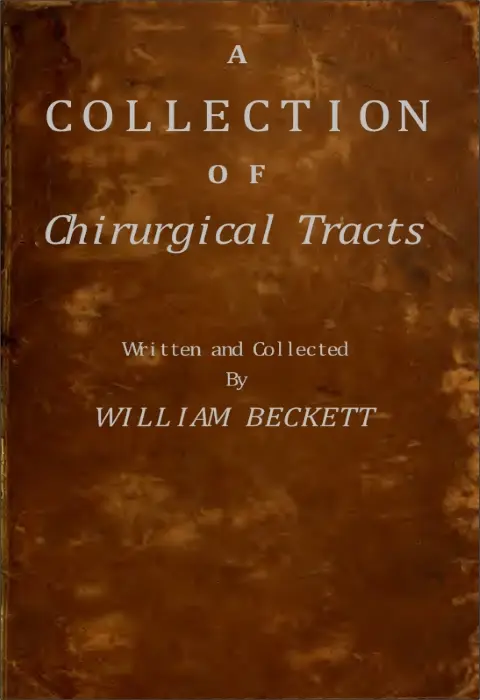
"A Collection of Chirurgical Tracts" by William Beckett is a scientific publication written in the early 18th century. The work consists of various tracts that explore surgical practices and medical discoveries, focusing on topics such as wounds, cancers, and the history of venereal diseases. This compilation aims to present and reflect on Beckett's contributions to the field of surgery based on his extensive experience and observations. The opening of the text introduces readers to William Beckett's life and his notable accomplishments as a surgeon and member of the Royal Society. It outlines his intention to compile various previously published chirurgical pieces into a single collection as a means of documentation and contribution to medical literature. The start of the text also hints at the organization of the subsequent tracts, including discussions on wounds of the head and brain, cancer treatments, and the history of venereal diseases, laying the groundwork for a serious academic exploration of the surgical field in his time.
Introduction adapted from the source catalogue; source summaries may be automatically generated.
Free to read · English · 61,089 words · No account needed
MAKE TIME FOR A GOOD BOOK
On by default. Untick to stop anonymous reading totals. Each page counts after 10 seconds in view. How this works.
Anonymous counting is on unless you have switched it off.
[8] Acts, c. 15. v. 29. That ye abstain from Meats offered to Idols, and from Blood, and from Things strangled, and from Fornication: from which if ye keep yourselves, ye do well. Fare ye well.
Since the Sin of the Intention is entirely out of the Legislature’s Power, the utmost they can do, with regard to this Sin, is, to prevent its being aggravated by actual Commission.
But the Public Stews, as we have already prov’d, will prevent as much as possible this actual Commission.
Therefore the Publick Stews will prevent as much as possible this SIN.
Another Branch of this Objection, without which the Objection itself would be of no Force, is, that the authorizing of Public Stews is a Public Encouragement for People to Whore.
If by People are meant those in the Stews, I hope it will be thought no Crime to encourage such People, rather to confine themselves to the Practice of one Vice, than live by committing a Thousand; especially when that one Vice is what they would really practise, whether they were encourag’d or not.
But if any imagine that this particular Licence would be a general Encouragement to the whole Nation, they are certainly mistaken. For, as to the Men, they are already as bad as they can be; if any Thing cures them, it must be Satiety: Let them have full and free Leave to take a Surfeit of unlawful Love, and they will soon learn to prefer the Chaste Embraces of Innocence before the bought Smile of Harlots loveless, joyless, unindear’d casual Fruition.
It is a right Observation, that Restraint does but whet a Man’s Passions instead of curing them.
Exuperat magis, ægrescitque medendo. Æn. 12. And a late ingenious Author, who study’d Mankind, speaking on this Subject, has these Words: To put down Publick Stews, is not only to disperse Fornication into all Parts, but, by the Difficulty, to excite wild and wanton People to this Vice.
It was observ’d at Rome, that in the full Liberty of Divorces, there was not a single Instance of one in fifty Years: And that Cato long’d for his Wife again as soon as she was in another’s Possession.
The Master of Love says positively,
Quod licet ingratum est, quod non licet acrius urit.
And Martial speaking to a married Rake, B. 3. Ep. 68. says,
Cur aliena placet tibi, quæ tua non placet uxor?
Nunquid Securus non potes arrigere?
I pr’ythee tell me why a Wife
Thy am’rous Fancy never warms?
What! without Danger o’thy Life,
Cannot thy Cod-pice stand to Arms?
And again, B. 1. Ep. 74.
Your reading position is saved on this browser. Take it to another device with a library code. Reading pages adapt to text, rather than matching a printed edition.
BEHIND THE BOOK
This eBook is for the use of anyone anywhere in the United States and most other parts of the world at no cost and with almost no restrictions whatsoever. You may copy it, give it away or re-use it under the terms of the Project Gutenberg License included with this eBook or online at www.gutenberg.org. If you are not located in the United States, you will have to check the laws of the country where you are located before using this eBook. Read the source licence.
The original source file, including credits and licence, is retained by this library. Request an original-format copy at no charge. Please include the book title and Project Gutenberg identifier #52993.
KEEP YOUR CURIOSITY GOING
Charles G. (Charles Griffith) Ross
Hannah Webster Foster

Emily Lawless
Edwin Hamlin Carr

Charles De Lano Hine
Andrew Ure