
The Writing of News A Handbook with Chapters on Newspaper Correspondence and Copy Reading
Charles G. (Charles Griffith) Ross
THE CLASSIC COLLECTION · 1740
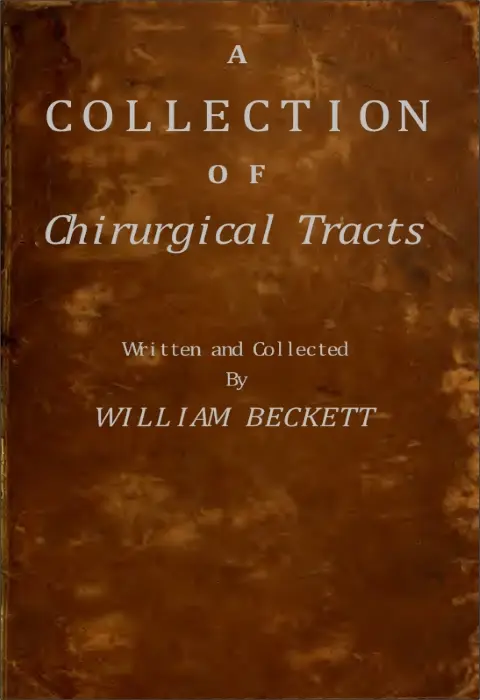
"A Collection of Chirurgical Tracts" by William Beckett is a scientific publication written in the early 18th century. The work consists of various tracts that explore surgical practices and medical discoveries, focusing on topics such as wounds, cancers, and the history of venereal diseases. This compilation aims to present and reflect on Beckett's contributions to the field of surgery based on his extensive experience and observations. The opening of the text introduces readers to William Beckett's life and his notable accomplishments as a surgeon and member of the Royal Society. It outlines his intention to compile various previously published chirurgical pieces into a single collection as a means of documentation and contribution to medical literature. The start of the text also hints at the organization of the subsequent tracts, including discussions on wounds of the head and brain, cancer treatments, and the history of venereal diseases, laying the groundwork for a serious academic exploration of the surgical field in his time.
Introduction adapted from the source catalogue; source summaries may be automatically generated.
Free to read · English · 61,089 words · No account needed
MAKE TIME FOR A GOOD BOOK
On by default. Untick to stop anonymous reading totals. Each page counts after 10 seconds in view. How this works.
Anonymous counting is on unless you have switched it off.
I proceed now to give an Account of some of our early Writers, besides those already mentioned. And first of Maugantius, who was by Birth a Briton, a famous Physician and Mathematician; who, says Leland, for his eminent Learning, was made President of a noble College (in those Days) of two hundred Philosophers; which Geofrey of Monmouth extols to the Skies, under the Name of Legionum Urbs; which Bale supposes to be Chester, excelling all other British Cities, at that Time, in Wealth and Roman Structures. This Place being most pleasantly situated, Astrologers, and other Artists, settled in it to observe the Motions of the Stars, and undertook to forewarn Mankind from the Comets, and certain Indications of the Planets, what should come to pass. Hence Maugantius, said to be superior to all others in this Art, being questioned by King Vortiger, whose chief Physician he was, about the prodigious Conception of Ambrose Merlin, after a Recital of various Philosophical Reasons, did, at length, it seems, give him Satisfaction therein. This Person, who was the most renowned Scholar of his Country, and who is said to have composed several Books, flourished in the Year of Christ 470, when King Vortiger was much distressed by the invading Anglo-Saxons. I have before observed, that there were several Dignitaries of the Papal Communion as well as those of inferior Orders, besides the Monks, who very early took upon them to practise Physic; and that they were absolutely forbid to exercise that Profession, by the Roman Assembly, in 1139. Of this Sort was Frabricius, or Faricius, as he is sometimes written, who practised Physic not long before this Time. He was the eighteenth Abbot of the Monastery of Abington in Berkshire; to whose Care Godfrey de Vere committed himself, to be cured of a grievous Disease he then laboured under; and, as an Acknowledgment for the Care the Abbot had taken of him, he bequeathed to the Abbey before-mentioned, the Church belonging to his Estate, in the Village of Kensington, near London, with 240 Acres of Land, &c. which was confirmed by the King; a Copy of which Grant will be given in the Antiquities of that Town, and the History of it’s Abbey. This Abbot departed this Life the VIIth of the Calends of March, Anno 1117. Soon after him flourished Athelardus, a Monk of Bath, who was so diligent in searching out the Mysteries and Causes of Natural Things, that he deserves to be equalled with some of the ancient Philosophers. Having a very promising Genius, while very young, and continuing, as he grew up, to improve his Parts, and fit himself for great Affairs, he left his native Soil, and, with much Alacrity, went to visit foreign Parts. In his Travels through Egypt and Arabia, having found many Things he sought after, he came Home again with good Fruit of his Labours and Improvement of his Learning. He was, without Dispute, in Philosophy, Astronomy, Physic, Mathematics, and Rhetoric, no ordinary Proficient. Some of his Works he Dedicated to Richard, Bishop of Bayeux: In the first Work he treats of the Principles, Qualities, and Effects of Natural Things, against the vain Opinions of the old Philosophers. In the Preface it appears, he wrote in the Year 1130, under the Reign of Henry I. I might here enlarge upon the great Fame and Merits of John Giles, a Native of St Albans, who made such Progress in the Study of Physic, that he was made Professor of that Faculty at Paris and Montpelier, and Physician to Philip, King of France. After his Return to his own Country, he was, according to Matthew Paris, consulted by Robert Grosthead, the learned Bishop of Lincoln, in his last Illness; of which he died in 1253. He has written, De re Medica, and de Prognosticis, and some other Things. He flourished about the Year 1230, in the Reign of King Henry III. Hugh de Eversham, deserves in this Place to be remembred, who was a Man of great Learning, a Physician by Profession, and perhaps the best of his Age. He was well known in many Countries, being a great Frequenter of the Universities. With the severer Studies of his Art, he mingled the pleasant Science of the Mathematics, and particularly Geometry and Astronomy. This made him known to many in France and Italy, and among the rest, to Pope Martin IV, who invited him, by Letters, to come to him, and solve some Questions in Physic, which were then newly started: Accordingly he went without Delay, and performed what was required readily and learnedly. He published Super Opere Febrium Isaac. Medicinales Canones. Problemata quædam, and some other Things. He flourished the Year 1281; when he was created Cardinal Presbyter of St Laurence, by the said Pope Martin, in the Reign of Edward I. He is said to have died by Poison at Rome, Anno 1287; although Cicæonius, to palliate this Matter, says he died of the Plague.
Your reading position is saved on this browser. Take it to another device with a library code. Reading pages adapt to text, rather than matching a printed edition.
BEHIND THE BOOK
This eBook is for the use of anyone anywhere in the United States and most other parts of the world at no cost and with almost no restrictions whatsoever. You may copy it, give it away or re-use it under the terms of the Project Gutenberg License included with this eBook or online at www.gutenberg.org. If you are not located in the United States, you will have to check the laws of the country where you are located before using this eBook. Read the source licence.
The original source file, including credits and licence, is retained by this library. Request an original-format copy at no charge. Please include the book title and Project Gutenberg identifier #52993.
KEEP YOUR CURIOSITY GOING
Charles G. (Charles Griffith) Ross
Hannah Webster Foster

Emily Lawless
Edwin Hamlin Carr

Charles De Lano Hine
Andrew Ure