READ · DISCOVER · ENJOYClassic literature · Always free
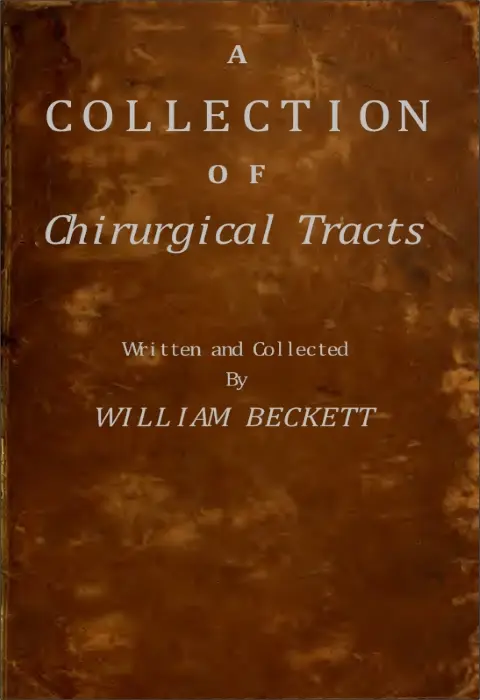
A Collection of Chirurgical Tracts — digital edition cover

THE CLASSIC COLLECTION · 1740

A Collection of Chirurgical Tracts

"A Collection of Chirurgical Tracts" by William Beckett is a scientific publication written in the early 18th century. The work consists of various tracts that explore surgical practices and medical discoveries, focusing on topics such as wounds, cancers, and the history of venereal diseases. This compilation aims to present and reflect on Beckett's contributions to the field of surgery based on his extensive experience and observations. The opening of the text introduces readers to William Beckett's life and his notable accomplishments as a surgeon and member of the Royal Society. It outlines his intention to compile various previously published chirurgical pieces into a single collection as a means of documentation and contribution to medical literature. The start of the text also hints at the organization of the subsequent tracts, including discussions on wounds of the head and brain, cancer treatments, and the history of venereal diseases, laying the groundwork for a serious academic exploration of the surgical field in his time.

Introduction adapted from the source catalogue; source summaries may be automatically generated.

Start reading ↓

Free to read · English · 61,089 words · No account needed

MAKE TIME FOR A GOOD BOOK

A Collection of Chirurgical Tracts

On by default. Untick to stop anonymous reading totals. Each page counts after 10 seconds in view. How this works.

Anonymous counting is on unless you have switched it off.

A Collection of Chirurgical Tracts

I Remain,
Honoured Sir,
Your Most Obliged,
And Obedient,
Humble Servant
,

E. CURLL.

INTRODUCTION

TO THE

HISTORY

OF

PHYSIC and SURGERY.

Concerning the Antient State of Learning, and the Antiquity of the Practice of Physic and Surgery.

Britain has been very happy in furnishing the World, in very early Times, with a great Number of famous and learned Men. Of the first Sort were the Druydæ, who, it is said, had their Original and Name from Druys Sarronius the fourth King of the Celts, who died Anno Mundi 2069. Next the Bardi, who celebrated the illustrious Deeds of famous Men, who had their Name from Bardus Druydus the fifth King of the Celts. Cæsar assures us, (and a noble Testimony it is) that the Learning of the Druydi, was first invented in Britain, and from thence transferred to France; and that, in his Time, those of France came over hither to be instructed. A celebrated German Writer, as quoted by Mr Ashmole in the Prolegomena to his Theat. Chem. says, that when the World was troubled with Pannonic Invasions, England flourished in the Knowledge of all good Arts, and was able to send her learned Men into other Countries to propagate Learning: And instances in Boniface, a Devonshire Man, and Willeboard, a Northern Man, which were sent into Germany for those Purposes. Mr John Leland, a famous Antiquary, in the Reign of King Henry VII, who was excellently well acquainted with our British Authors, assures us, upon his own Knowledge, that we have had a great Number of excellent Wits and learned Writers, who, besides their great Proficiency in Languages, were well acquainted with the Liberal Sciences. And Bishop Nicholson, in his Historical Library says, I think we may without Vanity affirm, that hardly any Kingdom in the World has out-done England, either in the Number or Goodness of her Authors; and that even in the darkest Ages our Lamps shone always as bright as any of our Neighbourhood. When School-Divinity was in Fashion, we had our Doctores Subtiles, Irrefragabiles, &c. But as the History of the Learning of this Nation in general is not my present Design, I shall confine myself more particularly to what relates to Physic and Surgery. An Historical Account of the Antiquity and Progress of which Faculties, with the successive Improvements they have received, has not hitherto been attempted by any Hand. And indeed the Difficulty which must attend an Undertaking of this Nature, must be very great, by reason of the little Knowledge we are able to get, in this Kind, from those Manuscripts which yet remain among us. The ancient Britains, who went without Cloaths, may be very well presumed to live without Physic; but external Accidents they must be liable to, as well in their Wars as from other Causes; and History informs us, they had Methods of Cure for such Misfortunes. The Saxons, while they possessed England, had their Leeches, a sort of Surgeons, but very little skilled in Methodical Practice. But under the Normans that Science began to be much more improved. About this Time the Monks and Fryars, and others in Religious Orders, out of a pretended Charity to their suffering Fellow-Creatures, intruded themselves into the Practice of Physic and Surgery, and continued it many Years, notwithstanding the Decree of the Council of Tours in 1163, where Pope Alexander III. presided; which forbids any Religious Persons going out of their Cloisters, to hear the Lectures in Law or Physic; and that it is absolutely forbidden, that any Sub-Deacon, Deacon, or Priest, exercise any Part of Surgery in which actual Cauteries or Incisions are required. Most of the Physicians who practised in England about this Time, were likewise well skilled in the Mathematics and other Parts of Philosophy; but the Surgeons of those Times were so much addicted to Astrology, as make some Parts of their Writings very obscure. After this both Physic and Surgery began to flourish much more, by the public Encouragement given very early by many of our Kings to several of the Practitioners in both Faculties, as will appear by the List of our Kings Physicians and Surgeons, to be inserted in it’s proper Place. Hector Boëtius informs us, that Josina, King of Scotland, who lived above a hundred Years before our Saviour, well understood the Nature of Scotch Plants, and their Use in Physic and Chirurgery; and John Bale, afterwards Bishop of Ossory in Ireland, assures us, he wrote a Book, de Herbarum Viribus. Buchanan relates, the Scotch Nobility were anciently very expert in Chirurgery, and it is particularly remarked of James IV, King of Scotland, Quod vulnera scientissime tractaret. It is said, that when Scribonius Largus attended the Emperor Claudius in his Expedition to Britany, he wrote a British Herbal, or Description of divers Plants in this Island. And our most learned and famous King Alfred, is said to have written a Book upon Aristotle de Plantis. Cinfrid, a famous Physician, is mentioned by that early Writer Venerable Bede, in his Histor. Ecclesiasticar. page 307, 308. And Ernulphus, another eminent Physician, in the Time of Nigellus, the second Bishop of Ely, is likewise recorded in the Anglia Sacra, Vol. I. p. 625. Many more Particulars might, in all Probability, have been met with relating to my present Design, had not one very great Misfortune attended the Suppression of the Abbies, which was the Destruction of a prodigious Number of Manuscripts. John Bale, before-mentioned, though an utter Enemy to Popery and Monastic Institution, remonstrates against this Piece of Barbarity, in pretty strong Terms, to King Edward VI. Covetousness, says he, was at that Time so busy about private Commodity, that public Wealth was not any where regarded. A Number of them, which purchased those superstitious Mansions, reserved of those Library-Books, some to serve their Jacks, some to scour their Candlestics, and some to rub their Boots, and some they sold to the Grocers and Soap-sellers, and some they sent over Sea to the Book-binders, not in small Numbers, but at Times whole Ships full. Yea, the Universities of this Realm, are not all clear in this detestable Fact: But cursed is the Belly which seeketh to be fed with so ungodly Gains, and so deeply shameth his natural Country. I know, says he, a Merchantman (which shall at this time be nameless) that bought the Contents of two noble Libraries for forty Shillings Price; a Shame it is to be spoken. This Stuff hath he occupied instead of gray Paper, by the Space of more than these ten Years, and yet he has Store enough for these ten Years to come. A prodigious Example is this, and to be abhorred of all Men, which love their Nation as they should do. Yea, what may bring our Nation to more Shame and Rebuke, than to have it noised abroad, that we are Despisers of Learning? I judge this to be true, and utter it with Heaviness, that neither the Britons, under the Romans and Saxons, nor yet the English People under the Danes and Normans, had ever such Damage of their learned Monuments, as we have seen in our Time. Our Posterity may well curse this wicked Fact of our Age, this unseasonable Spoil of England’s most noble Antiquities. Bale’s Declaration upon Leland’s Journal, published 1549. And Dr Thomas Fuller, in his Church History, speaking of the same Thing, tells us, Divinity was prophaned, Mathematics suffered for Correspondence with evil Spirits, Physic was maimed, and a Riot committed on the Law itself. However, notwithstanding this Devastation which was then made among our Manuscripts, our Colleges, and some of our Libraries, will furnish us with a great Number relating to almost all Parts of Learning: Some of which, more especially the most ancient ones, I shall here first give a Catalogue of, and then some more modern ones, confining myself to those which more especially relate to Physic and Chirurgery. And, first, we have in the Norfolk Library, belonging to the Royal Society,

Your reading position is saved on this browser. Take it to another device with a library code. Reading pages adapt to text, rather than matching a printed edition.

BEHIND THE WORDS

About William Beckett

William Beckett (1684–1738). Explore A Collection of Chirurgical Tracts in this collection. These books span literature & collections.

Explore this author’s books →

THE READERS’ VERDICT

How did this story stay with you?

Not rated yet
Your rating for A Collection of Chirurgical Tracts

Be the first to share your verdict.

One rating per browser, which you can change or remove. A necessary browser identifier remembers your vote. How ratings work

A GOOD STORY DESERVES COMPANY

Pass this book along.

A great read is even better when it’s shared.

SEND A LITTLE INSPIRATION

Share this book

BEHIND THE BOOK

Edition & source details.

Title
A Collection of Chirurgical Tracts
Author
William Beckett
First publication (Open Library catalogue match)
1740
Digital edition publisher
Project Gutenberg
Gutenberg release date
2016-09-06
Language
English
Source edition imprint
Not stated in source catalogue
Source identifier
Project Gutenberg #52993
Contributors
No additional named contributors in source metadata

Public-domain source & licence

This eBook is for the use of anyone anywhere in the United States and most other parts of the world at no cost and with almost no restrictions whatsoever. You may copy it, give it away or re-use it under the terms of the Project Gutenberg License included with this eBook or online at www.gutenberg.org. If you are not located in the United States, you will have to check the laws of the country where you are located before using this eBook. Read the source licence.

Full source licence and obtaining an original copy

The original source file, including credits and licence, is retained by this library. Request an original-format copy at no charge. Please include the book title and Project Gutenberg identifier #52993.

the full Project Gutenberg License must appear
prominently whenever any copy of a Project Gutenberg work (any work
on which the phrase “Project Gutenberg” appears, or with which the
phrase “Project Gutenberg” is associated) is accessed, displayed,
performed, viewed, copied or distributed:

This eBook is for the use of anyone anywhere in the United States and most
other parts of the world at no cost and with almost no restrictions
whatsoever. You may copy it, give it away or re-use it under the terms
of the Project Gutenberg™ License included with this eBook or online
at www.gutenberg.org. If you
are not located in the United States, you will have to check the laws
of the country where you are located before using this eBook.

1.E.2. If an individual Project Gutenberg electronic work is
derived from texts not protected by U.S. copyright law (does not
contain a notice indicating that it is posted with permission of the
copyright holder), the work can be copied and distributed to anyone in
the United States without paying any fees or charges. If you are
redistributing or providing access to a work with the phrase “Project
Gutenberg” associated with or appearing on the work, you must comply
either with the requirements of paragraphs 1.E.1 through 1.E.7 or
obtain permission for the use of the work and the Project Gutenberg
trademark as set forth in paragraphs 1.E.8 or 1.E.9.

1.E.3. If an individual Project Gutenberg electronic work is posted
with the permission of the copyright holder, your use and distribution
must comply with both paragraphs 1.E.1 through 1.E.7 and any
additional terms imposed by the copyright holder. Additional terms
will be linked to the Project Gutenberg License for all works
posted with the permission of the copyright holder found at the
beginning of this work.

1.E.4. Do not unlink or detach or remove the full Project Gutenberg
License terms from this work, or any files containing a part of this
work or any other work associated with Project Gutenberg.

1.E.5. Do not copy, display, perform, distribute or redistribute this
electronic work, or any part of this electronic work, without
prominently displaying the sentence set forth in paragraph 1.E.1 with
active links or immediate access to the full terms of the Project
Gutenberg License.

1.E.6. You may convert to and distribute this work in any binary,
compressed, marked up, nonproprietary or proprietary form, including
any word processing or hypertext form. However, if you provide access
to or distribute copies of a Project Gutenberg work in a format
other than “Plain Vanilla ASCII” or other format used in the official
version posted on the official Project Gutenberg website
(www.gutenberg.org), you must, at no additional cost, fee or expense
to the user, provide a copy, a means of exporting a copy, or a means
of obtaining a copy upon request, of the work in its original “Plain
Vanilla ASCII” or other form. Any alternate format must include the
full Project Gutenberg License as specified in paragraph 1.E.1.

1.E.7. Do not charge a fee for access to, viewing, displaying,
performing, copying or distributing any Project Gutenberg works
unless you comply with paragraph 1.E.8 or 1.E.9.

1.E.8. You may charge a reasonable fee for copies of or providing
access to or distributing Project Gutenberg electronic works
provided that:

• You pay a royalty fee of 20% of the gross profits you derive from
the use of Project Gutenberg works calculated using the method
you already use to calculate your applicable taxes. The fee is owed
to the owner of the Project Gutenberg trademark, but he has
agreed to donate royalties under this paragraph to the Project
Gutenberg Literary Archive Foundation. Royalty payments must be paid
within 60 days following each date on which you prepare (or are
legally required to prepare) your periodic tax returns. Royalty
payments should be clearly marked as such and sent to the Project
Gutenberg Literary Archive Foundation at the address specified in
Section 4, “Information about donations to the Project Gutenberg
Literary Archive Foundation.”

• You provide a full refund of any money paid by a user who notifies
you in writing (or by e-mail) within 30 days of receipt that s/he
does not agree to the terms of the full Project Gutenberg™
License. You must require such a user to return or destroy all
copies of the works possessed in a physical medium and discontinue
all use of and all access to other copies of Project Gutenberg™
works.

• You provide, in accordance with paragraph 1.F.3, a full refund of
any money paid for a work or a replacement copy, if a defect in the
electronic work is discovered and reported to you within 90 days of
receipt of the work.

• You comply with all other terms of this agreement for free
distribution of Project Gutenberg™ works.


1.E.9. If you wish to charge a fee or distribute a Project
Gutenberg™ electronic work or group of works on different terms than
are set forth in this agreement, you must obtain permission in writing
from the Project Gutenberg Literary Archive Foundation, the manager of
the Project Gutenberg™ trademark. Contact the Foundation as set
forth in Section 3 below.

1.F.

1.F.1. Project Gutenberg volunteers and employees expend considerable
effort to identify, do copyright research on, transcribe and proofread
works not protected by U.S. copyright law in creating the Project
Gutenberg™ collection. Despite these efforts, Project Gutenberg™
electronic works, and the medium on which they may be stored, may
contain “Defects,” such as, but not limited to, incomplete, inaccurate
or corrupt data, transcription errors, a copyright or other
intellectual property infringement, a defective or damaged disk or
other medium, a computer virus, or computer codes that damage or
cannot be read by your equipment.

1.F.2. LIMITED WARRANTY, DISCLAIMER OF DAMAGES - Except for the “Right
of Replacement or Refund” described in paragraph 1.F.3, the Project
Gutenberg Literary Archive Foundation, the owner of the Project
Gutenberg™ trademark, and any other party distributing a Project
Gutenberg™ electronic work under this agreement, disclaim all
liability to you for damages, costs and expenses, including legal
fees. YOU AGREE THAT YOU HAVE NO REMEDIES FOR NEGLIGENCE, STRICT
LIABILITY, BREACH OF WARRANTY OR BREACH OF CONTRACT EXCEPT THOSE
PROVIDED IN PARAGRAPH 1.F.3. YOU AGREE THAT THE FOUNDATION, THE
TRADEMARK OWNER, AND ANY DISTRIBUTOR UNDER THIS AGREEMENT WILL NOT BE
LIABLE TO YOU FOR ACTUAL, DIRECT, INDIRECT, CONSEQUENTIAL, PUNITIVE OR
INCIDENTAL DAMAGES EVEN IF YOU GIVE NOTICE OF THE POSSIBILITY OF SUCH
DAMAGE.

1.F.3. LIMITED RIGHT OF REPLACEMENT OR REFUND - If you discover a
defect in this electronic work within 90 days of receiving it, you can
receive a refund of the money (if any) you paid for it by sending a
written explanation to the person you received the work from. If you
received the work on a physical medium, you must return the medium
with your written explanation. The person or entity that provided you
with the defective work may elect to provide a replacement copy in
lieu of a refund. If you received the work electronically, the person
or entity providing it to you may choose to give you a second
opportunity to receive the work electronically in lieu of a refund. If
the second copy is also defective, you may demand a refund in writing
without further opportunities to fix the problem.

1.F.4. Except for the limited right of replacement or refund set forth
in paragraph 1.F.3, this work is provided to you ‘AS-IS’, WITH NO
OTHER WARRANTIES OF ANY KIND, EXPRESS OR IMPLIED, INCLUDING BUT NOT
LIMITED TO WARRANTIES OF MERCHANTABILITY OR FITNESS FOR ANY PURPOSE.

1.F.5. Some states do not allow disclaimers of certain implied
warranties or the exclusion or limitation of certain types of
damages. If any disclaimer or limitation set forth in this agreement
violates the law of the state applicable to this agreement, the
agreement shall be interpreted to make the maximum disclaimer or
limitation permitted by the applicable state law. The invalidity or
unenforceability of any provision of this agreement shall not void the
remaining provisions.

1.F.6. INDEMNITY - You agree to indemnify and hold the Foundation, the
trademark owner, any agent or employee of the Foundation, anyone
providing copies of Project Gutenberg™ electronic works in
accordance with this agreement, and any volunteers associated with the
production, promotion and distribution of Project Gutenberg™
electronic works, harmless from all liability, costs and expenses,
including legal fees, that arise directly or indirectly from any of
the following which you do or cause to occur: (a) distribution of this
or any Project Gutenberg work, (b) alteration, modification, or
additions or deletions to any Project Gutenberg work, and (c) any
Defect you cause.

Section 2. Information about the Mission of Project Gutenberg

Project Gutenberg is synonymous with the free distribution of
electronic works in formats readable by the widest variety of
computers including obsolete, old, middle-aged and new computers. It
exists because of the efforts of hundreds of volunteers and donations
from people in all walks of life.

Volunteers and financial support to provide volunteers with the
assistance they need are critical to reaching Project Gutenberg’s
goals and ensuring that the Project Gutenberg collection will
remain freely available for generations to come. In 2001, the Project
Gutenberg Literary Archive Foundation was created to provide a secure
and permanent future for Project Gutenberg and future
generations. To learn more about the Project Gutenberg Literary
Archive Foundation and how your efforts and donations can help, see
Sections 3 and 4 and the Foundation information page at www.gutenberg.org.

Section 3. Information about the Project Gutenberg Literary Archive Foundation

The Project Gutenberg Literary Archive Foundation is a non-profit
501(c)(3) educational corporation organized under the laws of the
state of Mississippi and granted tax exempt status by the Internal
Revenue Service. The Foundation’s EIN or federal tax identification
number is 64-6221541. Contributions to the Project Gutenberg Literary
Archive Foundation are tax deductible to the full extent permitted by
U.S. federal laws and your state’s laws.

The Foundation’s business office is located at 41 Watchung Plaza #516,
Montclair NJ 07042, USA, +1 (862) 621-9288. Email contact links and up
to date contact information can be found at the Foundation’s website
and official page at www.gutenberg.org/contact

Section 4. Information about Donations to the Project Gutenberg
Literary Archive Foundation

Project Gutenberg™ depends upon and cannot survive without widespread
public support and donations to carry out its mission of
increasing the number of public domain and licensed works that can be
freely distributed in machine-readable form accessible by the widest
array of equipment including outdated equipment. Many small donations
($1 to $5,000) are particularly important to maintaining tax exempt
status with the IRS.

The Foundation is committed to complying with the laws regulating
charities and charitable donations in all 50 states of the United
States. Compliance requirements are not uniform and it takes a
considerable effort, much paperwork and many fees to meet and keep up
with these requirements. We do not solicit donations in locations
where we have not received written confirmation of compliance. To SEND
DONATIONS or determine the status of compliance for any particular state
visit www.gutenberg.org/donate.

While we cannot and do not solicit contributions from states where we
have not met the solicitation requirements, we know of no prohibition
against accepting unsolicited donations from donors in such states who
approach us with offers to donate.

International donations are gratefully accepted, but we cannot make
any statements concerning tax treatment of donations received from
outside the United States. U.S. laws alone swamp our small staff.

Please check the Project Gutenberg web pages for current donation
methods and addresses. Donations are accepted in a number of other
ways including checks, online payments and credit card donations. To
donate, please visit: www.gutenberg.org/donate.

Section 5. General Information About Project Gutenberg electronic works

Professor Michael S. Hart was the originator of the Project
Gutenberg concept of a library of electronic works that could be
freely shared with anyone. For forty years, he produced and
distributed Project Gutenberg eBooks with only a loose network of
volunteer support.

Project Gutenberg eBooks are often created from several printed
editions, all of which are confirmed as not protected by copyright in
the U.S. unless a copyright notice is included. Thus, we do not
necessarily keep eBooks in compliance with any particular paper
edition.

Most people start at our website which has the main PG search
facility: www.gutenberg.org.

This website includes information about Project Gutenberg,
including how to make donations to the Project Gutenberg Literary
Archive Foundation, how to help produce our new eBooks, and how to
subscribe to our email newsletter to hear about new eBooks.


KEEP YOUR CURIOSITY GOING

Your next chapter awaits.

THE CLASSIC COLLECTION✦The Boarding School; Lessons of a Preceptress to Her Pupils Consisting of Information, Instruction and Advice, Calculated to Improve the Manners and Form the Character of Young Ladies. To Which Is Added, a Collection of Letters, Written by the Pupils to Their Instructress, Their Friends, and Each Other.Hannah Webster FosterCLASSIC FREE BOOKS
Open book ↗
Literature & Collections1798

The Boarding School; Lessons of a Preceptress to Her Pupils Consisting of Information, Instruction and Advice, Calculated to Improve the Manners and Form the Character of Young Ladies. To Which Is Added, a Collection of Letters, Written by the Pupils to Their Instructress, Their Friends, and Each Other.

Hannah Webster Foster