
The Writing of News A Handbook with Chapters on Newspaper Correspondence and Copy Reading
Charles G. (Charles Griffith) Ross
THE CLASSIC COLLECTION · 1740
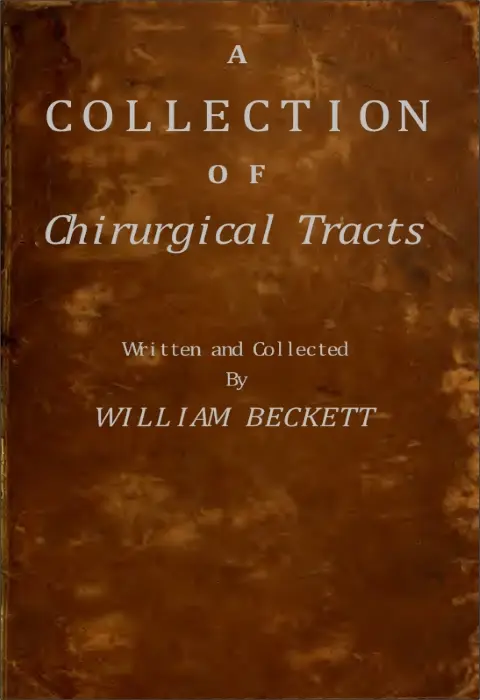
"A Collection of Chirurgical Tracts" by William Beckett is a scientific publication written in the early 18th century. The work consists of various tracts that explore surgical practices and medical discoveries, focusing on topics such as wounds, cancers, and the history of venereal diseases. This compilation aims to present and reflect on Beckett's contributions to the field of surgery based on his extensive experience and observations. The opening of the text introduces readers to William Beckett's life and his notable accomplishments as a surgeon and member of the Royal Society. It outlines his intention to compile various previously published chirurgical pieces into a single collection as a means of documentation and contribution to medical literature. The start of the text also hints at the organization of the subsequent tracts, including discussions on wounds of the head and brain, cancer treatments, and the history of venereal diseases, laying the groundwork for a serious academic exploration of the surgical field in his time.
Introduction adapted from the source catalogue; source summaries may be automatically generated.
Free to read · English · 61,089 words · No account needed
MAKE TIME FOR A GOOD BOOK
On by default. Untick to stop anonymous reading totals. Each page counts after 10 seconds in view. How this works.
Anonymous counting is on unless you have switched it off.
Whether Cancers are Curable by Causticks.
The Difficulty that those of our Predecessors who had Courage enough to attempt the Cure of Cancers, must unavoidably meet with, obliged them to enter upon several Methods of Practice, in order to be capable of surmounting it; and there have not been wanting for these several hundred Years last past, some Gentlemen in the Republick of Medicine that have proposed to conquer this Rebellious Disease, by the use of some particular Causticks, they have recommended. It is foreign to my Design, to give an Account of the Composition of the several Remedies, they have been big with the Expectation of Success from; I shall only take notice of one or two not very pompous Preparations, that by some Persons I know, have been looked upon as extraordinary as any that have been transmitted to us. Guido, who I think I may justly say is one of the best Authors of so ancient a Date, has been very lavish of his Encomiums on Arsnick, and after him Fallopius, Rodericus a Castro, Ossenius, Penotus, Faber, Borellus, and others, have recommended it in some particular Preparations. That of Fuschius, who is said to have cured abundance of Persons of Cancers, in England, Germany, and Poland, having had the most said in it’s Commendation, required our more particular Notice; Hartman calls it Pul Benedictus, which whether it deserves that Title, we will leave to the Reader to judge, after we have faithfully recounted the Effects of it. Its Preparation is as follows: ℞ Arsenici albi ℥i subtilissime pulverisetur per dies 15 de die tertio in tertium affundatur Aq. vitæ, ut cooperiat pulverem, post triduum Aq. vitæ abjiciatur, ac nova affundatur, ac misceantur. Rad Dracunouli Major, mense julio vel Agu. collect & in taleolas scissæ ac in loco ventis perflatili exsiccatæ ℥ii. Fuliginis Camini splendidi ℥iii redigantur omnia in subtilissimum pulverem super lapidem marmoreum, & servetur in Vase bene clauso vitreo. Ante annum vero ad usum non erit it a commodus. This Powder I applied to a Cancerated Breast of a Woman, under thirty Years of Age, after having made a Sore by applying one of the milder Causticks; the first Night it was made use of, it caused a great deal of pain, and the next Day, the Breast appeared very much tumefied and inflamed, a small quantity of Gleet, having discharged on the Bolster: in short for fifteen Days she was not free from pain, she had a Fever, was attended with frequent Vomitings, Faintings, and several other Disorders. I could afford her but very little Relief by Internals, or the most cool and temperate Applications to the Breast; nor was it in my Power to remove the dressing, it adhered so fast to the Sore. There was a Discharge of a bloody ferous Juice for twelve Days in a moderate quantity, after which the Matter thickened, and it began to smell somewhat offensive, at the end of fifteen Days the Dressing dropped off, and with it came away about two Ounces of the cancerous Mass. The Reader may easily imagine that making so small a Progress in such a time, and that at the Expence of so much Pain, I could easily prevail with my self to desist from the Undertaking, for the second Application would have been attended with the same Inconveniencies as the first, which to any Persons that entertains such a concern for his Patients as he ought to do, must be very fatiguing; in short, after this I made use of that Remedy I had elsewhere mentioned, and which from its Effect was properly enough called a Dissolvent, with this by the Blessing of God the Cancerous Substance was consumed in about three Weeks, and a perfect Cure compleated in not many Days after, the Patient which I saw lately continuing perfectly well, it being the first Case that ever Providence directed me to the use of the Remedy in. Hildan has an Observation very pertinent to what we have before related; he tells us, that the Powder so much celebrated by Penotus, and which is much the same with that just now mentioned, being applied to a Cancer, was succeeded by such ill Symptoms, that it killed the Patient in a few Days. We are informed in the communicated Observations of Riverius, that a Foreigner extirpated a Cancer, that had began to Ulcerate in the Breast of a Woman of fifty Years of Age, by the following Application: ℞ Arsenici ʒi. Salis Armoniaci ℥ii. Sublimat. crud. ℥iiii. Aq; Fortis ℥i. These were to be distill’d to Dryness, then an equal Weight of distill’d Vinegar put thereto, which was to be distilled again, till the remaining Matter, became of the Consistance of a Paste. The Surgeon bathed the Cancer with hot Wine, and rubbed it with Cloths for some time to irritate it, then he spread some of his Composition on a Bolster six times less than the Tumour, and applied it; in twenty four Hours time, it made an Escar as large as the Swelling, so that it wholly consumed the Cancer; after the Separation of the Escar he incarned the Ulcer and cicatrized it. It is very observable, that he did not engage in this painful Process, without immediately causing a Fever, which was attended with a Vomiting, Loosness, and much Provocation of Urine; which Symptoms lasted two or three Days, for Nature was disordered by the destructive Quality of a venemous Remedy. Paracelsus, Faber, and some others, make mention of Arsnical Preparations, that procure but little Pain in their Operation; I had a Design of making a Trial of some of these Remedies, had I not in my Enquiries met with what was very satisfactory to me, though after knowing what I have related, I should have always cautiously avoided the use of any Remedy, in which the Arsnick had not undergone such a Preparation as I should have approved of, because I am assured it may procure very mischievious Symptoms, though in Substance, it do not so much as touch the Skin, witness the Amulets, in which it has been the chief Ingredient, and of which there have been such direful Accidents related by Crato, Massaria, and Zacutus Lucitanus. I do not think it impossible, but that Arsnick may be prepared after such a manner as may, by the addition of some convenient Body, or depriving it of its noxious Particles, qualify it for effecting uncommon things in the Cure of this Disease, without causing the Surgeon to repent the use of it. I remember that Helmont somewhere says one may easily enough correct several sorts of Poisons, so that they shall not be deprived of their Force, when we destroy their Virulency. Many Instances of this Nature we meet with in Mr Boyle, and some others; but that which makes most for my present purpose, is, what is mentioned by the last Honourable Gentleman, of a very ingenious Man he knew, that was famous, as well for his Writings, as for a Remedy to cure ulcerated Cancers in Womens Breasts, without any considerable Pain. He assured our Author that his Medicine was indolent, and mortified the ulcerated Parts as far as they were corrupted, without disordering the Party, and this Remedy it seems partly by the Confession of the Gentleman, was reasonably enough supposed to be a Dulcification of Arsnick; one would think that the mention of this very Remedy, with Monsieur Alliot’s, and that recommended in the preceeding Letter, should be sufficient to influence the inquisitive of our Profession to farther Enquiries, which must be certainly an Undertaking, worthy the noblest Spirits. To conclude, we cannot say, but there are many Cancers that may be cured by Causticks, but the Person that is to undergo it, may very well answer, as a certain Patient did, who’s Thigh was to be cut off, Non est tanto digna dolore Salus. The Preservation of Life would be too dear bought at the Price of so much Pain. This puts me in Mind of what is related of Galienus the Emperor, who it seems had for a considerable time been very grieviously afflicted with a Sciatica, a certain Physician undertaking to cure him, performed indeed his Promise, but nevertheless made him undergo a thousand painful Experiments; whereupon, the Emperor one Day sent for, and thus said to him, Take Fabatus two Thousand Sesterces, but withal, be informed I give them not for curing my Sciatica, but that thou may’st never cure me again.
Your reading position is saved on this browser. Take it to another device with a library code. Reading pages adapt to text, rather than matching a printed edition.
BEHIND THE BOOK
This eBook is for the use of anyone anywhere in the United States and most other parts of the world at no cost and with almost no restrictions whatsoever. You may copy it, give it away or re-use it under the terms of the Project Gutenberg License included with this eBook or online at www.gutenberg.org. If you are not located in the United States, you will have to check the laws of the country where you are located before using this eBook. Read the source licence.
The original source file, including credits and licence, is retained by this library. Request an original-format copy at no charge. Please include the book title and Project Gutenberg identifier #52993.
KEEP YOUR CURIOSITY GOING
Charles G. (Charles Griffith) Ross
Hannah Webster Foster

Emily Lawless
Edwin Hamlin Carr

Charles De Lano Hine
Andrew Ure