
The Writing of News A Handbook with Chapters on Newspaper Correspondence and Copy Reading
Charles G. (Charles Griffith) Ross
THE CLASSIC COLLECTION · 1740
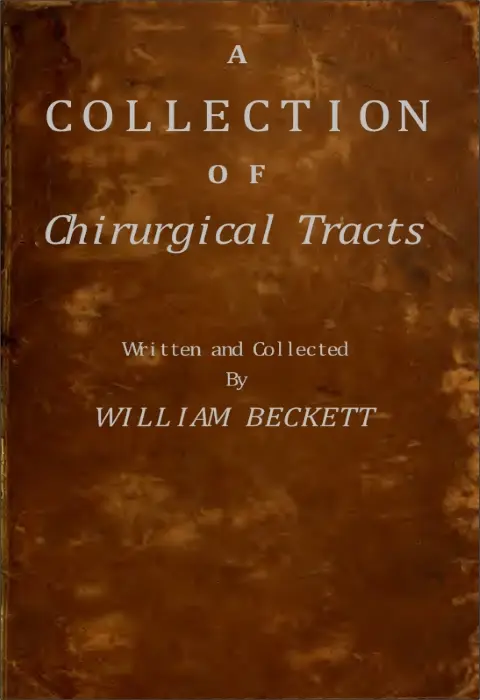
"A Collection of Chirurgical Tracts" by William Beckett is a scientific publication written in the early 18th century. The work consists of various tracts that explore surgical practices and medical discoveries, focusing on topics such as wounds, cancers, and the history of venereal diseases. This compilation aims to present and reflect on Beckett's contributions to the field of surgery based on his extensive experience and observations. The opening of the text introduces readers to William Beckett's life and his notable accomplishments as a surgeon and member of the Royal Society. It outlines his intention to compile various previously published chirurgical pieces into a single collection as a means of documentation and contribution to medical literature. The start of the text also hints at the organization of the subsequent tracts, including discussions on wounds of the head and brain, cancer treatments, and the history of venereal diseases, laying the groundwork for a serious academic exploration of the surgical field in his time.
Introduction adapted from the source catalogue; source summaries may be automatically generated.
Free to read · English · 61,089 words · No account needed
MAKE TIME FOR A GOOD BOOK
On by default. Untick to stop anonymous reading totals. Each page counts after 10 seconds in view. How this works.
Anonymous counting is on unless you have switched it off.
Perhaps, Sir, here you may object, that it is acting disengenuously, and not like a Friend, to give you an Account of those Persons only where I have succeeded. To this I answer, that excepting one Woman, that was emaciated almost to the last Degree by the excessive Discharge of a fætid Icorous Matter from her Breast, and an Abscess under her Arm, and who was carried off by a violent Loosness, I never had a Person miscarried under my Care, where I proposed a Cure. That poor Woman I suffered my self to be persuaded to take care of, having but little Prospect of effecting it, yet my Endeavours succeeded so well, that had it been in our Power to put a Stop to her Loosness, I am of opinion she might have been cured.
What has been hitherto said, I do not question but is sufficient to satisfy you, that this formidable Disease is not so rebellious, but that it may be sometimes conquered by Art; and I might here relate a Case I have at this present Writing, wherein not only a Part of the Cancer was fixed, but there were hard Cancerous Knots extended to the Arm-pit; and yet this seems to be almost well; the Ulcer that remains, and which heals daily, not being much broader than a Crown Piece. But in regard the Patient is not entirely cured, I shall reserve this Relation untill another Opportunity; though I will embrace the present to assure you that I am,
_Your very respectful Brother,
and Humble Servant,_
W^m. Beckett.
Hatton-Garden,
July 12, 1711.
A Solution of some Curious Problems concerning Cancers.
Whether the Cancerous Juice is Corrosive, or not.
[Sidenote: Vide Riolanus, Cap. 13. Sect. 2.] We cannot come to a certain Knowledge of the Principles of the Juice which is lodged in the Cancerous Substance, although it enjoyed the very same Properties, of that which is discharged from an ulcerated Cancer, from the Account which Authors have given of the latter; for they have differed very much in determining the Nature of the Salts, with which they suppose it abounds. Helmont, Van Horne, and most of those Gentlemen that were Chymically inclined, were of Opinion they belonged to the Alkaline Family, but a far greater Number than those, have thought they are Acid. Riolan, the Father, in his Chirurgical Works, without giving his Opinion what the constituent Parts of the purulent Matter are, affirmed it to be as strong as Poison, and that no Death could be devised too cruel for such a One as should give it to a Man. This brings to my Remembrance a very unhappy Accident a Gentleman informed me of that befel Mr Smith, one of the Surgeons of St Thomas’s Hospital, who being so curious as to taste the Juice of a cancerated Breast presently after it was extirpated, found himself very strangely affected by it, in a very short Time; he washed his Mouth with various Things, but nothing could free him from that penetrating, malignant, and nauseous Savour, he was continually attended with; in short, he became consumptive, and in a few Months died a Martyr to the Art of Surgery. I confess when I received this Account it did not a little surprize me, because I had several times had the Curiosity to do the very same Thing, at the Hospital where that unfortunate Genman made the Experiment. I never found any remarkable Sharpness in it, though it was always attended with a very unpleasant Savour. I proceeded at first very cautiously in making this Attempt; for I deluted some Drops of the Juice in several Spoons-full of fair Water, till at length, not finding any Inconvenience from it, I came to the Juice it self. We cannot imagine the Death of that Gentleman before-mentioned, was procured by the Action of any corrosive Salts, whether Acid or Alkaline, which would have caused a Corrosion of the Parts, but that it is only accountable from the extraordinary Stench and Malignity of the Matter, which impressing its Virulency on the Animal Juices must undoubtedly disturb their regular Motions, and cause the utmost Confusion of the whole Oeconomy. It must certainly be a very tragical Scene, to observe how Nature, by so inconsiderale Means, confounds and insults, over the Animal System; but still there is nothing we are more certain of, than that her Method of Procedure is always consistent to the Rules she acts by. Since the writing of this, looking over a little Tract which informs us of the Rarities in New-England, I met with a Relation which discovers to us the peculiar and odd Quality of the Juice of a cancerated Breast, or Wolf, as our Author calls it. He tells us that an indulgent Husband, by sucking his Wife’s sore Breast to draw out the Poison, lost all his Teeth, but was attended by no other Inconvenience. Now this does not prove that so strange an Effect should succeed the sucking the Ulcer, because of the Corrosiveness of the Matter; for had it been so, such tender Parts as the Gums, Lips, and Tongue, could not have escaped so well as to have received no Damage by it.
Your reading position is saved on this browser. Take it to another device with a library code. Reading pages adapt to text, rather than matching a printed edition.
BEHIND THE BOOK
This eBook is for the use of anyone anywhere in the United States and most other parts of the world at no cost and with almost no restrictions whatsoever. You may copy it, give it away or re-use it under the terms of the Project Gutenberg License included with this eBook or online at www.gutenberg.org. If you are not located in the United States, you will have to check the laws of the country where you are located before using this eBook. Read the source licence.
The original source file, including credits and licence, is retained by this library. Request an original-format copy at no charge. Please include the book title and Project Gutenberg identifier #52993.
KEEP YOUR CURIOSITY GOING
Charles G. (Charles Griffith) Ross
Hannah Webster Foster

Emily Lawless
Edwin Hamlin Carr

Charles De Lano Hine
Andrew Ure