
The Writing of News A Handbook with Chapters on Newspaper Correspondence and Copy Reading
Charles G. (Charles Griffith) Ross
THE CLASSIC COLLECTION · 1740
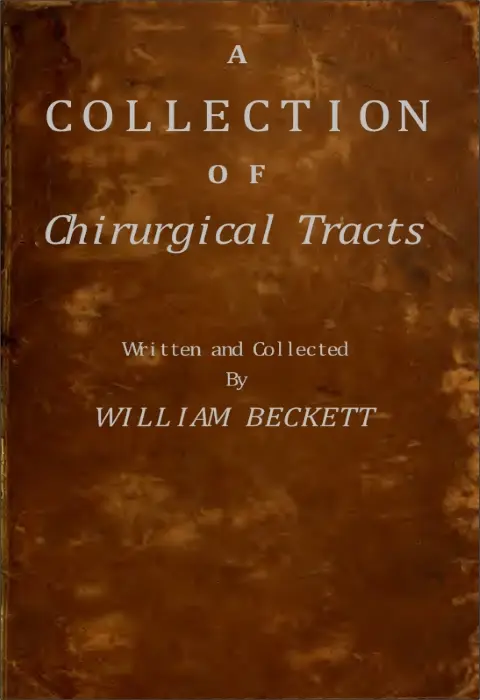
"A Collection of Chirurgical Tracts" by William Beckett is a scientific publication written in the early 18th century. The work consists of various tracts that explore surgical practices and medical discoveries, focusing on topics such as wounds, cancers, and the history of venereal diseases. This compilation aims to present and reflect on Beckett's contributions to the field of surgery based on his extensive experience and observations. The opening of the text introduces readers to William Beckett's life and his notable accomplishments as a surgeon and member of the Royal Society. It outlines his intention to compile various previously published chirurgical pieces into a single collection as a means of documentation and contribution to medical literature. The start of the text also hints at the organization of the subsequent tracts, including discussions on wounds of the head and brain, cancer treatments, and the history of venereal diseases, laying the groundwork for a serious academic exploration of the surgical field in his time.
Introduction adapted from the source catalogue; source summaries may be automatically generated.
Free to read · English · 61,089 words · No account needed
MAKE TIME FOR A GOOD BOOK
On by default. Untick to stop anonymous reading totals. Each page counts after 10 seconds in view. How this works.
Anonymous counting is on unless you have switched it off.
I have in my former Letters, to Dr. DOUGLASS, sufficiently I think proved that the first Degree of the Venereal Disease was very common among us some hundreds of Years before it is commonly said to have been known in Europe; there will be no Reason for any body to conceive we were at that time in any measure Strangers to it, when it came to be confirmed; more especially, when we consider the Methods of Treatment in those Times, which consisting principally in topical Applications, many of their Patients could not possibly escape having it confirmed on them. Now when it was in this confirmed State, the Writers of those early times looked upon it as an entirely new Disease, and not a Consequent of any Evil before contracted, because they were not apprised, that the first Symptoms being removed, and the Disease to Appearance cured, it should afterwards discover it self in such a manner, as should not seem to have the least Analogy with the Symptoms, that first attack’d a part which had been for a considerable time free from any Misfortune. But because the Symptoms are the only true Characteristicks, whereby we are infallibly able to know one Disease from another, it may be expected, that I produce sufficient Authorities to demonstrate they were all of them known and described by ancient Physical and Chirurgical Writers, just as they appear to be in the Venereal Disease at this Day, if I would prove that Disease to be of a much more ancient Date, than is generally thought; and if I do this, I cannot but think it will be satisfactory, since we can have no other way of coming to a Knowledge of any one Distemper, than by its Symptoms. The Method of laying down the exact Succession of them, will be impossible to be reduced to any certain and infallible Rule, there being so great a Variety of Causes, that obstruct such a Regularity; for which Reason, I shall take notice of them in such Order as they most generally appear, which was upon no account to be expected from our antient Writers, insomuch as they mention every particular Symptom by it self, not knowing but that they were independent of each other, and that each of them was a distinct Disease. However, the proving these Symptoms were in being in these early times, will be as strong an Argument to prove the Antiquity of this Distemper, as if they had been register’d in the most exact Order of Succession, because we shall, upon the strictest Examination, find they are peculiar to the Venereal Malady only. I have, I hope, sufficiently made it appear in my former Letter, that the first Degree of this Disease was anciently known among us by the name of Brening, or Burning; and that it was the same Thing with what we now call a Clap, The Symptoms, which are usually its Concomitants, are the Phymosis, and Parahphymosis, both which are accurately described, and proper Remedies, for them set down by John Arden, Esq; in another Manuscript of his, curiously written upon Vellum, and beautifully illuminated. The imprudent Method of Cure of this first Degree of the Venereal Malady, is sometimes attended with a Caruncle in the Urethra, which was a Disease very common among us anciently: For not to mention other early writers, Arden gives us the Case of a certain Rector, who had such a Substance, like a Wart, growing in the Penis, which he says frequently happens, and of another which had such an Excrescence as big as a small Strawberry, which (says he) proceeded from the corrupted Matter remaining in the Urethra. And indeed there is not any Symptom of the Venereal Disease, that I find so often mentioned as this of the Caruncle, insomuch that it seems to have been more common in those early Times, than at this Day. But this must be certainly owing to the smooth and oily Remedies they were continually injecting, which, by their relaxing and softning the Fibres of the Part, must necessarily dispose the Contexture of small Blood Vessels, lodged at the bottom of the little Ulcerations, to fill with nutritious Juices, and to extend themselves so, as to form such fungous Excrescences; and so solicitous were they for removing these Inconveniences, that they made use of several Ways by Corrosives and other Methods, to accomplish this end; and a very early Writer among us, has given a very methodical and curious Tract on this Subject, wherein he recommends the removing them by the medicated-Candle, which we use at this Day, and lays down divers other Instructions, in relation to it, which makes it probably the best Discourse on this Subject, that was ever yet written. He takes notice of those contumacious-Ulcers, which happen upon the Glans and the neighbouring Parts, which we now call Shankers; and the great Trouble our ancient Authors found in attempting their Cure, sufficiently discover them to have had their Original from a Venereal Infection. These several Symptoms of the Venereal-Malady our early Writers are very full in their Accounts of, and others, when the Disease was in a more confirmed State, to which they appropriated particular Names, perhaps more significant and expressive than those imposed by modern Authors. Thus the Buboes in the Groin they called Dorsers, which I have given a Reason for before; and the Venereal-Nodes on the Shin-Bones they termed the Boon-haw, which gives us a perfect Idea, not only of the Part affected, but after what manner it was diseased; for the old English Word Hawe, signified a Swelling of any Part. Thus for instance, a little Swelling upon the Cornea, was anciently called the Hawe in the Eye; and the Swelling that frequently happens on the Finger, on one side the Nail, was called the White-Hawe, and afterwards Whitflaw. The Process this Author recommends, for the Cure of the Boon or Bone-Hawe, is by making use of a Plaister, which had a Hole cut in the midst, to circumscribe it; and applying a Caustic of unslacked Lime, and black Soap incorporated together; which Plaister and Bandage were to be secured on the part 4 Hours, and longer, if that was not found sufficient: After this he proceeds to the separating the Slough, &c. This Practice of his seems to have been found out by accident. For he tells us, when he was a young Practitioner, he having applyed both the Natural and Artificial Arsenic to the Leg of a Man, who was his Patient, it so mortified the Flesh, as surprized him; but by proper Digestives, the Eschar coming off, and leaving the Bone bare, he scraped it with an Instrument for several Days, and drest it with Incarnatives, designing to have ingendred Flesh on it; but this proving unsuccessful, he continued to scrape it, till he observed it move under the Instrument; after which having separated it, he found the Sore covered with new Flesh, and that the Bone was 4 Inches in length, 2 in breadth, and very thick, upon the Removal of which the Patient was soon cured. Thus it’s probable this Observation of this great Man led our Predecessors to practice the very same Method; and we do at this Day in our Hospitals treat the Venereal Nodes on the Shins exactly as is here described, where we observe the same Appearances, he so long before took notice of; and it is not in the least to be doubted, but the Boon-Haw and our Venereal Nodes are the same Disease. By the Appearance of some of the last of these Symptoms, we infallibly judge the Patient has had the Infection upon him a considerable time, and that the Disease is making its gradual Advances, to the corrupting and destroying the whole Frame of the Body. That this was the Conclusion of the Miseries of those Persons, who gave themselves up to the deceitful-Delights and Entertainments of lewd-Women, in those early-times as well as now, I cannot better prove than by those remarkable Instances you quoted from a MS. in Lincoln-Colledge, in Oxon, Viz. Novi enim ego Magister Thomas Gascoigne, licet indignus sacræ Theologiæ Doctor, qui hæc scripsi & collegi, diversos viros, qui mortui fuerunt ex putrefactione membrorum suorum genitalium & corporis sui; quœ corruptio & putrefactio, ut ipsi dixerunt, causata fuit per exercitium copulæ carnalis cum mulieribus. Magnus enim dux in Anglia, scil. J. de Gaunt, mortuus est ex tali putrefactione membrorum genitalium, & corporis sui, causatâ per frequentationem mulierum. Magnus enim fornicator fuit, ut in toto Regno Angliæ divulgabatur, & ante mortem suam jacens sic infirmus in lecto, eandem putrefactionem Regi; Angliæ Ricardo secundo ostendit, cum idem Rex eundem Ducem in suâ infirmitate visitavit; & dixit mihi qui ista novit unus fidelis sacræ Theologiæ Baccalaureus. Willus etiam longe vir maturæ ætatis & de civitat. Londonii, mortuus est ex tali putrefactione membrorum suorum genitalium, & corporis sui, causatâ per copulam carnalem cum Mulieribus, ut ipsemet pluries confessus est ante mortem suam, quum manu sua propria eleemosynas distribuit, ut ego novi, anno Dni. 1430. Now what those Instances mentioned from Arden, or these from Gascoigne, who was then Chancellor of Oxford, could possibly be, but Venereal-Cases, I would be obliged to any body to inform me. Certain it is, no Disease was ever known to be gotten by the carnal Conversation of Women, which first attacked the Genitals, causing a Corruption and Putrefaction of them, and afterward of the whole Frame of the Body, but that which is Venereal. For nothing is more commonly known at this Day, than that after the Venereal-Engagement with an impure Woman, the Penis is the Part where the Scene is first laid for the succeeding Tragical Appearances; and there, and in the Neighbouring Parts, do the Symptoms of the Disease, as its Retainers, always first assemble, till the malignant Poison taint the Blood and other Juices; which being convey’d over the whole Frame of the human Fabric, if not check’d, soon brings about its total Corruption.
Your reading position is saved on this browser. Take it to another device with a library code. Reading pages adapt to text, rather than matching a printed edition.
BEHIND THE BOOK
This eBook is for the use of anyone anywhere in the United States and most other parts of the world at no cost and with almost no restrictions whatsoever. You may copy it, give it away or re-use it under the terms of the Project Gutenberg License included with this eBook or online at www.gutenberg.org. If you are not located in the United States, you will have to check the laws of the country where you are located before using this eBook. Read the source licence.
The original source file, including credits and licence, is retained by this library. Request an original-format copy at no charge. Please include the book title and Project Gutenberg identifier #52993.
KEEP YOUR CURIOSITY GOING
Charles G. (Charles Griffith) Ross
Hannah Webster Foster

Emily Lawless
Edwin Hamlin Carr

Charles De Lano Hine
Andrew Ure