
The Writing of News A Handbook with Chapters on Newspaper Correspondence and Copy Reading
Charles G. (Charles Griffith) Ross
THE CLASSIC COLLECTION · 1740
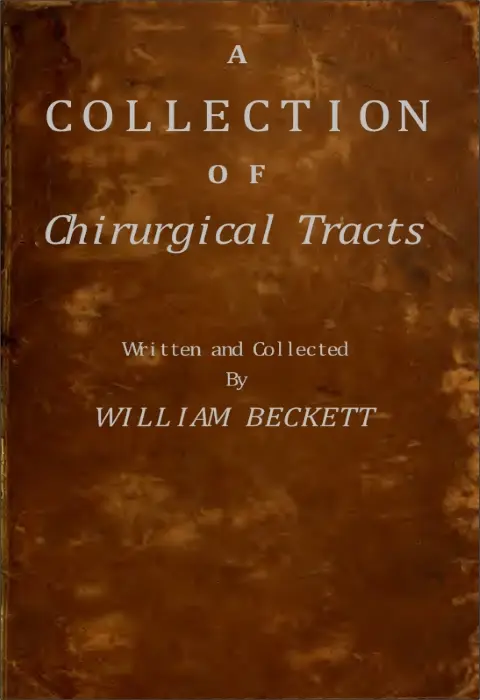
"A Collection of Chirurgical Tracts" by William Beckett is a scientific publication written in the early 18th century. The work consists of various tracts that explore surgical practices and medical discoveries, focusing on topics such as wounds, cancers, and the history of venereal diseases. This compilation aims to present and reflect on Beckett's contributions to the field of surgery based on his extensive experience and observations. The opening of the text introduces readers to William Beckett's life and his notable accomplishments as a surgeon and member of the Royal Society. It outlines his intention to compile various previously published chirurgical pieces into a single collection as a means of documentation and contribution to medical literature. The start of the text also hints at the organization of the subsequent tracts, including discussions on wounds of the head and brain, cancer treatments, and the history of venereal diseases, laying the groundwork for a serious academic exploration of the surgical field in his time.
Introduction adapted from the source catalogue; source summaries may be automatically generated.
Free to read · English · 61,089 words · No account needed
MAKE TIME FOR A GOOD BOOK
On by default. Untick to stop anonymous reading totals. Each page counts after 10 seconds in view. How this works.
Anonymous counting is on unless you have switched it off.
RICHARD RAWLINSON, L. L. D. and R. S. S. in his Account of Southwark,[11] informs us, that next to the Bear-Garden on the Bank-Side was formerly the BORDELLO, or STEWES, so called from several Licensed Houses for the Entertainment of Lewd Persons, in which were Women prepared for all Comers. They were subject to several Laws and Regulations, and their Manner of Life and Privileged Places, received several Confirmations from the Crown.
[11] See Aubrey’s Natural History and Antiquities of Surrey,
8vo. Vol. v. p. 221.
In 1162, King Henry II, in a Parliament held at Westminster, passed an Act, confirming several Ordinances, Statutes, and old Customs observed in that Place, amongst which the following are remarkable:
That no Stew-Holder or his Wife, should lett or stay any single Woman to go and come freely at all Times when she listed.
No Stewholder to keep any Woman to board, but she to board abroad at
her Pleasure.
To take no more for the Woman’s Chamber than fourteen Pence.
Not to keep open his Doors upon the Holy-days.
Not to keep any single Woman in his House on the Holy-days, but the Bailiff to see them voided out of the Lordship.
No single Woman to be kept against her Will, that would leave her Sin.
No Stew-Holder to receive any Woman of Religion, or any Mans Wife.
No single Woman to take Money to lie with any Man, except she lye with him all Night, till the Morrow.
No Man to be drawn or enticed into any Stew-House.
The Constables, Bailiffs, and others, were every Week to search
every Stew-House.
No Stew-Holder to keep any Woman that hath the perillous Infirmity of Burning, nor to sell Bread, Ale, Flesh, Fish, Wood, Coal, or any sort of Victuals.
Anno 1345, Stews were licenced by King Edward III. Anno 1381, these Stew-Houses belonged to William Walworth, Lord-Mayor of London, who let them out to some Flemish Women, and soon after they were plundered by Walter Tyler, and the rebellious Kentishmen, when probably they were put down, and again suffered, and afterwards confirmed by Henry VI. In 1506, King Henry VII. for some Time shut up these Houses, which were in Number Eighteen, and not long after renewed their Licence, and reduced them to Twelve; at which Number they continued till their final Suppression by Sound of Trumpet, in 1546, by King Henry VIII, whose tender Conscience startled at such scandalous and open Lewdness. The single Women who were Retainers to, or Inmates in, these Houses, were excommunicated, not suffered to enter the Church while alive, or if not reconciled before their Death, prohibited Christian Burial, and were interred in a Piece of Ground called the Single-Women’s Church-Yard, set a-part for their Use only. These Houses were distinguished by several Signs painted on their Fronts, as, a Boar’s-Head, the Crane, the Cardinal’s Hat, the Swan, the Bell, the Castle, the Cross-Keys, and the Gun.
Your reading position is saved on this browser. Take it to another device with a library code. Reading pages adapt to text, rather than matching a printed edition.
BEHIND THE BOOK
This eBook is for the use of anyone anywhere in the United States and most other parts of the world at no cost and with almost no restrictions whatsoever. You may copy it, give it away or re-use it under the terms of the Project Gutenberg License included with this eBook or online at www.gutenberg.org. If you are not located in the United States, you will have to check the laws of the country where you are located before using this eBook. Read the source licence.
The original source file, including credits and licence, is retained by this library. Request an original-format copy at no charge. Please include the book title and Project Gutenberg identifier #52993.
KEEP YOUR CURIOSITY GOING
Charles G. (Charles Griffith) Ross
Hannah Webster Foster

Emily Lawless
Edwin Hamlin Carr

Charles De Lano Hine
Andrew Ure