THE CLASSIC COLLECTION✦An outlaw’s diary: the CommuneCLASSIC FREE BOOKS
An outlaw’s diary: the Commune
Cécile Tormay
THE CLASSIC COLLECTION · 1890
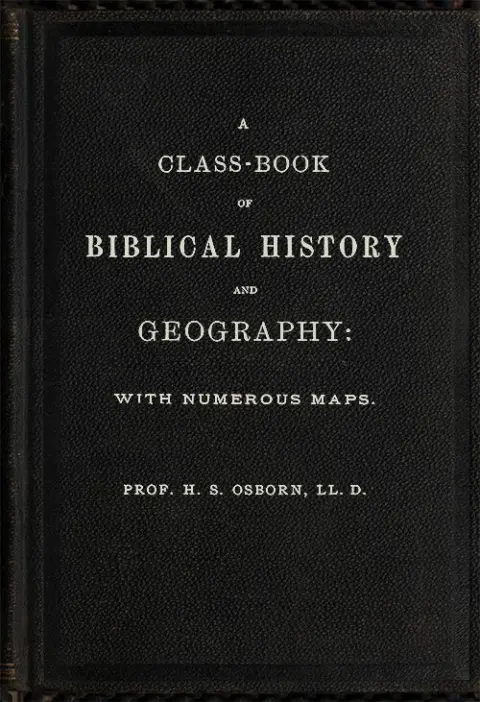
"A Class-Book of Biblical History and Geography" by H. S. Osborn is an educational text that presents a structured historical account of the Bible, focusing on both the Old and New Testaments, and was written in the late 19th century. This work aims to provide a comprehensive overview of biblical events through a historical lens, including the significant periods of Jewish history that bridge the timeframe from the Old Testament's conclusion to the advent of the New Testament. The book also incorporates geographical insights, with maps intended to enhance the reader's understanding of the events discussed. The opening of this class-book begins with a preface outlining its objectives and structure, emphasizing a historical approach devoid of speculative opinions. It introduces the initial chapters by summarizing biblical accounts such as the Creation, the Garden of Eden, and the early generations of humanity, including significant lineage details that contribute to understanding biblical narratives. Moreover, it details the chronological framework utilized to analyze Biblical events and introduces the notion that names and their meanings are crucial for grasping the scriptural context. The narrative is designed to guide readers—especially educators and students—through biblical history in a clear and engaging manner, setting the stage for a deeper exploration of the text's historical richness.
Introduction adapted from the source catalogue; source summaries may be automatically generated.
Free to read · English · 67,754 words · No account needed
MAKE TIME FOR A GOOD BOOK
On by default. Untick to stop anonymous reading totals. Each page counts after 10 seconds in view. How this works.
Anonymous counting is on unless you have switched it off.
158 – See the full references and statements in Maclear’s “New Testament History,” p. 134. Merivale shows that Cyrenius was twice governor of Syria, and the Greek word πρώτη may refer to the first time, or the enrolment. See also Bloomfield’s “Notes on the New Testament,” Luke 2. “The whole world” is a term frequently used when only all that land and no more was meant. Thus in 2 Sam. 24:8, in the Hebrew, “the whole world” meant, evidently, the whole of that land only. So in Acts 11:28; 17:6; the phrase was used in either way as including only the entire Syria or Judæa to a Jew, or, to a Roman citizen, it was the Roman Empire.
159 – Gen. 49:10.
160 – As shown in Prideaux’s “Connection.”
161 – This place was then in Gaul, now called France.
162 – “Wars of the Jews,” VI., §9:3.
163 – Bloomfield, John 2:14, note.
164 – Herod Antipas, son of Herod the Great by Malthace. See the
Table, p. 229.
165 – Bloomfield, Notes in Matt. 9:9.
166 – Quarterly Statement of the Palestine Exploration.
167 – Died A. D. 420.
168 – Murray’s “Handbook,” 1875, p. 408.
169 – Baedeker’s “Palestine and Syria,” p. 374.
170 – Merrill, “Galilee in the time of Christ,” p. 48.
171 – Herodotus, 3:20, and Athen., p. 268.
172 – Bloomfield, “Notes,” Matt. 26:7.
173 – Idyll 15, line 114; Parkhurst, Lex., 5; Bloomfield,
Luke 8:1.
174 – Josephus, “Antiquities,” XVII., 2:2.
175 – Ellicott, 333, in Maclear’s “Class Book of the New
Testament,” p. 149.
176 – Prideaux, “Connection,” II., 9, p. 379.
177 – “Antiquities,” XVIII., 3:2.
178 – Pausanias, V., 12:12, in Bloomfield’s “Notes,” Matt. 27:51.
179 – As mentioned, “Iliad,” III., l. 315, 316, etc. “Iliad,” VII., l. 175, 176, etc.
180 – Conybeare and Howson’s, “Life and Travels of St. Paul,”
CXIV.
181 – John 21:2, 3.
182 – Sebaste being the Greek form of the word Augustus.
183 – Acts 6:5.
184 – Baedeker, p. 317.
185 – Josephus’ “Antiquities,” XIX., 1:11, and Maclear’s “New Testament History,” p. 394.
186 – These cohorts are mentioned by Arrian; see authority in Bloomfield’s “Notes,” Acts 10:1.
187 – Maclear, “New Testament History,” p. 403, note.
188 – Tac., “Ann.,” 12:13; Josephus, “Antiquities,” III., 15:3; XX., 2:5. The famine here foretold took place in Judæa A. D. 44, in the fourth year of Claudius. Josephus, “Antiquities,” XIX., 7:2.
189 – Merivale, VI., 116, 117. Cassius Longinus was now appointed, A. D. 44, to the presidency of Syria, and Cuspius Fadus was appointed governor of Judæa, Josephus, “Antiquities,” XIX., 9:2; XX., 1:1. See Maclear, “New Testament History,” p. 409.
190 – For authorities and more minute description see Conder’s “Handbook to the Bible,” p. 301, seq. For Galilee see Merrill’s “Galilee in the time of Christ.”
191 – Lightfoot “On the Galatians,” p. 285. Maclear, “New Testament History,” p. 40.
192 – There was a remarkable influx of Oriental sorcerers, astrologers, and soothsayers at this time into Rome and other cities, as Conybeare and Howson show, Vol. I., p. 141.
193 – Walpole, “Travels in the East,” p. 222.
194 – Conybeare and Howson place Adana and Ægæ on the course, but Adana is thought to have been planted by Justinian, and Ægæ if at Aias, 35 miles southeast of Adana on the coast, was too far out of the way.
Your reading position is saved on this browser. Take it to another device with a library code. Reading pages adapt to text, rather than matching a printed edition.
BEHIND THE BOOK
This eBook is for the use of anyone anywhere in the United States and most other parts of the world at no cost and with almost no restrictions whatsoever. You may copy it, give it away or re-use it under the terms of the Project Gutenberg License included with this eBook or online at www.gutenberg.org. If you are not located in the United States, you will have to check the laws of the country where you are located before using this eBook. Read the source licence.
The original source file, including credits and licence, is retained by this library. Request an original-format copy at no charge. Please include the book title and Project Gutenberg identifier #56019.
KEEP YOUR CURIOSITY GOING
Cécile Tormay

Moritz Busch
John L. Ransom
Frances Wright
Cécile Tormay

Mabel Potter Daggett