THE CLASSIC COLLECTION✦An outlaw’s diary: the CommuneCLASSIC FREE BOOKS
An outlaw’s diary: the Commune
Cécile Tormay
THE CLASSIC COLLECTION · 1584
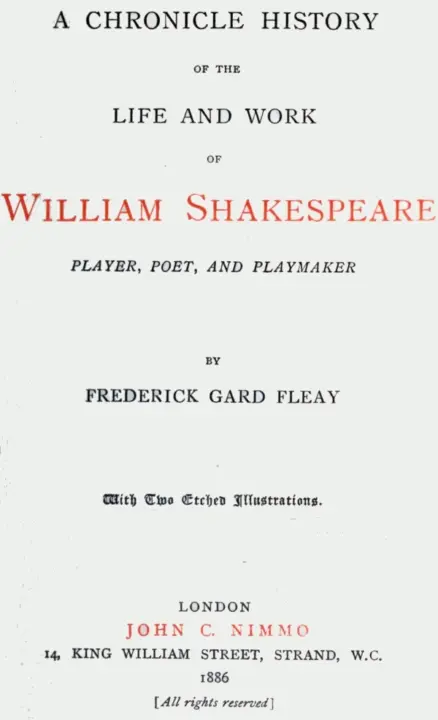
"A Chronicle History of the Life and Work of William Shakespeare" by Frederick Gard Fleay is a historical account written in the late 19th century. This work delves into the life and career of the iconic playwright William Shakespeare, examining his public and personal connections with other poets and dramatists of his time. Fleay not only recounts Shakespeare's biographical details but also analyzes the significant influence he had on English literature. The opening of the text sets the tone for a comprehensive examination of Shakespeare's career, emphasizing the importance of understanding his interactions with other figures in the theatrical community. Fleay critiques previous biographers for focusing excessively on trivial aspects of Shakespeare's personal life and instead aims to highlight the public dimensions of his career, such as the nature of the acting companies he was part of and the chronological order of his plays. The thorough introduction serves as a foundation for the detailed exploration of Shakespeare's life and work that unfolds in the subsequent sections of the book.
Introduction adapted from the source catalogue; source summaries may be automatically generated.
Free to read · English · 76,096 words · No account needed
MAKE TIME FOR A GOOD BOOK
On by default. Untick to stop anonymous reading totals. Each page counts after 10 seconds in view. How this works.
Anonymous counting is on unless you have switched it off.
2 Henry VI.--This play exists in two forms: one in the 1623 Folio, hereafter for convenience called F.; the other in Quarto, entered S. R. 12th March 1594, hereafter called Q. It was published in 1594 as The First part of the Contention betwixt the two Famous Houses of York and Lancaster. This Quarto version is a mangled and probably surreptitious copy of the original play, greatly abbreviated for acting. The play as first written will be hereafter called O. But F. and O. are not identical, although in many parts O. was more like F. than Q. It will be convenient to enter on the proof that O. was revised and altered before beginning the discussion of the authorship of either version, which is the most difficult, if not the most important, problem in Shakespearian criticism.
In the Folio of 1623 a list is given of the principal actors in Shakespeare's plays. The method in which this list is arranged has never been pointed out. It is chronological. The first ten names are those of the original men actors when the Chamberlain's company was instituted in 1594; the next five were added not later than 1603; the next five (excepting Field, who is inserted here from his early connection with Underwood and Ostler) c. 1610; the final six after 1617. By a comparison of this list with the names of the actors in The Seven Deadly Sins, originally acted before 1588, but the extant plot of which dates c. 1594, we shall get the evidence we want. The first seven names in the Folio list are (1.) W. Shakespeare, (2.) R. Burbadge, (3.) J. Hemmings, (4.) A. Phillips, (5.) W. Kempe, (6.) J. Pope, (7.) G. Bryan. The last five of these we know to have been members of Lord Strange's company in 1593. In the 7. D. S. we find neither Shakespeare nor Hemmings; but we do find (2.) R. Burbadge, (4.) Mr. Phillips, (5.) Will Foole, (6.) Mr. Pope, (7.) Mr. Bryan. It will be noticed that the prefix Mr. is confined to members of Lord Strange's company. Next in the Folio list come (8.) Henry Condell, (9.) William Sly, (10.) Richard Cowley. These appear in 7. D. S. as (8.) Harry, (9.) W. Sly, (10.) R. Cowley. At this point we are struck with the fact that Harry, Will, and Dick are names of three Cade conspirators in Q., and naturally try to see if the other names, Nick, Jack, Robin, Tom, and George, occur in 7. D. S. For it is certain that in very early plays up to the end of the sixteenth century it was frequently the case that the actors in plays are designated by their proper christian names. We do find (11.) Nick (i.e., Nicholas Tooley, a boy-actor in 1597, but a man c. 1610 in the Folio of 1623), (12.) John Duke, (13.) Robert Pallant, (14.) Thomas Goodall; but George, i.e., G. Peele, is not there discoverable. I may notice that Duke and Pallant, like Beeston, all three of whom left the Chamberlain's men for the Earl of Derby's in 1599, are excluded from the Folio list. On turning to another play, Sir Thomas More, c. 1596, the only other one that can give us similar information on the same scale, I find (8.) Harry, (13.) Robin, (14.) T. Goodall, (15.) Kit (i.e., Christopher Beeston), and two boys, (16.) Ned and (17.) a second Robin, i.e., Robert Gough, who occurs in the Folio list as a man c. 1617. In the 7. D. S. these latter correspond to (15.) Kitt, (16.) Ned, (17.) R. Go. In Sir T. More there are two other names of this kind, Giles and Rafe. Of Giles nothing more is known, but Rafe Raye is mentioned in Henslowe's Diary as a Chamberlain's man in 1594. A further examination of older plays leads to little additional information; but what is to be found all confirms the opinion that I had formed (as will be seen), on other grounds, that 2 Henry VI. was written for the Queen's men. Thus in plays known to have belonged to that company, I find in The Famous Victories, (12.) John, (13.) Robin, (14.) Tom, (16.) Ned and Lawrence; in Orlando, (14.) Tom and Rafe (Raye); in Friar Bacon, (10.) Dick, (14.) Tom; and in James IV., Andrew. There is no Andrew in our lists, but one occurs in Much Ado About Nothing, iv. 2, 1597-8, in place of Kempe: apparently a remnant of the older form of Love's Labour's Won before Kempe undertook the part. But our list of the 7. D. S. is not yet exhausted: (18.) Sander (a boy-player, but the same as Alexander Cooke, a man in 1603 in the Folio list), (19.) T. Belt, and (20.) Will (another boy), occur in The Taming of a Shrew, 1588. Of (21.) Vincent, nothing is known; but (22.) J. Sinkler acted with Gabriel (Spenser) and Humfrey (Jeffes) in 3 Henry VI., which belonged to Pembroke's company. Now as the last two, with Antony Jeffes and Robert Shaw, appear in Henslowe's Diary for the first time immediately after the partial breaking up of Pembroke's company and their juncture with the Admiral's in October 1597, it is morally certain that Sinkler had gone to the Chamberlain's, and Spenser Shaw and the two Jeffes to the Admiral's, at or before that date. I feel, therefore, justified in concluding that the 7. D. S. gives us a nearly complete list of the Chamberlain's actors, formed of Lord Strange's players as a nucleus; such of the Queen's men as joined them in 1591-2, when they obtained many Queen's plays (see p. 108), and such of Pembroke's as joined them in 1594, when they obtained Pembroke's plays (see p. 21). I have omitted only one name, and the absolute coincidence of nearly every one of the rest with the lists obtained from other sources is too remarkable to be the mere effect of accident: in fact, the chances are many millions to one against this being the case. The one name omitted is (23.) John Holland. This name occurs nowhere else to my knowledge, but in the 7. D. S. plot and 2 Henry VI., Act iv. in the Folio, where he replaces Nick of the Quarto. There can be no doubt of this being an actor's name; and its occurrence shows at once that the Cade part of the play was revised, and that the revision was probably made after 1594. Had it been earlier, there would have been two Johns in the company, Duke and Holland, and Duke would not have been called simply Jack.
Your reading position is saved on this browser. Take it to another device with a library code. Reading pages adapt to text, rather than matching a printed edition.
BEHIND THE BOOK
This eBook is for the use of anyone anywhere in the United States and most other parts of the world at no cost and with almost no restrictions whatsoever. You may copy it, give it away or re-use it under the terms of the Project Gutenberg License included with this eBook or online at www.gutenberg.org. If you are not located in the United States, you will have to check the laws of the country where you are located before using this eBook. Read the source licence.
The original source file, including credits and licence, is retained by this library. Request an original-format copy at no charge. Please include the book title and Project Gutenberg identifier #46756.
KEEP YOUR CURIOSITY GOING
Cécile Tormay

Moritz Busch
John L. Ransom
Frances Wright
Cécile Tormay

Mabel Potter Daggett