THE CLASSIC COLLECTION✦An outlaw’s diary: the CommuneCLASSIC FREE BOOKS
An outlaw’s diary: the Commune
Cécile Tormay
THE CLASSIC COLLECTION · 1584
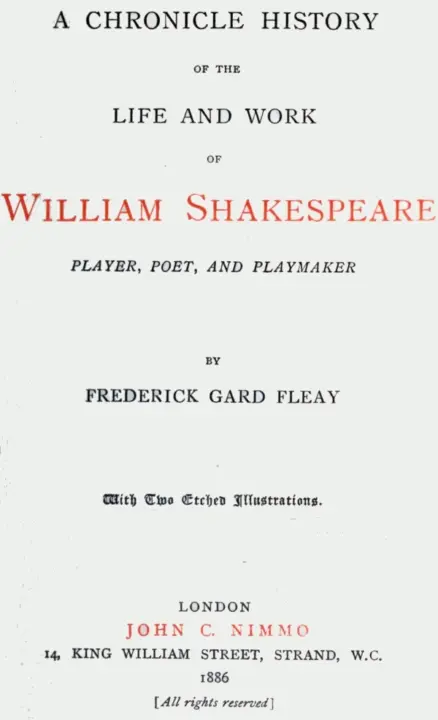
"A Chronicle History of the Life and Work of William Shakespeare" by Frederick Gard Fleay is a historical account written in the late 19th century. This work delves into the life and career of the iconic playwright William Shakespeare, examining his public and personal connections with other poets and dramatists of his time. Fleay not only recounts Shakespeare's biographical details but also analyzes the significant influence he had on English literature. The opening of the text sets the tone for a comprehensive examination of Shakespeare's career, emphasizing the importance of understanding his interactions with other figures in the theatrical community. Fleay critiques previous biographers for focusing excessively on trivial aspects of Shakespeare's personal life and instead aims to highlight the public dimensions of his career, such as the nature of the acting companies he was part of and the chronological order of his plays. The thorough introduction serves as a foundation for the detailed exploration of Shakespeare's life and work that unfolds in the subsequent sections of the book.
Introduction adapted from the source catalogue; source summaries may be automatically generated.
Free to read · English · 76,096 words · No account needed
MAKE TIME FOR A GOOD BOOK
On by default. Untick to stop anonymous reading totals. Each page counts after 10 seconds in view. How this works.
Anonymous counting is on unless you have switched it off.
Macbeth, as we have it, is abridged for the stage in an unusual degree. Nevertheless it contains one scene, iii. 5, and a few lines, iv. i. 39-43, which are not by Shakespeare. The character of Hecate, and the songs in these passages (Black spirits and white, and Come away), are from Middleton's Witch, acted 1621-22. The insertions in Macbeth must have been made in 1622; they were probably merely intended to introduce a little singing and music then popular; and music has ever since been an essential ingredient in the stage representations. Omitting these forty lines, we have ample evidence of the date of the play as Shakespeare left it. In the Porter's speech, ii. 3. 1-23, 26-46, the "expectation of plenty" refers to the abundance of corn in 1606; the allusions to equivocation certainly allude to the trial of Garnet and other Jesuits in the spring of that year: the "stealing out of a French hose" agrees with the short and strait fashion then in vogue, when "the tailors took more than enough for the new fashion sake" (A. Nixon's Black Year, 1606); the touching for the King's evil, iv. 3. 140-159, implies that James was on the throne. Camden, in his Remains (1605), a book certainly known to Shakespeare, refers to it as a "gift hereditary." The "double balls and treble sceptres" in iv. 1. 119-122, necessitate a time of writing subsequent to 24th October 1604, when the constitution was changed. The applicability of the circumstances of the play to the Gowry conspiracy would be especially pleasing to James, and the predictions of the weyward sisters had already been presented to the King at Oxford in Latin in 1605. Warner added an account of Macbeth to his new edition of Albion's England in 1606, but the absolute argument against this being a new play when Forman saw it performed 20th April 1610, lies in the distinct allusion in The Puritan by Middleton, acted 1606--"instead of a jester, we'll ha' th' ghost in a white sheet sit at upper end o' th' table." This was Shakespeare's first play without a jester, and Banquo's ghost sits in Macbeth's place at the upper end. There is little doubt that Malone was right in assigning the visit of the King of Denmark in July and August 1606 as the occasion for the production of this play at Court. But was this the date of its first production on the stage? All the evidences for it are gathered from ii. 3. 1-23, 26-46; iv. 1. 119-122; iv. 3. 140-159; every one of which passages bears evident marks of being an addition to the original text. The description of Cawdor's death is remarkably like that of the Earl of Essex in Stow (by Howes, p. 793), who minutely describes "his asking the Queen's forgiveness, his confession, repentance, and concern about behaving with propriety on the scaffold." Steevens (ii. 4) reminds us of corresponding passages in Hamlet and Cæsar, to which plays Macbeth is throughout more closely allied than to Lear or Timon. The references to Antony, i. 3. 84, iii. 1. 57, are just what might be expected from one who had recently read Plutarch's life of Antony for writing Julius Cæsar. Shakespeare's company were in Scotland in 1601, and were appointed the King's Servants; Laurence Fletcher being admitted burgess of the guild of the borough of Aberdeen, 22d October 1601. This, I think, is the date of production of Macbeth on the stage, 1606 being that of the revised play at Court. But there are traces of a still earlier play. In 1596, August 27, there is, says Mr. Collier, an entry in S. R. (I suppose in that portion relating to fines, &c., which Mr. Arber has not been allowed to reprint) referring to two ballads, one on Macdobeth, the other on The Taming of a Shrew. Kempe, in his Dance from London to Norwich (1600), refers to this ballad as made by "a penny poet whose first making was the miserable stolen story of Mac-do-el or Mac-do-beth or Mac somewhat, for I am sure a Mac it was, though I never had the maw to see it;" he bids the writer "leave writing these beastly ballads; make not good wenches prophetesses, for little or no profit." This ballad was in all probability founded on a play, as its companion was; a play probably written some year or two before. That Shakespeare had some connection with this early play, is rendered probable by iv. 1. 94-101, in which Dunsin'ane is accented in the southern manner; in the rest of the play it is always, as in Scotland, Dunsina'ne. This passage, in which Macbeth speaks of himself in the third person, and rhymes in a manner which strongly reminds us of the pre-Shakespearian stage, suggests that the old play of c. 1593-4 was used by Shakespeare in making his 1601 version. I may ask the reader who doubts the remarkable alterations to which this play has been subjected, to examine the following incomplete lines at points where compression by omission seems to have taken place, i. 3. 103; i. 4. 35; ii. 1. 16; ii. 1. 24; ii. 3. 120; iii. 2. 155; iv. 3. 15; and to compare the later alterations by Davenant and others, as given in my article in Anglia, vol. vii.
Your reading position is saved on this browser. Take it to another device with a library code. Reading pages adapt to text, rather than matching a printed edition.
BEHIND THE BOOK
This eBook is for the use of anyone anywhere in the United States and most other parts of the world at no cost and with almost no restrictions whatsoever. You may copy it, give it away or re-use it under the terms of the Project Gutenberg License included with this eBook or online at www.gutenberg.org. If you are not located in the United States, you will have to check the laws of the country where you are located before using this eBook. Read the source licence.
The original source file, including credits and licence, is retained by this library. Request an original-format copy at no charge. Please include the book title and Project Gutenberg identifier #46756.
KEEP YOUR CURIOSITY GOING
Cécile Tormay

Moritz Busch
John L. Ransom
Frances Wright
Cécile Tormay

Mabel Potter Daggett