THE CLASSIC COLLECTION✦An outlaw’s diary: the CommuneCLASSIC FREE BOOKS
An outlaw’s diary: the Commune
Cécile Tormay
THE CLASSIC COLLECTION · 1584
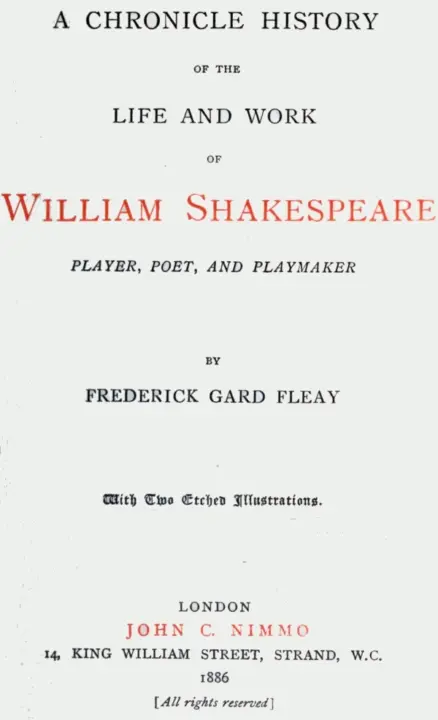
"A Chronicle History of the Life and Work of William Shakespeare" by Frederick Gard Fleay is a historical account written in the late 19th century. This work delves into the life and career of the iconic playwright William Shakespeare, examining his public and personal connections with other poets and dramatists of his time. Fleay not only recounts Shakespeare's biographical details but also analyzes the significant influence he had on English literature. The opening of the text sets the tone for a comprehensive examination of Shakespeare's career, emphasizing the importance of understanding his interactions with other figures in the theatrical community. Fleay critiques previous biographers for focusing excessively on trivial aspects of Shakespeare's personal life and instead aims to highlight the public dimensions of his career, such as the nature of the acting companies he was part of and the chronological order of his plays. The thorough introduction serves as a foundation for the detailed exploration of Shakespeare's life and work that unfolds in the subsequent sections of the book.
Introduction adapted from the source catalogue; source summaries may be automatically generated.
Free to read · English · 76,096 words · No account needed
MAKE TIME FOR A GOOD BOOK
On by default. Untick to stop anonymous reading totals. Each page counts after 10 seconds in view. How this works.
Anonymous counting is on unless you have switched it off.
Twelfth Night, or What You Will, was first acted 2d February 1602 at one of the Inns of Court (Manningham's Diary). Its date lies between Marston's Malcontent (1602), (of Malevole in which play Malvolio is clearly a caricature), and What You Will (1602) by the same author. This adoption of the name of his play seems to have induced Shakespeare to replace it by the now universally adopted title. The appellation Rudesby (v. 1. 55) is from Chapman's Sir Giles Goosecap (1601). Several minor points have been already noticed under the previous play All's Well. In this play, as in that, I believe that earlier written scenes have been incorporated. It is only in similar cases that we find such contradictions as that between the three months' sojourn of Viola at the Count's court (v. 1), and the three days' acquaintance with the Duke in i. 4. In ii. 4 there are palpable signs of alteration, and iii. 1. 159-176, v. 1. 133-148 are surely of early date. Moreover, the singular agreement of the plot with the Comedy of Errors in the likeness of the twins, and with The Gentleman of Verona, or rather with Apollonius and Sylla, whence part of that play was derived, point to a likelihood that the first conceptions of these plays were not far apart in time. I think the early portions were written in 1593, like those of the preceding play. For the change from Duke (i. 1-4) to Count in the rest of the play compare The Gentlemen of Verona. I believe that Sir Toby represents Jonson and Malvolio Marston; but that subject requires to be treated in a separate work from its complexity.
Troylus and Cressida was published surreptitiously in 1609, with an address to the reader stating that it had been "never staled with the stage." This statement was withdrawn in the same year, and a new title-page issued, "as it was acted by the King's Majesty's servants at the Globe." It had in fact been entered in S. R. 1603, February 7, by J. Roberts, and licensed for printing, "when he hath gotten sufficient authority for it"--which he evidently did not get. It could not therefore have been produced later than 1602. Nor could it, as we have it, have been earlier; the line i. 3. 73, "rank Thersites with his mastic jaws" evidently alluding to Dekker's Satiro-MASTIX (1601). I once thought Marston, as Histriomastix or Theriomastix, was alluded to; but the character of Thersites suits Dekker, not Marston. Jonson describes him in The Poetaster, iii. 1, as "one of the most overflowing rank wits in Rome; he will slander any man that breathes if he disgust him." In 1602, Jonson, Marston, and Shakespeare had become reconciled; of reconciliation with Dekker, at any time, there is no trace. This play is probably the "purge" given by Shakespeare to Jonson when he put down all those "of the university pen" (The Return from Parnassus, iv. 3, acted in the winter 1602-3); Ajax representing Jonson, Achilles Chapman, and Hector Shakespeare: but whether this conjecture be true or no, Dekker is certainly Thersites. All this part of the play (the camp story) splits off from the love story of Troylus and Cressida, which is of much earlier date, c. 1593. The two parts are discrepant in minor points, notably in the existence of a truce (i. 3. 262), "dull and long-continued" fighting having been abundant in i. 2. The parts written in 1602 are i. 3; ii. 1; ii. 2; ii. 3; iii. 3. 34 to end; iv. 5. (except lines 12-53); v. i; v. 2 (retains much older work); v. 3. 1-97. All this part bears evident marks of the reading of Chapman's Iliad i.-vii. (1598); the love story is somewhat from the old Troy book printed by Caxton, but more from Chaucer's Troilus and Cressid. At the end of v. 3, in the Folio v. 10. 32-34, are repeated; this shows that the 1602 acting copy was meant to end with v. 3, thus making the play a comedy; as it now stands it is usually classed with the tragedies; in the Folio, it is placed unpaged between the Histories and Tragedies, and is not mentioned in the "Catologue" of contents. The prologue and v. 4-10 contain much work that is unlike Shakespeare's, and are probably by some coadjutor whose other lines have been replaced by the 1602 additions. Heywood in his Iron Age treated this same subject, and the date of that play is important in this investigation. The Ages of Heywood were acted before 1611 (see his Address to the Reader in The Golden Age); The Iron Age was "publicly acted by two companies on one stage at once," and "at sundry times thronged three several theatres." These were the Rose, the Curtain, and the Bull; Pembroke's men, and the Admiral's, acted together at the Rose, October to November 1597. This must have been the time when the Iron Age was performed; but not as a new play. It would otherwise have been entered in Henslowe's Diary as such. All the Ages were then probably old in 1597. In 1595-6 we find them accordingly entered by Henslowe under other names; in 1595, March 5, The Golden Age, whose scenes are in Heaven and Olympus, appears as Steleo (Coelo) and Olempo; he subsequently writes Seleo for Steleo; The Silver and Brazen Ages on May 7 and May 23, as the first and second parts of Hercules. These three plays were produced in succession. The entry of Galfrido and Bernardo is a forgery, and a clumsy one, for it necessitates a Sunday performance, which is a thing unknown in Henslowe's Diary, if the dates be properly corrected. On 23d June 1596, Troy was acted, palpably The Iron Age; and on 7th April 1597, Five Plays in One may have been the second part of that play. About February 1599, Heywood left the Admiral's men, and joined Lord Derby's; in April, Dekker and Chettle produced their Troylus and Cressida; in May their Agamemnon, and Dekker his Orestes' Furies. I believe that all these were merely enlargements of Heywood's Iron Age. Dekker was a "dresser of plays" and a shameless plagiarist; witness the stealing of Day's work, which he afterwards reclaimed in his Parliament of Bees. At the same time that Dekker was thus pillaging Heywood, his friend Marston was satirising Heywood as Post-haste in Histriomastix for appropriating Shakespeare's Troylus (of 1593) and bringing out The Prodigal Child, the old Acolastus of 1540, as a new play. There can be no doubt that the company satirised in Histriomastix is Derby's. It was a "travelling" company, newly set up, with a poet who extemporises his plays (Heywood had a share in 220) and uses
Your reading position is saved on this browser. Take it to another device with a library code. Reading pages adapt to text, rather than matching a printed edition.
BEHIND THE BOOK
This eBook is for the use of anyone anywhere in the United States and most other parts of the world at no cost and with almost no restrictions whatsoever. You may copy it, give it away or re-use it under the terms of the Project Gutenberg License included with this eBook or online at www.gutenberg.org. If you are not located in the United States, you will have to check the laws of the country where you are located before using this eBook. Read the source licence.
The original source file, including credits and licence, is retained by this library. Request an original-format copy at no charge. Please include the book title and Project Gutenberg identifier #46756.
KEEP YOUR CURIOSITY GOING
Cécile Tormay

Moritz Busch
John L. Ransom
Frances Wright
Cécile Tormay

Mabel Potter Daggett