THE CLASSIC COLLECTION✦An outlaw’s diary: the CommuneCLASSIC FREE BOOKS
An outlaw’s diary: the Commune
Cécile Tormay
THE CLASSIC COLLECTION · 1584
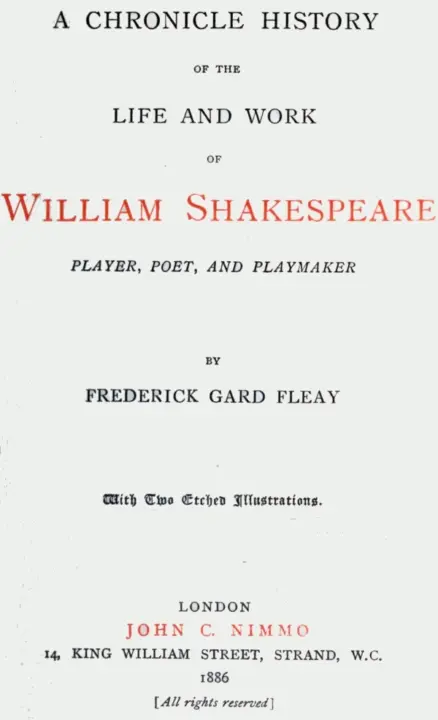
"A Chronicle History of the Life and Work of William Shakespeare" by Frederick Gard Fleay is a historical account written in the late 19th century. This work delves into the life and career of the iconic playwright William Shakespeare, examining his public and personal connections with other poets and dramatists of his time. Fleay not only recounts Shakespeare's biographical details but also analyzes the significant influence he had on English literature. The opening of the text sets the tone for a comprehensive examination of Shakespeare's career, emphasizing the importance of understanding his interactions with other figures in the theatrical community. Fleay critiques previous biographers for focusing excessively on trivial aspects of Shakespeare's personal life and instead aims to highlight the public dimensions of his career, such as the nature of the acting companies he was part of and the chronological order of his plays. The thorough introduction serves as a foundation for the detailed exploration of Shakespeare's life and work that unfolds in the subsequent sections of the book.
Introduction adapted from the source catalogue; source summaries may be automatically generated.
Free to read · English · 76,096 words · No account needed
MAKE TIME FOR A GOOD BOOK
On by default. Untick to stop anonymous reading totals. Each page counts after 10 seconds in view. How this works.
Anonymous counting is on unless you have switched it off.
Richard III. was no doubt acted this same year by the Chamberlain's men; just before the old play which had been acted by the Queen's players was published (S. R. 19th June 1594). A Richard is alluded to in John Weever's Epigrams, published 1599, when the author was twenty-three, but written when he was not twenty; they must therefore date at latest in 1596 (not 1595 as usually stated). Weever mentions Venus and Adonis, Lucrece, Romeo, and Richard as the issue of honey-tongued Shakespeare. We shall see that Romeo, as referred to here, was acted in 1595-6, and I believe the Richard referred to is the Richard II. of 1595. Edward III. I have shown in p. 118 to be an alteration of an old play of Marlowe's written in 1590, revived in 1594 about the autumn, after Lucrece was published. It will be most convenient to defer the consideration of authorship of the preceding plays till I have to treat of Henry VI.; the dates of editions of all the plays will be exhibited in tabular form further on, which will save much repetition and interruption of argument. We now come to an unquestionable date; and it is from this, the first recorded date in connection with an undoubted play, that I wish the reader to regard our investigation of play dates as beginning.
December 28. Shakespeare's only farcical comedy of Errors was acted at Gray's Inn at night: the same players had acted before the Queen at Greenwich on that day, very likely in the same comedy. In April 1595 the English agent in Edinburgh wrote to Burghley, how ill King James took it that the comedians in London should scorn the king and people of Scotland in their plays. The barrenness of Scotland is mentioned in iii. 2. Neither would James approve of a play in which witchcraft and exorcising is so constantly ridiculed. The opening scene is very like in method to that of Midsummer-Night's Dream; and the reiterated allusions by either Dromio to being transformed to an ass (ii. 2. 201; iii. 1. 15; iv. 4. 28; iii. 2. 77) remind us so strongly of that play as almost to infer contemporaneity of production; especially as in iii. 1. 47 the same quibble, an ass and ace, occurs as in Midsummer-Night's Dream, v. 1. 317. Now in 1593, in his Pierce's Supererogation, and in 1592 in his Four Letters, Gabriel Harvey had rung the changes on an ass and a Nash even to wearisomeness; just as Shakespeare in this play puns on an ell and a Nell (iii. 2. 112). This may seem very forced; but I must remind the reader, that s and sh were not distinguished in pronunciation except by pedants at the end of the sixteenth century. It seems then most likely that in dwelling on this transformation, Shakespeare meant to recall to his audience the dyslogistic name inflicted on his old enemy Nash by Gabriel Harvey. All this points to a production of the play in 1594, by the Chamberlain's men; but there are also indications of its having been altered from an earlier version. In the stage directions there are traces of the name Juliana[12] for Luciana: in the text Dowsabel occurs instead of Nell, and in v. 1, the prefix Fat. (Father) has been clearly replaced by Mar. (Merchant) in a revision; note especially v. 1. 195, where both prefixes have by a common printer's error been inserted at once. The older form, again, had Antipholus Sereptus for A. of Syracuse, and Erotes or Erratis for A. of Ephesus; and it had twenty-five years of separation between the parents for thirty-three in the later version. This last difference occurs in i. 1, which is throughout written in a more mechanical and antique style of metre than the rest of the play; and indeed seems to be one of the earliest specimens left us of Shakespeare's attempts to bombast out a blank verse. There is also the name Menaphon (v. 1. 368), which is likely to have been adopted from Greene's Menaphon (1589), who again took it from Marlowe's Tamberlaine (1587-8). The Adam "that goes in the calf-skin," surely alludes to the Adam in the Looking-glass for London (1590), whose "calf-skin jests" were even after seven years an object of ridicule to the playwrights. For all these reasons I believe that a version of this play was acted c. 1590, perhaps in the winter of that year. It does not follow that that version was entirely by Shakespeare, as the present play is; he may have replaced a coadjutor's work of 1590 by his own of 1594. The plot, with its time-unity, is not likely to be of his arranging. As to the pun on the war made by France against her heir (iii. 2. 126), which is usually relied on for the date of production, it merely gives as limits August 1589, when the war of succession began, and 27th February 1594, when Henri IV. was crowned. It does, however, enable us to say positively that the first performance of the play was before the formation of the Chamberlain's company, who only revived it, no doubt in an amended shape, on 28th December 1594, most likely for the sake of the Court performance. The original plot was probably suggested by Plautus' Menæchmi and Amphitryo; and perhaps more directly by the History of Error performed by the Chapel children in 1576, which, by the bye, has nothing to do with the Ferrar of the Earl of Sussex' men in 1582. But we cannot assume in these early plays that Shakespeare was the plotter. It is certain, however, that he did afterwards adopt the likeness of twins in Twelfth Night as a means of introducing "errors" on the stage.
Your reading position is saved on this browser. Take it to another device with a library code. Reading pages adapt to text, rather than matching a printed edition.
BEHIND THE BOOK
This eBook is for the use of anyone anywhere in the United States and most other parts of the world at no cost and with almost no restrictions whatsoever. You may copy it, give it away or re-use it under the terms of the Project Gutenberg License included with this eBook or online at www.gutenberg.org. If you are not located in the United States, you will have to check the laws of the country where you are located before using this eBook. Read the source licence.
The original source file, including credits and licence, is retained by this library. Request an original-format copy at no charge. Please include the book title and Project Gutenberg identifier #46756.
KEEP YOUR CURIOSITY GOING
Cécile Tormay

Moritz Busch
John L. Ransom
Frances Wright
Cécile Tormay

Mabel Potter Daggett