THE CLASSIC COLLECTION✦An outlaw’s diary: the CommuneCLASSIC FREE BOOKS
An outlaw’s diary: the Commune
Cécile Tormay
THE CLASSIC COLLECTION · 1584
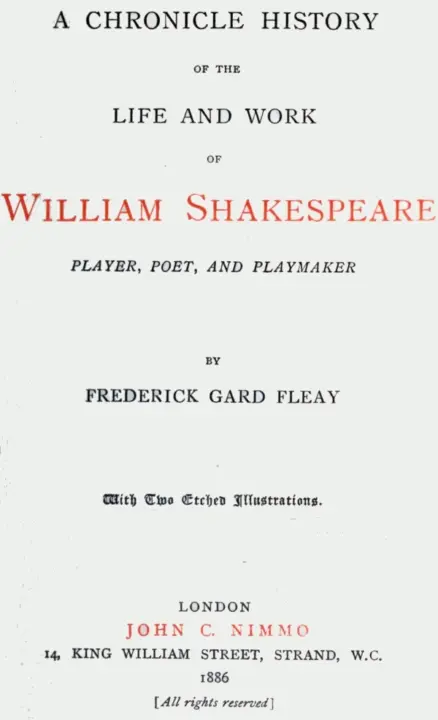
"A Chronicle History of the Life and Work of William Shakespeare" by Frederick Gard Fleay is a historical account written in the late 19th century. This work delves into the life and career of the iconic playwright William Shakespeare, examining his public and personal connections with other poets and dramatists of his time. Fleay not only recounts Shakespeare's biographical details but also analyzes the significant influence he had on English literature. The opening of the text sets the tone for a comprehensive examination of Shakespeare's career, emphasizing the importance of understanding his interactions with other figures in the theatrical community. Fleay critiques previous biographers for focusing excessively on trivial aspects of Shakespeare's personal life and instead aims to highlight the public dimensions of his career, such as the nature of the acting companies he was part of and the chronological order of his plays. The thorough introduction serves as a foundation for the detailed exploration of Shakespeare's life and work that unfolds in the subsequent sections of the book.
Introduction adapted from the source catalogue; source summaries may be automatically generated.
Free to read · English · 76,096 words · No account needed
MAKE TIME FOR A GOOD BOOK
On by default. Untick to stop anonymous reading totals. Each page counts after 10 seconds in view. How this works.
Anonymous counting is on unless you have switched it off.
I have brought together this enumeration of the new plays of Strange's men that the reader may better appreciate the often quoted but sadly misunderstood address by Greene to his fellow-dramatists in his Groatsworth of Wit, not published till September after its author's death, but manifestly written and probably circulated in manuscript in the early months of 1592. Its aim is directed against a company of players, "burs, puppets, antics, apes, grooms, painted monsters, peasants," among whom is "an upstart crow, a Johannes Factotum, a Shakescene," who supposes he can bombast out a blank verse. This is palpably directed against Shakespeare and Lord Strange's players, for whom he was then writing and with whom he was then acting. But Greene also says that they had all been beholding to him and to his fellow writers whom he addresses; that is, to Marlowe, Peele, "young Juvenal" (Lodge), and two more (Kyd and Wilson) "that both have writ," whom he might "insert against these buckram gentlemen." This can only apply to the Queen's players, for which company alone Greene had written up to 1591, having supplied them with a play every quarter and purveyed more plays for them than the other four (Marlowe, Peele, Kyd, and Lodge), as Nash tells us in his Piers Penniless. There must then have been an amalgamation of the better portions of the two companies, the Queen's and Lord Strange's, just before the opening of the Rose Theatre, a conclusion confirmed by the fact that the Queen's plays had passed into the hands of the other company, and, as will be seen when I treat of the Henry VI. plays, deduced by me on other and independent grounds. This attack of Greene's was, I think, answered by Shakespeare in his Midsummer Night's Dream, produced in its first form c. June 1592. Bottom and his scratch company have long been recognised as a personal satire, and the following marks would seem to indicate that Greene and the Sussex' company were the butts at which it was aimed. Bottom is a Johannes Factotum who expects a pension for his playing; his comrades are unlettered rustics who once obtain an audience at Theseus' court. The Earl of Sussex' men were so inferior a company that they acted at Court but once, viz., in January 1591-2, and the only new play which can be traced to them at this date is George a Greene, in which Greene acted the part of the Pinner himself. This only shows that the circumstances of the fictitious and real events are not discrepant; but when we find Bottom saying that he will get a ballad written on his adventure, and "it shall be called Bottom's Dream, because it hath no bottom" (iv. i. 212) and that peradventure he shall "sing it at her (?) death," we surely may infer an allusion to Greene's Maiden's Dream (S. R. 6th December 1591), apparently so called because it hath no maiden in it, and sung at the death of Sir Christopher Hatton. This play of Midsummer Night's Dream was produced after the closing of the theatres, c. 12th June 1592, on account of the plague; it and the Jealous Comedy, produced 5th January 1592-3, when the theatres reopened for that month only, were almost the last in which Shakespeare worked as a journeyman or with a coadjutor. When he revived these earlier plays for the Chamberlain's men he carefully replaced in almost every instance the work of his quondam companions by other and certainly not weaker lines of his own. Some of his own work of this date, apparently left unfinished on account of the sudden closure of the playhouses, he appears to have taken up and completed in his 1601-2 plays. But no doubt the greater part of this autumn was occupied in writing Venus and Adonis, dedicated to Lord Southampton (S. R. 18th April 1593) as "the first heir of his invention," a product of "idle hours:" idle because during the plague no new plays were required of him, nor even rehearsals; the players travelled and acted old plays only. In these circuits a whole company did not usually journey together; it was more profitable to separate into parties of half-a-dozen, and of course to cut down their plays so as to be capable of representation by this small body of actors. One part of Lord Strange's men, consisting of Alleyn, Pope, Bryan, Hemings, Phillips, and Kempe, so travelled in 1593; but no document has been preserved respecting the remainder of the company, which included probably Burbadge, Sly, Condell, Holland, Cowley, and Shakespeare. It appears from Alleyn's correspondence that Cowley was the bearer of a letter to him from London to Bristol; that his section of the company had been at Chelmsford in May, were at Bristol in August, and afterwards visited Shrewsbury, Chester, and York. Meanwhile, on June 1, Marlowe had been killed in a brawl, and his version of the Andronicus story was acted by Sussex' men at the Rose, 23d January 1594. From their hands this play passed to Pembroke's men c. 8th February, when Sussex' company broke up and went into the country, and from them to the Earl of Derby's before 16th April. But this company of Derby's was no other than Lord Strange's. After Henry Earl of Derby died, 25th September 1593, Ferdinand, his son, who succeeded him, and who had previously borne the title of Lord Strange, was called either Strange or Derby indifferently, he having no son to whom the title of Lord Strange could be, in accordance with custom, assigned in courtesy, although by strict right this title appertained to the Earls of Derby and not to their sons. Along with this Andronicus play the following can be traced as passing from Pembroke's company to Lord Strange's at this date: The Taming of a Shrew, Edward III., Hamlet, 3 Henry VI.; and besides this transfer of playbooks there was also a partial transfer of the company itself. Beeston, Cooke, Sinkler, Holland, and others were among these new members. The cause of this arrangement was no doubt poverty; already on 28th September 1593 they could not "save their charges to travel, and were fain to pawn their apparel." So writes Henslowe to Alleyn.
Your reading position is saved on this browser. Take it to another device with a library code. Reading pages adapt to text, rather than matching a printed edition.
BEHIND THE BOOK
This eBook is for the use of anyone anywhere in the United States and most other parts of the world at no cost and with almost no restrictions whatsoever. You may copy it, give it away or re-use it under the terms of the Project Gutenberg License included with this eBook or online at www.gutenberg.org. If you are not located in the United States, you will have to check the laws of the country where you are located before using this eBook. Read the source licence.
The original source file, including credits and licence, is retained by this library. Request an original-format copy at no charge. Please include the book title and Project Gutenberg identifier #46756.
KEEP YOUR CURIOSITY GOING
Cécile Tormay

Moritz Busch
John L. Ransom
Frances Wright
Cécile Tormay

Mabel Potter Daggett