THE CLASSIC COLLECTION✦An outlaw’s diary: the CommuneCLASSIC FREE BOOKS
An outlaw’s diary: the Commune
Cécile Tormay
THE CLASSIC COLLECTION · 1584
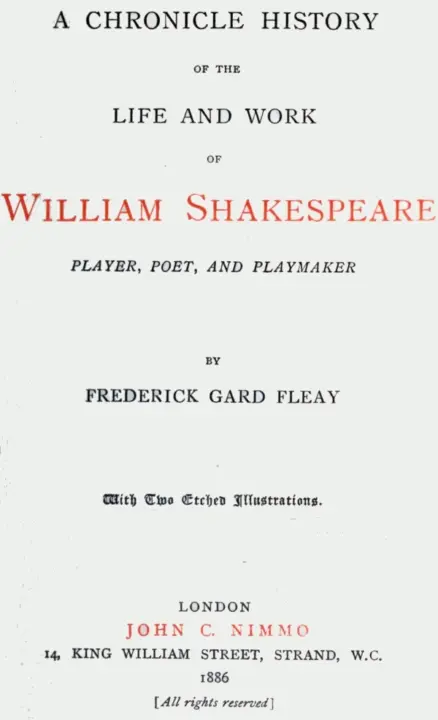
"A Chronicle History of the Life and Work of William Shakespeare" by Frederick Gard Fleay is a historical account written in the late 19th century. This work delves into the life and career of the iconic playwright William Shakespeare, examining his public and personal connections with other poets and dramatists of his time. Fleay not only recounts Shakespeare's biographical details but also analyzes the significant influence he had on English literature. The opening of the text sets the tone for a comprehensive examination of Shakespeare's career, emphasizing the importance of understanding his interactions with other figures in the theatrical community. Fleay critiques previous biographers for focusing excessively on trivial aspects of Shakespeare's personal life and instead aims to highlight the public dimensions of his career, such as the nature of the acting companies he was part of and the chronological order of his plays. The thorough introduction serves as a foundation for the detailed exploration of Shakespeare's life and work that unfolds in the subsequent sections of the book.
Introduction adapted from the source catalogue; source summaries may be automatically generated.
Free to read · English · 76,096 words · No account needed
MAKE TIME FOR A GOOD BOOK
On by default. Untick to stop anonymous reading totals. Each page counts after 10 seconds in view. How this works.
Anonymous counting is on unless you have switched it off.
On May 14 The Famous Victories of Henry V. and Leir were entered on
S. R.
On May 14 also the Admiral's company, of which nothing is heard since 1591, began to act at the Rose, having acted at Newington for three days only. Alleyn, Henslow's son-in-law, had left the management of Shakespeare's company on the death of Lord Derby, and now joined the Admiral's men.
Between[5] June 3 and June 13 the Chamberlain's men played at Newington Butts alternately with the Admiral's: among the Chamberlain's plays we notice on June 3, 10, Hester and Ahasuerus, which exists in a German version of which a translation ought to be published; June 5, 12, Andronicus;
June 9, Hamlet; June 11, The Taming of a Shrew. The intermediate days were occupied by the Admiral's men: who on the 15th [17th] went to the Rose, and the Chamberlain's men no doubt to the Theater, the Burbadges' own house. The Chamberlain's company at this date included W. Shakespeare, R. Burbadge, J. Hemings, A. Phillips, W. Kempe, T. Pope, G. Bryan, all of whom, with the possible exception of Burbadge, had been members of Lord Strange's company; together with H. Condell, W. Sly, R. Cowley, N. Tooley, J. Duke, R. Pallant, and T. Goodall, who had previously been in all probability members of the Queen's company. C. Beeston must have joined them soon afterwards. The names of Richard Hoope, William Ferney, William Blackway, and Ralph Raye occur in Henslow's Diary as Chamberlain's men c. January 1595. The Queen's men came in on the reconstitution of that company in 1591-2. See on this matter further on under the head of The Seven Deadly Sins.
On June 19 the old play of Richard III. (with Shore's wife in it) was entered on S. R., a pretty sure indication, which tallies with other external evidence, that the play attributed to Shakespeare was produced about this time. No one can read the four plays composing the Henry 6th series without feeling that, however various their authorship, they form a connected whole in general plan. Margaret is the central figure, who hovers like a Greek Chorus over the terrible Destiny that involves King and people in its meshes. But Margaret is not Shakespeare's creation; she is Marlowe's. Shakespeare had no share in the plays on the contention of York and Lancaster, and but a slight one in 1 Henry VI. Marlowe had a chief hand in 1 Henry VI. and York and Lancaster; probably wrote the whole of Richard Duke of York, and laid, in my opinion, the foundation and erected part of the building of Richard III. At his death he seems to have left unacted or unpublished his poem of Hero and Leander, finished afterwards by Chapman; Dido, partly by Nash, and produced (when?) by the Chapel children; Andronicus acted (under Peele's auspices?) by the Sussex men, and Richard III., completed by Shakespeare, and acted by the Chamberlain's company as we have it in the Quarto. All these plays were produced or published in 1594. About the same time an earlier play of Marlowe's, originally acted c. 1589, was altered and revised by Shakespeare. The date and authorship of the Shakespearian part of Edward III., viz., from "Enter King Edward" in the last scene of act i. to the end of act ii., are proved by the allusion to the poem of Lucrece; the repetition of lines from the Sonnets: "Their scarlet ornaments," "Lilies that foster smell far worse than weeds," and many smaller coincidences with undoubted Shakespearian plays: while the original date and authorship of the play as a whole will appear from the following quotations. In the Address prefixed to Greene's Menaphon, in a passage in which Nash has been satirising Kyd and another as void of scholarship and unable to read Seneca in the original, he suddenly attacks Marlowe, whom he has previously held up as the object of their imitation, and asks what can they have of him? in Nash's own words: "What can be hoped of those that thrust Elysium into Hell, and have not learned, so long as they have lived in the spheres, the just measure of the Horizon without an hexameter?" Marlowe in Faustus[6] has "confound Hell in Elysium," and, in Edward III, horízon is pronounced hórizon. This, however, might occur in other plays; but in Greene's Never Too Late we find Tully addressing the player Roscius, who certainly represents R. Wilson, in these words: "Why, Roscius, are thou proud with Æsop's crow, being pranked with the glory of others' feathers? Of thyself thou canst say nothing: and if the Cobbler hath taught thee to say Ave Cæsar, disdain not thy tutor because thou pratest in a King's chamber." Unless another play can be produced with "Ave Cæsar" in it, this must be held to allude to Edward III., in which play Wilson must have acted the Prince of Wales (act i. 1. 164). The "cobbler" alludes to Marlowe as a shoemaker's son.
Your reading position is saved on this browser. Take it to another device with a library code. Reading pages adapt to text, rather than matching a printed edition.
BEHIND THE BOOK
This eBook is for the use of anyone anywhere in the United States and most other parts of the world at no cost and with almost no restrictions whatsoever. You may copy it, give it away or re-use it under the terms of the Project Gutenberg License included with this eBook or online at www.gutenberg.org. If you are not located in the United States, you will have to check the laws of the country where you are located before using this eBook. Read the source licence.
The original source file, including credits and licence, is retained by this library. Request an original-format copy at no charge. Please include the book title and Project Gutenberg identifier #46756.
KEEP YOUR CURIOSITY GOING
Cécile Tormay

Moritz Busch
John L. Ransom
Frances Wright
Cécile Tormay

Mabel Potter Daggett