THE CLASSIC COLLECTION✦An outlaw’s diary: the CommuneCLASSIC FREE BOOKS
An outlaw’s diary: the Commune
Cécile Tormay
THE CLASSIC COLLECTION · 1584
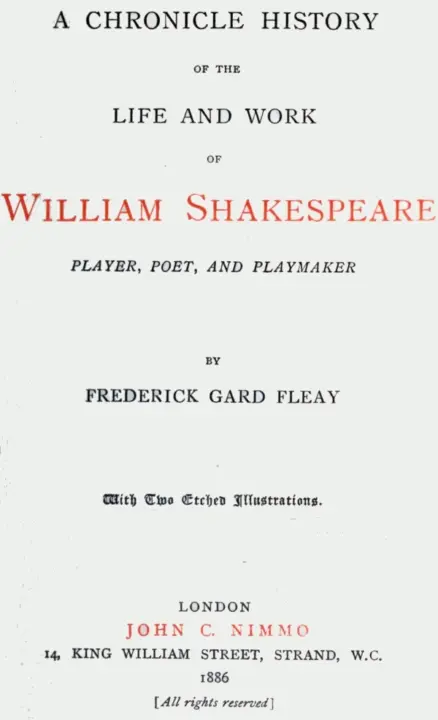
"A Chronicle History of the Life and Work of William Shakespeare" by Frederick Gard Fleay is a historical account written in the late 19th century. This work delves into the life and career of the iconic playwright William Shakespeare, examining his public and personal connections with other poets and dramatists of his time. Fleay not only recounts Shakespeare's biographical details but also analyzes the significant influence he had on English literature. The opening of the text sets the tone for a comprehensive examination of Shakespeare's career, emphasizing the importance of understanding his interactions with other figures in the theatrical community. Fleay critiques previous biographers for focusing excessively on trivial aspects of Shakespeare's personal life and instead aims to highlight the public dimensions of his career, such as the nature of the acting companies he was part of and the chronological order of his plays. The thorough introduction serves as a foundation for the detailed exploration of Shakespeare's life and work that unfolds in the subsequent sections of the book.
Introduction adapted from the source catalogue; source summaries may be automatically generated.
Free to read · English · 76,096 words · No account needed
MAKE TIME FOR A GOOD BOOK
On by default. Untick to stop anonymous reading totals. Each page counts after 10 seconds in view. How this works.
Anonymous counting is on unless you have switched it off.
At that date there were two theatres in London: the better of the two, the Theater, was occupied by the Queen's men, for whom Greene was the principal play-writer. Marlowe, Kyd, and R. Wilson had also contributed plays to their repertoire, but just at this time left them and joined Pembroke's, which, like Leicester's, had been a strolling company, but were now settling in London. On the other hand, Peele and Lodge, who had previously written for the Admiral's company, acting at the other theatre, the Curtain, had also joined, and still remained with, the Queen's. Nearly all these writers, if not quite all, were actors as well as authors. Greene, the Johannes Factotum of the Queen's men, had evidently expected to establish a monopoly of play-acting in their favour, and was indignant at the arrival of vagrant troops of Thespians from the country, just when he had practically succeeded in crippling the rival company in London, by enlisting some of their best authors in the service of his own. Hence on 23d August 1589 his publication of Menaphon, with Nash's address, containing a virulent attack on Kyd and Marlowe, then writing for Pembroke's men, together with a glorification of Peele, then writing in conjunction with Greene. The absence of any allusion in this tract to Shakespeare or Lord Strange's company conclusively proves that they were not as yet dangerous rivals to the Queen's. Pembroke's men were, and there is indirect evidence that they had from their first settlement in London obtained possession of the second theatre, the Curtain. This evidence is connected with the first direct mention which is extant of Shakespeare's company. For in this same year, 1589, the Martinist controversy had been raging in London; Lyly, Nash, Greene, Monday, and Cooper were the anti-Martinist champions; the Martinists had been ridiculed on the stage in April, probably by Greene at the Theater, possibly by the Paul's children in some play of Lyly's, or by the Earl of Oxford's boys in one of Monday's. The authorities did not interfere. But in November certain players "within the city," to wit, Lord Strange's and the Admiral's, were silenced for "abuses or indecent reflexions" (Strype). A comparison of the worthies in Love's Labour's Lost with the anti-Martinist writers, of the Euphuist Armado with Lyly, the boy-satirist Mote with Nash, the curate with the Reverend Robert Greene, the schoolmaster-pedant with the pedagogue Cooper, and Antony Dull with Antony Monday, will I think confirm the theory developed by me in a separate essay, that this was the play suppressed on this occasion. It is characteristic of the independence of action shown by Shakespeare's company throughout the reign of Elizabeth that they refused to obey the injunction, and went and played at the Cross-Keys that same afternoon, while the subservient Admiral's company dutifully submitted. I do not suppose, however, that the play as then performed was in all parts from the hand of Shakespeare. It is extremely unlikely that he should have commenced his career by independent writing, and there is not a play of his that can be referred even on the rashest conjecture to a date anterior to 1594, which does not bear the plainest internal evidence to its having been refashioned at a later time. In all probability he began to compose plays, as we know so many of his contemporaries did, as an assistant to some experienced dramatist. It may seem idle, in the absence of any positive evidence, to guess who was his original tutor in composition, and yet, as the careers of Peele, Greene, and Marlowe conclusively show that none of them were in 1589 connected with Lord Strange's company, I venture to suggest that it was Robert Wilson. That dramatist is not heard of in connection with Pembroke's or any other company after August 1589, and he certainly continued to write for the stage. That Shakespeare was greatly influenced by him and Peele is evident from the metrical character of Shakespeare's earliest work, which abounds in heroic rhyme like Peele's in tragedy, and in doggerel and stanza like Wilson's in comedy. It is not till the Historic plays that the influence of Marlowe's blank verse is fully perceptible, and in the earliest of these, Richard II., rhyme is still dominant. Wilson was in this view a better teacher for the inexperienced Shakespeare than a greater man. Marlowe, for instance, might have biassed him on the tragic side, and deferred or prevented his comedy from its earlier pastoral development. Love's Labour's Won must have been written at about the same time as Love's Labour's Lost, and before the end of 1590 The Comedy of Errors probably appeared in its original form. In this same year was produced a play in which, although I cannot detect Shakespeare's hand as coadjutor with its probable author, R. Wilson, he most likely appeared as an actor--Fair Em; and that this comedy contained a satirical attack on Greene is evident from the offence he took at it, as shown in his virulent address prefixed to his Farewell to Folly. Up to this date Greene's chief attacks had been directed against Kyd in Menaphon and in Never too late, but as yet there has been found no allusion to Shakespeare in his writings anterior to 1592. Yet Shakespeare must have been known to him as at least part author of the plays acted by Lord Strange's men in 1589 and 1590. Of Romeo and Juliet, originally acted in 1591, we also possess a version anterior to Shakespeare's final remodelling, which palpably contains scenes not written by him. These scenes, however, seem due to a finer artist than Kyd, and there is independent evidence that George Peele had by 1591 also become a playwright for Lord Strange's men. One of the plays acted by them in this year was probably Peele's Edward I., here mentioned on account of a curious allusion which would seem to fix the character performed by Shakespeare. In scene 3 Elinor says to Baliol--
Your reading position is saved on this browser. Take it to another device with a library code. Reading pages adapt to text, rather than matching a printed edition.
BEHIND THE BOOK
This eBook is for the use of anyone anywhere in the United States and most other parts of the world at no cost and with almost no restrictions whatsoever. You may copy it, give it away or re-use it under the terms of the Project Gutenberg License included with this eBook or online at www.gutenberg.org. If you are not located in the United States, you will have to check the laws of the country where you are located before using this eBook. Read the source licence.
The original source file, including credits and licence, is retained by this library. Request an original-format copy at no charge. Please include the book title and Project Gutenberg identifier #46756.
KEEP YOUR CURIOSITY GOING
Cécile Tormay

Moritz Busch
John L. Ransom
Frances Wright
Cécile Tormay

Mabel Potter Daggett