THE CLASSIC COLLECTION✦An outlaw’s diary: the CommuneCLASSIC FREE BOOKS
An outlaw’s diary: the Commune
Cécile Tormay
THE CLASSIC COLLECTION · 1584
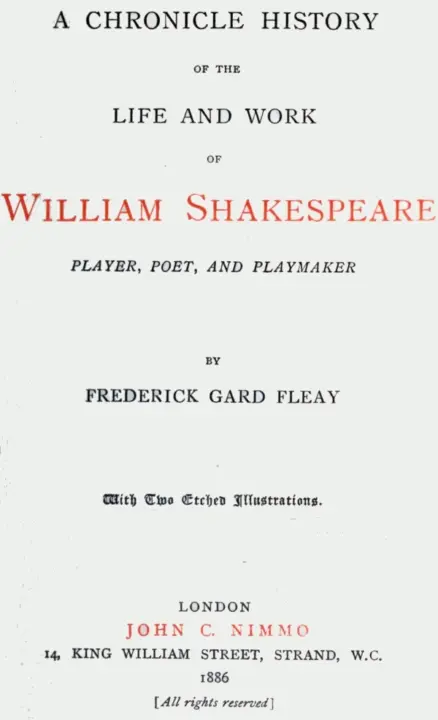
"A Chronicle History of the Life and Work of William Shakespeare" by Frederick Gard Fleay is a historical account written in the late 19th century. This work delves into the life and career of the iconic playwright William Shakespeare, examining his public and personal connections with other poets and dramatists of his time. Fleay not only recounts Shakespeare's biographical details but also analyzes the significant influence he had on English literature. The opening of the text sets the tone for a comprehensive examination of Shakespeare's career, emphasizing the importance of understanding his interactions with other figures in the theatrical community. Fleay critiques previous biographers for focusing excessively on trivial aspects of Shakespeare's personal life and instead aims to highlight the public dimensions of his career, such as the nature of the acting companies he was part of and the chronological order of his plays. The thorough introduction serves as a foundation for the detailed exploration of Shakespeare's life and work that unfolds in the subsequent sections of the book.
Introduction adapted from the source catalogue; source summaries may be automatically generated.
Free to read · English · 76,096 words · No account needed
MAKE TIME FOR A GOOD BOOK
On by default. Untick to stop anonymous reading totals. Each page counts after 10 seconds in view. How this works.
Anonymous counting is on unless you have switched it off.
Three or four years after his union with Anne Hathaway, he had, says Rowe, "by a misfortune common enough to young fellows, fallen into ill company, and, amongst them, some, that made a frequent practice of deer stealing, engaged him with them more than once in robbing a park, that belonged to Sir Thomas Lucy of Charlecote, near Stratford; for this he was prosecuted by that gentleman, as he thought, somewhat too severely, and in order to revenge that ill usage made a ballad upon him, and though this, probably the first essay of his poetry, be lost, yet it is said to have been so very bitter that it redoubled the prosecution against him to that degree that he was obliged to leave his business and family in Warwickshire for some time, and shelter himself in London." Whether this tradition be well founded or no, we are compelled by subsequent events to place the date of Shakespeare's leaving Stratford in or about 1587; and whether there be any truth in the story traced to Davenant or not, that he held horses at the play-house door, while their owners were witnessing performances inside, it is certain that he was very soon connected with the stage, first as actor, then as dramatic writer. It becomes therefore of importance to ascertain if possible the specific company with which he originally joined.
In the latter part of 1585 there were two regular theatres existing in London, the Theater and the Curtain. It clearly appears from a report by Recorder Fleetwood preserved in the Lansdown MSS. that at Whitsuntide 1584 these were occupied by the Queen's players and those of Lord Arundel. It is not clear that a third company, that of Lord Hunsdon, acted at the Theater: although Mr. J. O. H. Phillipps (whom I most usually refer to under his former and better known name of Halliwell) assures us that it is so. It is true that the "owner of the Theater," whom he takes to be a temporary occupier of that building, but whom I regard as the ground landlord, Giles Alleyn, is called a servant of Lord Hunsdon's, and that a company of actors, called Lord Hunsdon's men, acted at Court 27th December 1582; but it does not follow that these men were occupiers of the Theater. In fact the only companies anyhow known to us as in London in 1585 are the two already mentioned. It is by no means likely à priori, nor would it agree with the passages hereafter to be referred to in the writings of Greene and Nash, that Shakespeare should immediately on his appearance in London obtain employment in either. But there was a third company not noticed in Collier's Annals of the Stage, into which he may easily have obtained admittance. When the Queen's company was formed in 8th March 1582-3, by the selection of twelve players from the companies of the two Dudleys, Earls of Leicester and Warwick, there must have been sufficient men left unemployed to form another company. These were probably still retained by the Earl of Leicester: for in a letter from Sir Philip Sidney, dated Utrecht, 24th March 1575-6, mention is made of "Will, the Earl of Leicester's jesting player," who had gone with the Earl to the Netherlands in December 1575. Thomas Heywood, in his Apology for Actors, 1612, tells us that "The King of Denmark, father to him that now reigneth, entertained into his service a company of English comedians, commended unto him by the honourable Earl of Leicester." This King of Denmark, Frederick II., died in 1588, and the exact date of the transaction is fixed by documents dated October 1586, in which we find that five of these actors had been transferred from the service of Frederick II. of Denmark to that of Christian I., Duke of Saxony. I am far from wishing to adopt the conjecture of Mr. Bruce that "jesting Will" was Shakespeare; but when among the names of these five actors--Thomas King, Thomas Stephen, George Bryan, Thomas Pope, Robert Persie--we find two, Pope and Bryan, that are identical with those of two actors in the very first list extant of the first company with which we can positively connect Shakespeare as an actor; when we find this same company acting at Stratford in 1587, at the very time that Shakespeare's disappearance from all known connection with that town for nine years commences; when we find among a list of plays that had been acted by the English in Germany Hester and Ahasuerus, Titus Andronicus [and Vespasian], both of which we shall trace to Shakespeare's company; when we also find a version of the Corambis Hamlet existing early in the same country--then I think we are justified in saying that there is great likelihood of this company having been the one in which Shakespeare found his first employment. If so, he accompanied it in all its fortunes, and never (as we shall see) forsook it for another.
Your reading position is saved on this browser. Take it to another device with a library code. Reading pages adapt to text, rather than matching a printed edition.
BEHIND THE BOOK
This eBook is for the use of anyone anywhere in the United States and most other parts of the world at no cost and with almost no restrictions whatsoever. You may copy it, give it away or re-use it under the terms of the Project Gutenberg License included with this eBook or online at www.gutenberg.org. If you are not located in the United States, you will have to check the laws of the country where you are located before using this eBook. Read the source licence.
The original source file, including credits and licence, is retained by this library. Request an original-format copy at no charge. Please include the book title and Project Gutenberg identifier #46756.
KEEP YOUR CURIOSITY GOING
Cécile Tormay

Moritz Busch
John L. Ransom
Frances Wright
Cécile Tormay

Mabel Potter Daggett