THE CLASSIC COLLECTION✦An outlaw’s diary: the CommuneCLASSIC FREE BOOKS
An outlaw’s diary: the Commune
Cécile Tormay
THE CLASSIC COLLECTION · 1584
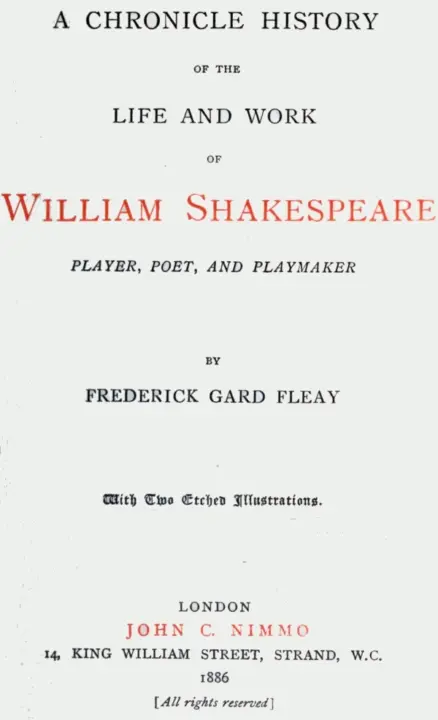
"A Chronicle History of the Life and Work of William Shakespeare" by Frederick Gard Fleay is a historical account written in the late 19th century. This work delves into the life and career of the iconic playwright William Shakespeare, examining his public and personal connections with other poets and dramatists of his time. Fleay not only recounts Shakespeare's biographical details but also analyzes the significant influence he had on English literature. The opening of the text sets the tone for a comprehensive examination of Shakespeare's career, emphasizing the importance of understanding his interactions with other figures in the theatrical community. Fleay critiques previous biographers for focusing excessively on trivial aspects of Shakespeare's personal life and instead aims to highlight the public dimensions of his career, such as the nature of the acting companies he was part of and the chronological order of his plays. The thorough introduction serves as a foundation for the detailed exploration of Shakespeare's life and work that unfolds in the subsequent sections of the book.
Introduction adapted from the source catalogue; source summaries may be automatically generated.
Free to read · English · 76,096 words · No account needed
MAKE TIME FOR A GOOD BOOK
On by default. Untick to stop anonymous reading totals. Each page counts after 10 seconds in view. How this works.
Anonymous counting is on unless you have switched it off.
ONE of the objects of the present treatise is to bring into clearer light the relations of Shakespeare with contemporary dramatists. Strangely enough this has scarcely been attempted in earlier biographies. His dealings in malt have been carefully chronicled: his connections with poets have been slurred over. It will be useful, therefore, to gather up the scattered notices of personal contact between him and his fellows in dramatic production. Mere allusions to his works, whether complimentary or otherwise, will not come under this category. Such will be found collected, and well collected, in Dr. Ingleby's Century of Praise; but they consist almost entirely of slight references to his published works, and have no bearing of importance on his career. Nor, indeed, have we any extended material of any kind to aid us in this investigation; one source of information, which is abundant for most of his contemporaries, being in his case entirely absent. Neither as addressed to him by others, nor by him to others, do any commendatory verses exist in connection with any of his or other men's works published in his lifetime--a notable fact, in whatever way it may be explained. Nor can he be traced in any personal contact beyond a very limited circle, although the fanciful might-have-beens so largely indulged in by his biographers might at first lead us to an opposite conclusion.
With John Lyly, the founder of English Comedy, he seems to have had no personal intercourse, although the reproduction by him of many of Lyly's puns and conceits, and some few of his dramatic situations, distinctly prove that he had carefully examined his published plays. Nor does the solitary reference to Shakespeare in Greene's Groatsworth of Wit, however it may display strong personal feeling, lead us to suppose that there had been any personal relations between these dramatists; in fact, the very wording of the passage properly understood distinctly disproves the existence of such relations. Of all the dramatists who had preceded him on the London stage the only two with whom he can be even conjecturally brought in personal contact before the opening of the Rose Theatre in 1592 are Robert Wilson and George Peele. It is unlikely that he should have begun his career as a novice and journeyman independent of tutor or coadjutor, and a minute examination of the careers of these two dramatists leads me to infer that they were connected with the same company as Shakespeare in 1590-1. In any case, they were his immediate models in his early work in several respects. It is from Wilson that his liking for doggerel rhymes and alternately rhyming stanzas was derived: it is from Peele that his love tragedy of Romeo and Juliet--his only early tragedy--derived, in its earliest form, as acted in 1591, whatever in it was not Shakespeare's own. Wilson was probably his tutor or coadjutor in Comedy and Peele in Tragedy. But this is after all conjecture; on the other hand, it is certain that in 1592-3 a greater than Peele or Wilson was writing for the same company as Shakespeare, and necessarily in close connection with him. For Marlowe he certainly had a sincere regard: from his poem of Hero and Leander Shakespeare makes the only direct quotation to be found in his plays; on his historical plays Shakespeare, after his friend's decease, bestowed in addition, revision, and completion, a greater amount of minute work than on his own; and the earlier of his own histories were distinctly built on lines similar to those of Edward II. and Edward III. The relation of Shakespeare's Histories to Marlowe's is far more intimate than that of his Comedies or of Romeo to any predecessor's productions. I cannot find a trace of direct connection between Shakespeare and any other poet than these mentioned, during the life of Lord Strange. His connection with Lord Southampton seems to have been more intimate than any with his fellow-poets. In the Sonnets addressed to him there is mention of other pens who have dedicated poems to his lordship, and whom Shakespeare for poetical purposes professes to regard as dangerous rivals. The only persons known to have dedicated anything to Southampton are Nash and Markham, although George Peele had written a high eulogy of him in his Honour of the Garter in 1593. Markham's dedication is one of four prefixed to his poem on The Tragedy of Sir Richard Grenvile (S. R. 9th September 1595); (1.) to Charles Lord Montjoy (in prose); (2.) to Robert Earl of Sussex (Sonnet); (3.) to the Earl of Southampton (Sonnet); (4.) to Sir Edward Wingfield (Sonnet). I am not aware of any previous attempt to identify Markham with the rival alluded to in the Sonnets of Shakespeare, and yet there are many coincidences of language which would lead to this conclusion. Take Sonnet 78, for instance. "Thine eyes ... have added feathers to the learned's wing and given grace a double majesty." In Markham we find in 1, "hath given wings to my youngling Muse;" and in 3, "whose eyes doth crown the most victorious pen" (cf. in 1, "that thine eyes may lighten," &c.); and in 4, the double majesty of the grace, "vouchsafe to grace my work and me, Gracing the soul beloved of heaven and thee." I do not find in Markham the "affable familiar ghost" of Sonnet 86, but this and other allusions may have referred to his Thyrsis and Daphne (S. R. 23d April 1593, five days after the entry of Venus and Adonis) which is now unfortunately lost; and there is something like it in the Grenvile Tragedy, in which Markham calls on Grenvile's soul to "sit on his hand" while he writes, which the ghost apparently does until it is dismissed to its "rest" at the end of the poem. Markham was an exceedingly learned man and the "proud full sail of his great verse" would well apply to his stilted and conceited effusion. He does not in it allude to Southampton's beauty, though he may have done so in his Thyrsis, but he calls him "Bright lamp of virtue" with which compare Sonnet 79: "He lends thee virtue, and he stole that word from thy behaviour." On the whole I incline to regard Markham as the rival poet of Shakespeare's Sonnets. As to Nash, his supposed satirical allusions to Shakespeare, as set forth by the fertile fancy of Mr. Simpson, have no more real existence than the allusions discovered by other like imaginations in the writings of Spenser. His only notice of Shakespeare's writings is the well-known mention of the representation of Talbot on the stage, and that is highly complimentary. He may be included under the "every alien pen" of Sonnet 78, but he is not (as I once thought he was) the rival poet alluded to. It may be of interest in connection with this matter to note that in The Dumb Knight, in which Markham certainly wrote i. 2, ii. 1, iii. 4, and iv. 2, Venus and Adonis is satirised as a lascivious poem.
Your reading position is saved on this browser. Take it to another device with a library code. Reading pages adapt to text, rather than matching a printed edition.
BEHIND THE BOOK
This eBook is for the use of anyone anywhere in the United States and most other parts of the world at no cost and with almost no restrictions whatsoever. You may copy it, give it away or re-use it under the terms of the Project Gutenberg License included with this eBook or online at www.gutenberg.org. If you are not located in the United States, you will have to check the laws of the country where you are located before using this eBook. Read the source licence.
The original source file, including credits and licence, is retained by this library. Request an original-format copy at no charge. Please include the book title and Project Gutenberg identifier #46756.
KEEP YOUR CURIOSITY GOING
Cécile Tormay

Moritz Busch
John L. Ransom
Frances Wright
Cécile Tormay

Mabel Potter Daggett