THE CLASSIC COLLECTION✦An outlaw’s diary: the CommuneCLASSIC FREE BOOKS
An outlaw’s diary: the Commune
Cécile Tormay
THE CLASSIC COLLECTION · 1584
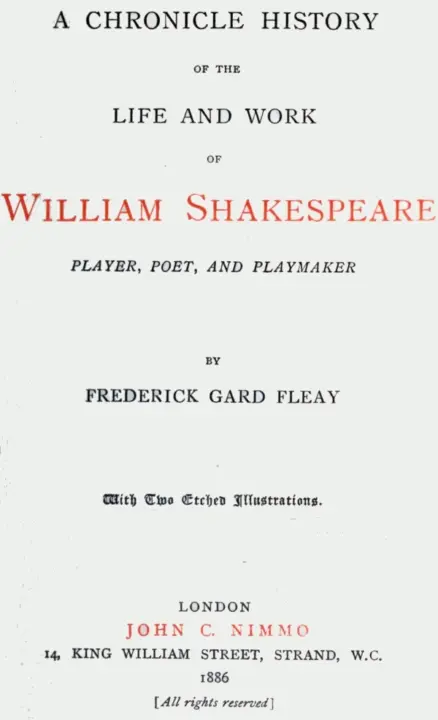
"A Chronicle History of the Life and Work of William Shakespeare" by Frederick Gard Fleay is a historical account written in the late 19th century. This work delves into the life and career of the iconic playwright William Shakespeare, examining his public and personal connections with other poets and dramatists of his time. Fleay not only recounts Shakespeare's biographical details but also analyzes the significant influence he had on English literature. The opening of the text sets the tone for a comprehensive examination of Shakespeare's career, emphasizing the importance of understanding his interactions with other figures in the theatrical community. Fleay critiques previous biographers for focusing excessively on trivial aspects of Shakespeare's personal life and instead aims to highlight the public dimensions of his career, such as the nature of the acting companies he was part of and the chronological order of his plays. The thorough introduction serves as a foundation for the detailed exploration of Shakespeare's life and work that unfolds in the subsequent sections of the book.
Introduction adapted from the source catalogue; source summaries may be automatically generated.
Free to read · English · 76,096 words · No account needed
MAKE TIME FOR A GOOD BOOK
On by default. Untick to stop anonymous reading totals. Each page counts after 10 seconds in view. How this works.
Anonymous counting is on unless you have switched it off.
The loss of Shakespeare was repaired as well as circumstances would permit by the accession of Beaumont and Fletcher to the King's company in 1611. In that year they produced their masterpieces Philaster, a King and no King and The Maid's Tragedy: in 1612 The Woman's Prize (by Fletcher alone), the play of Cardenas (probably the original form of Love's Pilgrimage), and The Captain. Jonson contributed Catiline in 1611, and Webster The Duchess of Malfi in 1612. The Second Maiden's Tragedy (by the author of The Revenger's Tragedy, I think) was also produced in 1611. At Court the unusual number of twenty-two plays was acted in the 1611 winter and twenty-eight in 1612. These must have included nearly every play they possessed; and the fact that the whole, or nearly so, of Shakespeare's plays were revived at Court in these two years makes his retirement in 1610 to my mind nearly a certainty, and accounts for the not very felicitous praise of his "copious industry" by Webster in the Dedication of his White Devil in 1612. Webster couples the retired Shakespeare with Dekker and Heywood: but Jonson's works he speaks of as "laboured and understanding," Beaumont's and Fletcher's as "no less worthy composures." This higher praise is given to the writers who like himself were then contributing to the Globe repertory. He mentions no one else but Chapman of "full and heightened style." Are we to attribute to this mention of him the tradition that Chapman wrote The Second Maiden's Tragedy? On 11th September 1611 Shakespeare's name occurs "in the margin, as if a later insertion" (says Mr. Halliwell) of a list of Stratford donors "towards the charge of prosecuting the bill in Parliament for the better repair of the highways." In 1612 Lane, Greene, and Shakespeare filed a bill before Lord Ellesmere complaining that some of the lessees of the Stratford tithes refused to contribute their proper shares of a reserved rent. It appears from this document that Shakespeare's income from this source was £60. In the same year Heywood, in his Apology for Actors, complained of W. Jaggard's having printed in The Passionate Pilgrim, 3d edition, two love epistles taken from his Troia Britannica, as by W. Shakespeare, "which might put the world in opinion I might steal them from him;" he adds that he knows the author was much offended for Jaggard's presuming to make bold with his name. The name was in consequence withdrawn altogether from the title-page. Notwithstanding this, many modern editors print The Passionate Pilgrim as Shakespeare's. On 4th February 1613 Richard Shakespeare was buried at Stratford; whether the Gilbert Shakespeare, "adolescens," who was buried 3d February 1612, was also a brother of William's, is doubtful, but likely. On l0th March 1613 Shakespeare bought of Henry Walker a house and yard near Blackfriars Theatre for £140, of which £60 remained on mortgage (one of the trustees being in 1618 John Heming, Shakespeare's fellow-actor): he leased the house to John Robinson for ten years. On 29th June the Globe was burned down. It caught fire during the performance of All is True (Henry VIII.) This was not the play as we have it--which is a later version by Massinger and Fletcher, written for the Blackfriars Theatre, and containing only three scenes that can be attributed to Shakespeare--but a play in which there was a fool's part. Wotton describes it as "the play of Henry VIII.," but Lorkin says it was a new play called All is True, representing some principal pieces of Henry VIII. Whether new play or not it was probably by Shakespeare, written c. 1609, and portions of it remain imbedded in that now extant by Fletcher and Massinger c. 1617, the original MS. having perished in the fire. Just at the same time one Lane had been maligning Mrs. Hall, Shakespeare's daughter, in connection with Ralph Smith. Lane was summoned before the Ecclesiastical Court at Worcester on 15th July and excommunicated on the 27th. There were only seven plays performed at Court by the King's men in the winter 1613-14, all their principal writers--Fletcher, Beaumont, Jonson, Webster--having left them after the Globe fire. Surely this is not consistent with the statement of C. Burbadge that they had taken the Blackfriars building to their own use. No new play can be traced to them till 1615, when the Globe had been[2] rebuilt, and the Prince Charles' men had gone to the Curtain. Then they certainly did take the Blackfriars to themselves, and with an excellent staff of writers--Jonson, Fletcher, Massinger, and Field--they occupied it as well as the new Globe. A letter of John Chamberlain's to Sir Dudley Carleton, 5th January 1615, says of the stage in general: "Of five new plays there is not one that pleases, and therefore they are driven to furbish over their old." Yet Jonson's Bartholomew Fair was one of these 1614 plays acted at Court. I suspect that Lady Elizabeth's players were not so well liked as the King's, and that Shakespeare and Beaumont were greatly missed. Fletcher and Massinger were not yet able to replace them even at Court.
Your reading position is saved on this browser. Take it to another device with a library code. Reading pages adapt to text, rather than matching a printed edition.
BEHIND THE BOOK
This eBook is for the use of anyone anywhere in the United States and most other parts of the world at no cost and with almost no restrictions whatsoever. You may copy it, give it away or re-use it under the terms of the Project Gutenberg License included with this eBook or online at www.gutenberg.org. If you are not located in the United States, you will have to check the laws of the country where you are located before using this eBook. Read the source licence.
The original source file, including credits and licence, is retained by this library. Request an original-format copy at no charge. Please include the book title and Project Gutenberg identifier #46756.
KEEP YOUR CURIOSITY GOING
Cécile Tormay

Moritz Busch
John L. Ransom
Frances Wright
Cécile Tormay

Mabel Potter Daggett