THE CLASSIC COLLECTION✦An outlaw’s diary: the CommuneCLASSIC FREE BOOKS
An outlaw’s diary: the Commune
Cécile Tormay
THE CLASSIC COLLECTION · 1584
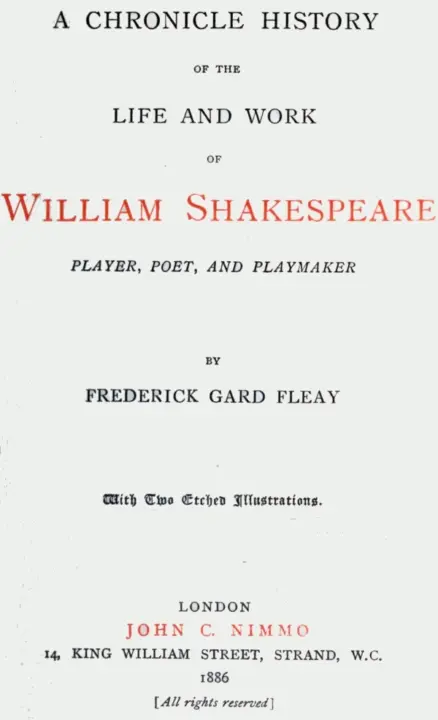
"A Chronicle History of the Life and Work of William Shakespeare" by Frederick Gard Fleay is a historical account written in the late 19th century. This work delves into the life and career of the iconic playwright William Shakespeare, examining his public and personal connections with other poets and dramatists of his time. Fleay not only recounts Shakespeare's biographical details but also analyzes the significant influence he had on English literature. The opening of the text sets the tone for a comprehensive examination of Shakespeare's career, emphasizing the importance of understanding his interactions with other figures in the theatrical community. Fleay critiques previous biographers for focusing excessively on trivial aspects of Shakespeare's personal life and instead aims to highlight the public dimensions of his career, such as the nature of the acting companies he was part of and the chronological order of his plays. The thorough introduction serves as a foundation for the detailed exploration of Shakespeare's life and work that unfolds in the subsequent sections of the book.
Introduction adapted from the source catalogue; source summaries may be automatically generated.
Free to read · English · 76,096 words · No account needed
MAKE TIME FOR A GOOD BOOK
On by default. Untick to stop anonymous reading totals. Each page counts after 10 seconds in view. How this works.
Anonymous counting is on unless you have switched it off.
Fair Em is the earliest play we certainly know of as acted by Lord Strange's company. It is alluded to by Greene in his address prefixed to his Farewell to Folly. He quotes as abusing of Scripture, "A man's conscience is a thousand witnesses," and "Love covereth the multitude of sins," and says these words were used by "two lovers on the stage arguing one another of unkindness." Greene's tract was written and entered S. R. 1st June 1587, but not published till 1591, when the address which mentions his Mourning Garment (S. R. November 2, 1590) was added. Fair Em dates, therefore, late in 1590. It was probably written by R. Wilson, and is certainly not a romantic, but a satirical play; else why should Greene have been offended at it?
In Sc. 14 of The Three Ladies of London, produced before 1584, Wilson uses the expression, "I, Conscience, am a thousand witnesses," and in his Three Lords and Three Ladies of London, acted at Court, Christmas 1588-9, Sc. 2, "Love doth cover heaps of cumbrous evils." In order to explain the nature of the satire in Fair Em, it is necessary to investigate a hitherto unnoticed identification of Worcester's 1586 company with the Admiral's, of the highest importance for stage history as determining the actors in Marlowe's early plays. On Twelfth Day 1585-6, "the servants of the Admiral and the Lord Chamberlain" acted at Court, i.e. the players of Lord Charles Howard, who held both these offices. Mr. Halliwell (Illustrations, p. 31) confused this Chamberlain with Lord Hunsdon, and takes the entry to refer to two companies. I sent him a correction of these and many other blunders, which he has never rectified, years ago--a fact which I should not notice had he not publicly complained that, with one or two exceptions, of whom I am not one, he had received no help of this kind. Of this Admiral's company in the plague year, 1586, there is no trace in London; but in that year, and that year only, a company travelled under the protection of the Earl of Worcester. They were licensed for this travel on 14th January, and were at Leicester in the course of the year (Shakespeare Society's Papers, iv.); their names were R. Browne, J. Tunstall (Dunstan), E. Allen, W. Harryson, T. Cooke, R. Jones, E. Browne, R. Andrews; all of whom were licensed, together with hired men, T. Powlton and W. Paterson, "Lord Harbard's man," i.e. a member of the company of Herbert Earl of Pembroke: a scratch company evidently, but containing names of celebrated London actors. In 1587 and 1588, the Admiral's men acted in London publicly, and at Christmas 1588-9 at Court. On 3d January 1588-9, Alleyn and Jones (acting evidently for the company) dissolved partnership, and Alleyn bought up their properties and play-books. In November the Admiral's men were playing about the City, and not at the Curtain, where they had probably produced Tamberlain, Faustus, Orlando, Alcazar, and Marius and Sylla; and in their Court performance on 23d December were reduced to showing "feats of activity." In 1590 R. Brown and Jones went abroad and acted at Leyden in October. They returned, and on December 27 and February 16 the Admiral's men acted at Court for the last time before the reconstitution of their company in 1594. Already R. Brown, J. Broadstreet, T. Sackville, and R. Jones had obtained a pass from Lord C. Howard, the Admiral, their patron, to travel to Germany by way of Holland, and a company acted there till 1617 under Sackville. Jones returned to England and joined the reconstituted Admiral's company under Allen in 1594. Alleyn had never relinquished the title of Admiral's servant, even when in Lord Strange's service in 1593. Putting these facts together, can there be any doubt that the service under Worcester was merely temporary, and that in the list of 1586 we have that of the principal actors in the Admiral's company? Mr. R. Simpson, to whom we owe so much as a discoverer of problems to be solved, and so little for their solution, rightly stated that Fair Em was a satirical play, and that Manvile (or Mandeville, the lying traveller) meant Greene, and Mounteney the aspiring Marlowe. He was wrong in identifying Valingford with Shakespeare--he was Peele (valing, an old castle or peele--Camden)--and doubly wrong in making William Conqueror Kempe. Robert of Windsor, his travelling name, points to Robert Browne; and it was to Browne's company that Marlowe and Peele had been attached, not to Kempe's. The names William Conqueror and Marquess Lubeck were probably names of characters which had been acted by Browne and Jones, perhaps in the play of William Conqueror, which was on the stage as an old play in 1593. Fair Em of Manchester is no doubt, as Mr. Simpson says, Lord Strange's company of players.
Your reading position is saved on this browser. Take it to another device with a library code. Reading pages adapt to text, rather than matching a printed edition.
BEHIND THE BOOK
This eBook is for the use of anyone anywhere in the United States and most other parts of the world at no cost and with almost no restrictions whatsoever. You may copy it, give it away or re-use it under the terms of the Project Gutenberg License included with this eBook or online at www.gutenberg.org. If you are not located in the United States, you will have to check the laws of the country where you are located before using this eBook. Read the source licence.
The original source file, including credits and licence, is retained by this library. Request an original-format copy at no charge. Please include the book title and Project Gutenberg identifier #46756.
KEEP YOUR CURIOSITY GOING
Cécile Tormay

Moritz Busch
John L. Ransom
Frances Wright
Cécile Tormay

Mabel Potter Daggett