THE CLASSIC COLLECTION✦An outlaw’s diary: the CommuneCLASSIC FREE BOOKS
An outlaw’s diary: the Commune
Cécile Tormay
THE CLASSIC COLLECTION · 1584
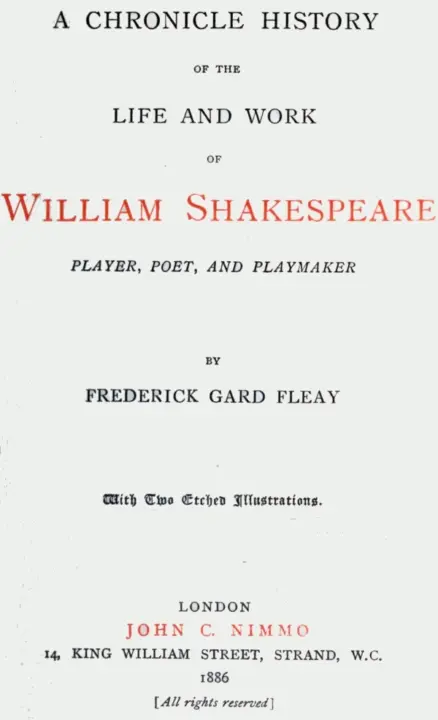
"A Chronicle History of the Life and Work of William Shakespeare" by Frederick Gard Fleay is a historical account written in the late 19th century. This work delves into the life and career of the iconic playwright William Shakespeare, examining his public and personal connections with other poets and dramatists of his time. Fleay not only recounts Shakespeare's biographical details but also analyzes the significant influence he had on English literature. The opening of the text sets the tone for a comprehensive examination of Shakespeare's career, emphasizing the importance of understanding his interactions with other figures in the theatrical community. Fleay critiques previous biographers for focusing excessively on trivial aspects of Shakespeare's personal life and instead aims to highlight the public dimensions of his career, such as the nature of the acting companies he was part of and the chronological order of his plays. The thorough introduction serves as a foundation for the detailed exploration of Shakespeare's life and work that unfolds in the subsequent sections of the book.
Introduction adapted from the source catalogue; source summaries may be automatically generated.
Free to read · English · 76,096 words · No account needed
MAKE TIME FOR A GOOD BOOK
On by default. Untick to stop anonymous reading totals. Each page counts after 10 seconds in view. How this works.
Anonymous counting is on unless you have switched it off.
I have not noticed here the many parallel passages from the works of Marlowe and others which confirm the assignment of authorship now advocated. It would be out of all proportion to give them here unless imperfectly: the reader will find some in Dyce's Marlowe, and more in my edition of Edward II. Nor have I noticed the schoolboy interpretation that explains "their" in Henry V., Epil. l. 13, as referring to 2 and 3 Henry VI.: "their," more Shakespeariano, like "they" in the previous line, refers in form to the "many" of l. 12, but in meaning to the actors of 1 Henry VI., in which play, and not in 3 Henry VI., the loss of France is treated of. It is also most unlikely that the 1600 edition of The Duke of York should have been issued as played by Pembroke's servants if the play had been previously acted by the Chamberlain's. Compare the parallel case of Andronicus. Miss Lee's statement, "Greene wrote, Nash tells us," more than four others "for Lord Pembroke's company," is absolutely without foundation. Nash says "the company" (Apology, 1593), and evidently alludes to the Queen's men, for whom Orlando, Bacon, Selimus, and The Looking-glass were written. In fact, Greene's only known connection with any other company was his fraudulent selling of Orlando a second time to the Admiral's. Marlowe, and he alone, is known as a writer for Pembroke's: Kyd may have been, however, and in my opinion was, a contributor to their stage.
Richard III. is closely connected with 3 Henry VI., and written with direct reference to it. In i. 2. 158, iv. 2. 98, iv. 4. 275, scenes in that play are plainly alluded to. Nor is it possible, if the two plays be read in immediate sequence, to avoid the feeling that they have a common authorship. On the other hand, a closer analysis shows that in Richard the Latin quotations, classical allusions, and peculiar animal similes which are characteristic of Henry have entirely disappeared. There are also discrepancies, such as Gray's fighting for the Lancastrians, i. 3. 130, whereas in 3 Henry VI., iii. 2. 2, he is represented as a Yorkist, which shows a different hand in the two plays. Richard III. has always been regarded as entirely Shakespeare's, and its likeness to 3 Henry VI. has more than anything else kept alive the untenable belief that this last-named play was also, in part or wholly, written by our greatest dramatist. Yet the unlikeness of Richard III. to the other historical plays of Shakespeare, and the impracticability of finding a definite position for it, metrically or æsthetically, in any chronological arrangement, have made themselves felt. Even cautious Mr. Halliwell says, "There are slight traces of an older play to be observed, passages which belong to an inferior hand;" and again, "To the circumstance of an anterior work having been used do we owe some of its weakness and excessively turbulent character" (Outlines, 94). A careful examination of the editions will be found to confirm and extend this conclusion. The 1597 Quarto Q{1}, which is evidently an abridged version made for the stage, and which no doubt was the version acted during nearly all Elizabeth's reign, differs from the Folio in a way not to be paralleled in any other Shakespearian play. Minute alterations have been made in almost every speech, in a fashion which could not have been customary with him who uttered his thoughts so easily as scarcely to make a blot (i.e. alteration) in his papers. The question of anteriority of the Q. and F. versions has been hotly debated on æsthetic grounds; but the mere expurgation of oaths and metrical emendations in F. are enough to show that it is the later version, probably made c. 1602; while the fact that it was preferred by the editors of the 1623 Folio shows that they considered it the authentic copy of Shakespeare's work. In other instances, Macbeth, The Tempest, &c., they have indeed given us abridged editions; but there is neither proof nor likelihood that any other were accessible. We do not know what original copies were destroyed in the Globe fire of 1613, and should be thankful for such versions as we have, which were probably the acting versions used at Blackfriars. But in this case the editors had at hand the Quartos, and unless they thought the Folio more authentic, I cannot see why they preferred it. Furthermore, the F. version appears to have been defective in some places; for v. 3. 50, end of play, and iii. 1. 17-165, are certainly printed from Q{3} (1602). This has been controverted, but on very insufficient grounds. Now directly we compare the Folio and Quarto versions, we meet with evidence that alteration and correction have been largely used in both of them. For instance, Derby is found as a character in the play in i. 1, ii. 1, 2, iv. 5, v. 5, in both versions; in iii. 1. 2, iv. 1, v. 2, he is called Stanley. This shows correction by a second hand. In iv. 1, while Stanley has been inserted in the text, Derby remains in the prefixes; v. 3 is only partially corrected, and both names occur. The names were not used indifferently, for in iv. 2, 4, we find Stanley in F. but Derby in Q. This shows a progressive correction in which Q. precedes F. It may be noticed that Darby is the original author's spelling. In like manner, Gloster, the original prefix, has in i. 1, 2, 3, ii. 1. 2, iii. 4, 5, 7, been replaced in F. by Richard, but in iii. 1, in the part printed from Q{3}, and there only, Gloster remains. So again Margaret is indicated in the older version by Qu. Mar., Qu. M., &c., but never Mar., as in F. iv. 4. In F. i. 3 we find by side of Mar. a remainder of the older form in Q. M. This is not an exhaustive statement, but sufficient I think to show that alterations were made, as I suggest. There can be little doubt that in this, as in John, Shakespeare derived his plot and part of his text from an anterior play, the difference in the two cases being that in Richard III. he adopted much more of his predecessor's text. I believe that the anterior play was Marlowe's, partly written for Lord Strange's company in 1593, but left unfinished at Marlowe's death, and completed and altered by Shakespeare in 1594. It was no doubt on the stage when, on 19th June 1594, the older play on Richard III., "with the conjunction of the two Houses of Lancaster and York," was entered S. R. That was acted by the Queen's players. The unhistorical but grandly classical conception of Margaret, the Cassandra prophetess, the Helen-Ate of the House of Lancaster, which binds the whole tetralogy into one work, is evidently due to Marlowe, and the consummate skill with which he has fused the heterogeneous contributions of his coadjutors in the two earlier Henry VI. plays is no less worthy of admiration. I do not think it possible to separate Marlowe's work from Shakespeare's in this play--it is worked in with too cunning a hand; but wherever we find Darby, Qu. M., Glo., &c., we may be sure that some of his handiwork is left. Could any critic, if the older John were destroyed, tell us which lines had been adopted in the later play? Nor can I enter, unless in a special monograph, on the relations of the Quartos to each other. The question is of no importance, and I need only say that the usual corruptions take place from Q{1} to Q{5}, and that in Q{6} (1622) many readings are found agreeing with F. which are not in the other Quartos. The same phenomenon is observed in the 1619 edition of The Whole Contention, and far too much has been made of it. It merely indicates correction by attendance at the theatre and picking up a few words during the action. The only Quartos deserving special notice are Q{1}, as containing Shakespeare's first "additions," and Q{3}, as having been used in printing part of F. I do not think the allusion in Weever's Epigrams, written 1595-6, is to this play. It may be so.
Your reading position is saved on this browser. Take it to another device with a library code. Reading pages adapt to text, rather than matching a printed edition.
BEHIND THE BOOK
This eBook is for the use of anyone anywhere in the United States and most other parts of the world at no cost and with almost no restrictions whatsoever. You may copy it, give it away or re-use it under the terms of the Project Gutenberg License included with this eBook or online at www.gutenberg.org. If you are not located in the United States, you will have to check the laws of the country where you are located before using this eBook. Read the source licence.
The original source file, including credits and licence, is retained by this library. Request an original-format copy at no charge. Please include the book title and Project Gutenberg identifier #46756.
KEEP YOUR CURIOSITY GOING
Cécile Tormay

Moritz Busch
John L. Ransom
Frances Wright
Cécile Tormay

Mabel Potter Daggett