THE CLASSIC COLLECTION✦An outlaw’s diary: the CommuneCLASSIC FREE BOOKS
An outlaw’s diary: the Commune
Cécile Tormay
THE CLASSIC COLLECTION · 1584
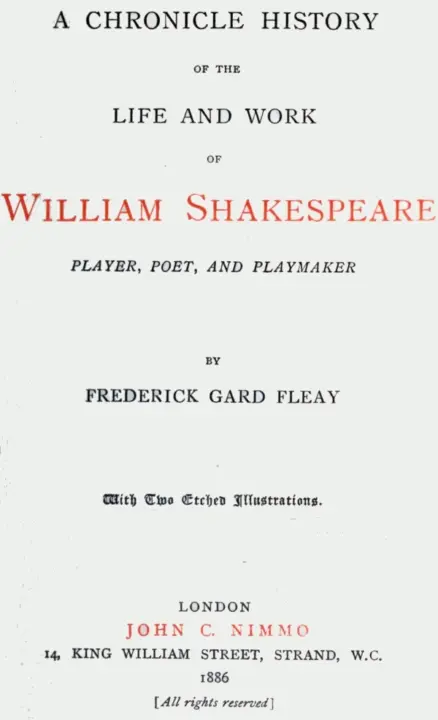
"A Chronicle History of the Life and Work of William Shakespeare" by Frederick Gard Fleay is a historical account written in the late 19th century. This work delves into the life and career of the iconic playwright William Shakespeare, examining his public and personal connections with other poets and dramatists of his time. Fleay not only recounts Shakespeare's biographical details but also analyzes the significant influence he had on English literature. The opening of the text sets the tone for a comprehensive examination of Shakespeare's career, emphasizing the importance of understanding his interactions with other figures in the theatrical community. Fleay critiques previous biographers for focusing excessively on trivial aspects of Shakespeare's personal life and instead aims to highlight the public dimensions of his career, such as the nature of the acting companies he was part of and the chronological order of his plays. The thorough introduction serves as a foundation for the detailed exploration of Shakespeare's life and work that unfolds in the subsequent sections of the book.
Introduction adapted from the source catalogue; source summaries may be automatically generated.
Free to read · English · 76,096 words · No account needed
MAKE TIME FOR A GOOD BOOK
On by default. Untick to stop anonymous reading totals. Each page counts after 10 seconds in view. How this works.
Anonymous counting is on unless you have switched it off.
Between August and October, the Theater having become ruinous, and litigation between James Burbadge, its lessee, and Giles Alleyn, the ground landlord, being imminent, the Chamberlain's company removed to the Curtain. The Earl of Pembroke's company, who have for controversial purposes been unjustifiably confused with the Chamberlain's, in August acted as strollers at Rye, in September at Dover, and on their return to London amalgamated with the Admiral's, and acted at the Rose. Among the plays acted by Shakespeare's company at the Curtain was Romeo and Juliet, as appears from a singular allusion in Marston's Satires, which also serves to show that this play then, as now, was one of the most popular of his productions. But his popularity is shown in another way this year. Coincidently with the removal to the Curtain, we find the first appearance of authorised publication of his plays, Richard II. having been entered S. R. on 29th August, and Richard III. on 20th October. The Romeo and Juliet printed this year was neither entered nor authorised. On 26th December Love's Labour's Lost was acted at Court, being one of four plays provided for the Christmas festivities by this company. It was probably specially commanded, and the alterations from the 1589 version, which were very hurriedly done, were almost certainly made on this occasion.
On 25th February 1598, the first part of Henry IV. was printed, and the second part was acted soon after. The popularity of these plays caused a re-issue in this year of the old Queen's play of The Famous Victories of Henry V., brought out in order that the purchaser might imagine he was procuring a copy of Shakespeare's plays. The genuine Henry IV., for this and reasons alluded to above connected with the elimination of Oldcastle's name, was published earlier after its production on the stage than usual. For the same reason this alteration was expressly alluded to in the Epilogue to 2 Henry IV., "Oldcastle is not the man." In this same year Much Ado about Nothing (probably a recast of Love's Labour's Won) was performed. On 7th September was entered S. R., Meres' Wit's Treasury, which contains, among many encomiums of Shakespeare, a list of twelve of his plays. This tract was demonstrably not written till June, and the plays are manifestly those that had been produced by Shakespeare during the existence of the Chamberlain's company. These are: Gentlemen of Verona (1595), Errors (1594), Love's Labour's Lost (1597), Love's Labour's Won (1598), Midsummer Night's Dream (1595), and Merchant of Venice (1597); Richard II. (1595), Richard III. (1594), Henry IV. (1597), King John (1596), Titus Andronicus (1594), and Romeo and Juliet (1596). Plays produced before or in 1594 that had not been recast after that year are not mentioned; for instance, 1 Henry VI. (1592), Troylus and Cressida (1593), The Merry Wives of Windsor (1592), and Edward III. (1594). This list is of the highest value, when rightly understood, in determining the order of production of the plays. Another event, important to the welfare of the Chamberlain's company, was the introduction of Ben Jonson as a play-writer for their stage. This took place in September, and there is no reason for doubting the tradition that he was introduced to them by Shakespeare, who acted in Every Man in his Humour, as it was published in the Quarto, before the end of the year. The fact that the Chamberlain's men acted three plays at Court during the Christmas festivities, closes the theatrical record for 1598, but one or two other details remain to be noticed. The establishment of peace on May 2 by the treaty of Vervins, compared with Sonnet 107, "olives of endless age," fixes the conclusion of these effusions as about this time, and Southampton's marriage at the end of the year precluded the need of their continuance. They probably were finished before Meres' mention of them in Wit's Treasury (written c. July) as Shakespeare's "sugared sonnets among his private friends." Little details of evidence are also extant, showing that since his purchase of New Place, Shakespeare's residence was partly in the country. On 4th February he appears as third largest owner of corn in his ward at Stratford, and in October we find him procuring a loan of £30 in London, for his friend and countryman Richard Quiney. His London residence at this time was in St. Helen's, Bishopsgate; but still earlier than this, on 24th January, he was in negotiation about the purchase of some thirty acres of land at Shottery, and Abraham Sturley wrote from Stratford to his brother-in-law, the same Richard Quiney, urging him to suggest to Shakespeare the purchase of the corporation tithe-lease; it "would advance him indeed, and would do us much good," says Sturley.
Your reading position is saved on this browser. Take it to another device with a library code. Reading pages adapt to text, rather than matching a printed edition.
BEHIND THE BOOK
This eBook is for the use of anyone anywhere in the United States and most other parts of the world at no cost and with almost no restrictions whatsoever. You may copy it, give it away or re-use it under the terms of the Project Gutenberg License included with this eBook or online at www.gutenberg.org. If you are not located in the United States, you will have to check the laws of the country where you are located before using this eBook. Read the source licence.
The original source file, including credits and licence, is retained by this library. Request an original-format copy at no charge. Please include the book title and Project Gutenberg identifier #46756.
KEEP YOUR CURIOSITY GOING
Cécile Tormay

Moritz Busch
John L. Ransom
Frances Wright
Cécile Tormay

Mabel Potter Daggett