THE CLASSIC COLLECTION✦An outlaw’s diary: the CommuneCLASSIC FREE BOOKS
An outlaw’s diary: the Commune
Cécile Tormay
THE CLASSIC COLLECTION · 1584
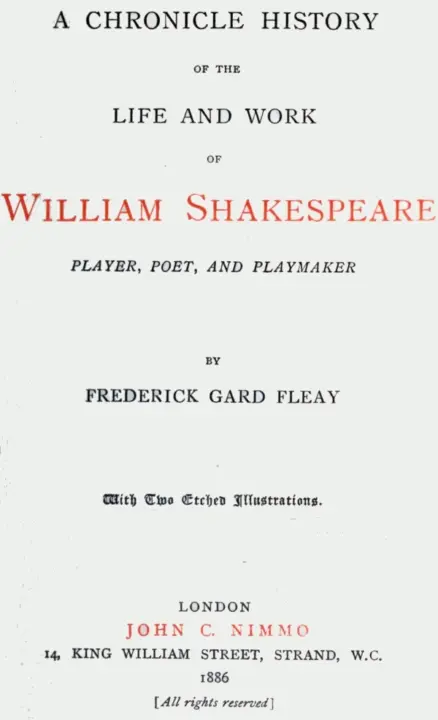
"A Chronicle History of the Life and Work of William Shakespeare" by Frederick Gard Fleay is a historical account written in the late 19th century. This work delves into the life and career of the iconic playwright William Shakespeare, examining his public and personal connections with other poets and dramatists of his time. Fleay not only recounts Shakespeare's biographical details but also analyzes the significant influence he had on English literature. The opening of the text sets the tone for a comprehensive examination of Shakespeare's career, emphasizing the importance of understanding his interactions with other figures in the theatrical community. Fleay critiques previous biographers for focusing excessively on trivial aspects of Shakespeare's personal life and instead aims to highlight the public dimensions of his career, such as the nature of the acting companies he was part of and the chronological order of his plays. The thorough introduction serves as a foundation for the detailed exploration of Shakespeare's life and work that unfolds in the subsequent sections of the book.
Introduction adapted from the source catalogue; source summaries may be automatically generated.
Free to read · English · 76,096 words · No account needed
MAKE TIME FOR A GOOD BOOK
On by default. Untick to stop anonymous reading totals. Each page counts after 10 seconds in view. How this works.
Anonymous counting is on unless you have switched it off.
Transcriber's Note.
A list of the changes made can be found at the end of the book. Formatting and special characters are indicated as follows:
italic
_{subscript}
^{superscript}
[=i] i with macron
[)i] i with inverted breve
With Two Etched Illustrations.
LONDON
JOHN C. NIMMO
14, KING WILLIAM STREET, STRAND, W.C.
1886
[All rights reserved]
Dedication.
To him, whose craft, so subtly terse,
(While lesser minds, for music's sake,
From single thoughts whole cantos make),
Includes a poem in a verse;--
To him, whose penetrative art,
With spheric knowledge only his,
Dissects by keen analysis
The wiliest secrets of the heart;--
To him, who rounds us perfect wholes,
Where wisdom, wit, and love combine;
Chief praise be this:--he wrote no line
That could cause pain in childlike souls.
APPENDIX 319 TABLES 324 I. QUARTO EDITIONS OF SHAKESPEARE'S PLAYS 324 II. QUARTO EDITIONS OF OTHER PLAYS PERFORMED BY SHAKESPEARE'S COMPANY 326 III. NUMBER OF PERFORMANCES AT COURT, 1584-1616 327 IV. ENTRIES OF PLAYS IN THE STATIONERS' REGISTERS, 1584-1640 328 V. TRANSFERS OF COPYRIGHT IN PLAYS, 1584-1640 350 SUPPLEMENTARY TABLE OF MOSELEY'S ENTRIES IN 1653 AND 1660, AND WARBURTON'S LIST 358 INDEX 361 NOTE ON ETCHINGS 364
IT is due to the reader of a new work on a subject already so often handled as the Life of Shakespeare to tell him at the outset what he may expect to find therein, and to state the reasons for which I have thought it worth while to devote nearly ten years to its production. Previous investigators have with industrious minuteness already ascertained for us every detail that can reasonably be expected of Shakespeare's private life. With laborious research they have raked together the records of petty debts, of parish assessments, of scandalous traditions, of idle gossip; and they have shown beyond doubt that Shakespeare was born at Stratford-on-Avon, was married, had three children, left his home, made money as an actor and play-maker in London, returned to his native town, invested his savings there, and died. I do not think that when stript of verbiage, and what the slang of the day calls padding, much more than this can be claimed as the result of the voluminous writings on this side of his career. For one I am thankful that things are so; I have little sympathy with the modern inquisitiveness that peeps over the garden wall to see in what array the great man smokes his pipe, and chronicles the shape and colour of his head-covering. But on the public side of Shakespeare's career little has been adequately ascertained; and with this we are deeply concerned. Not for a mere personal interest, but in its bearings on the history of English literature, we ought to ascertain so far as is possible what companies of actors Shakespeare belonged to, at what theatres they acted, in what plays besides his own he was a performer, what authors this brought him into personal contact with, what influence he exerted on or received from them, what relations, friendly or unfriendly, they had with rival companies, and finally, in what order his own works were produced, and what if any share other hands had in their production. All these matters have been treated carelessly and inaccurately by biographers of the peeping school; and in the last of these we are gravely referred for the chronology of Shakespeare's plays to a schoolboy compilation the author of which is so ignorant as to speak of Lust's Dominion as a play of Jonson's, the News from Hell as a play of Dekker's, and Achilles as Laertes' son. This marvel of inefficiency we are told is the best work on the subject; and this while Malone and Drake are accessible to any student. In the present treatise this hitherto neglected side of Shakespeare's career has been chiefly dwelt on. The facts of his private life are also given; but not the documents on which they are founded, these having been excellently well collected and arranged in the recent Outlines of the Life of Shakespeare, by J. O. Halliwell-Phillipps, F.R.S., F.S.A., Hon. M.R.S.L., Hon. M.R.I.A. This book is a treasure-house of documents, and it is greatly to be regretted that they are not published by themselves, apart from hypotheses founded on idle rumour or fallacious mis-reasoning. I do not know any work so full of fanciful theories and "ignes fatui" likely to entice "a deluded traveller out of the beaten path into strange quagmires."[1] There is much else besides documents not given in the present treatise; discussions as to who might have been Shakespeare's schoolmaster, whether he was apprenticed to a butcher, whether he stole a deer out of a non-existent park, whether he held horses at the theatre door or "was employed in any other equine capacity," whether he went to Denmark or to Venice, and whether Lord Bacon wrote his plays for him. On all these points I must refer to earlier and less sceptical treatises. What the reader will find here is--(1.) A continuous narrative in which the statements are mostly taken for granted in accordance with my own view of the evidence accessible to us; (2.) Annals or chronological arrangement of the same facts, with discussion of their mutual interrelations; (3.) Discussion of the evidence on which the chronological succession of Shakespeare's plays is based; (4.) Similar discussions for plays in which he was not main author but only "coadjutor, novice, journeyman, tutor," or even merely one of the possible actors; (5.) A few remarks on the German versions of his plays acted on the Continent; and (6.) Tables of quarto editions of his plays, &c., with a list of all plays entered on the Stationers' Registers from the first opening of theatres to their closing in 1640-42. This last item may seem to be somewhat beyond the scope of this book, but it is greatly needed, and it is better that so difficult a task should be performed by one acquainted with dramatic literature than by some scissors-and-paste compiler who cannot distinguish a play from a prose tract. As to the preparation for the whole work it has been to me a labour of love, not, I trust, altogether lost. I have read and re-read for it every play accessible to me that dates earlier than 1640, have compiled annals for every known writer of that period and discussions of the dates of his plays, and have compared the results and corrected and re-corrected until a consistent whole has been obtained. Of this whole only the part relating to Shakespeare is here issued. I have to thank the editors of Anglia Englische Studien and Shakespeariana for enabling me to print some portions relating to other authors, which will, however, require some minor corrections. I have also to thank Dr. Furnivall and Mr. Swinburne for some wholesome criticism upon my earlier work; Dr. Ingleby, Miss Lee, Mr. Boyle, Mr. A. H. Bullen, and especially Dr. H. H. Furness, for kindly sympathy and copies of their own writings, some of which might otherwise have escaped my notice; and above all Mr. P. A. Daniel, for ever-ready help when asked for, and for judicious strictures on received hypotheses or points debatable. The main regret for the earnest student is that so many of these still exist; as any attempt to give a biography of Shakespeare the form which is æsthetically its due must fail so long as the true order of the facts on which it rests is still esteemed matter of argument. If the reader would wish to judge before proceeding further of the quality of such argument in the present work I would refer him to the discussion on Mucedorus or that on Henry VI. in subsequent Sections.
Your reading position is saved on this browser. Take it to another device with a library code. Reading pages adapt to text, rather than matching a printed edition.
BEHIND THE BOOK
This eBook is for the use of anyone anywhere in the United States and most other parts of the world at no cost and with almost no restrictions whatsoever. You may copy it, give it away or re-use it under the terms of the Project Gutenberg License included with this eBook or online at www.gutenberg.org. If you are not located in the United States, you will have to check the laws of the country where you are located before using this eBook. Read the source licence.
The original source file, including credits and licence, is retained by this library. Request an original-format copy at no charge. Please include the book title and Project Gutenberg identifier #46756.
KEEP YOUR CURIOSITY GOING
Cécile Tormay

Moritz Busch
John L. Ransom
Frances Wright
Cécile Tormay

Mabel Potter Daggett