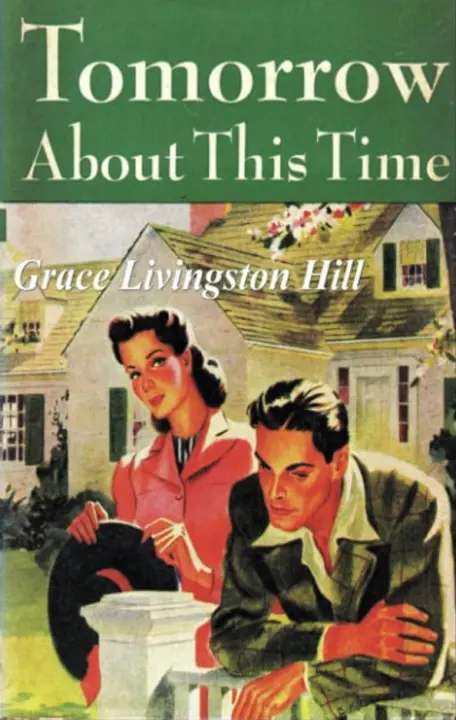
Tomorrow about this time
Grace Livingston Hill
THE CLASSIC COLLECTION · 1887
"A Chautauqua Idyl" by Grace Livingston Hill is a narrative written in the late 19th century that falls under the category of a philosophical allegory. The book centers around the Chautauqua movement, highlighting themes of education, spirituality, and community. It weaves a story through the perspectives of various flower and animal characters who discuss their desire for gathering and learning in a celebratory way that honors their creator. In the story, a group of flowers and creatures living near a brook yearn for something meaningful to do, leading to the idea of creating a Chautauqua gathering. They talk about the experiences of a new arrival, a bachelor button, who shares tales of a beautiful place where people come together to study and sing about God and nature. As they debate what their own Chautauqua should consist of, they explore topics such as theology, literature, and art. Each character brings their own unique contributions to the committee planning their event, culminating in a hopeful undertaking designed to celebrate their existence and the beauty of God's creation. The narrative illustrates the joy of collaboration, the importance of knowledge, and the power of collective praise.
Introduction adapted from the source catalogue; source summaries may be automatically generated.
Free to read · English · 10,364 words · No account needed
MAKE TIME FOR A GOOD BOOK
On by default. Untick to stop anonymous reading totals. Each page counts after 10 seconds in view. How this works.
Anonymous counting is on unless you have switched it off.
“Yes, I see. As the young leaves and flowers unfold. The plants must take full charge of this department, I think. I remember once turning over the leaves of a fat, dark-gray book, with gilt letters on its back. It lay on a minister’s window-seat, and it looked interesting, so I read a few minutes while the minister was out and not using it, and among other things that I read was this, and it stayed with me ever since: ‘A lily grows mysteriously. Shaped into beauty by secret and invisible fingers, the flower develops, we know not how. Every day the thing is done: it is God.’ You see, my dear,” addressing himself to a pure white lily that had only that morning unfolded its delicate petals to the sun, “you see a great many don’t understand how it is done. You need to tell how God has made you able to unfold.”
“Yes, we will, we can,” they all cried.
“The flowers will speak on Evolution,” wrote down Woodpecker.
“There are three more words spoken by our friend Fish, still
unexplained,—literature,—”
“I know what literature means, Mr. Wind, it is books,” announced a bright butterfly who had just arrived on the scene.
“Are you sure?” questioned the fish doubtfully.
“Yes; of course I am. I went with a big pinch-bug one day into a great room full of books, and he said, when he saw the shelves and shelves full of them, ‘My! what a lot of literature!’”
The committee looked convinced, but now came the question of books,—Where should they get them? How could they lecture on books, when they knew nothing about them?
“We must just send word around to all the flowers and birds and trees and everything, to see who can lecture on books, and we must all keep our eyes and ears open,” said a buttercup bud.
“We shall have to lay that on the table for the present,” said the wind.
“But we haven’t any table,” chattered a squirrel.
“A well brought-up squirrel should know better than to interrupt. We shall have to put this aside, then, until we can learn more about it. In the meantime, let us proceed with the next word on the list, poetry.”
“I know,” said the brook. “A bit of paper lay upon my bank, miles and miles away from here, too high up for me to reach, but I could read it. It said, ‘For poetry is the blossom and the fragrance of all human knowledge.’ And I have said it over and over all the way here.”
“Ah! the flowers shall give us poetry,” said the good old wind.
Your reading position is saved on this browser. Take it to another device with a library code. Reading pages adapt to text, rather than matching a printed edition.
Grace Livingston Hill
Grace Livingston Hill
Grace Livingston Hill
Grace Livingston Hill
BEHIND THE BOOK
This eBook is for the use of anyone anywhere in the United States and most other parts of the world at no cost and with almost no restrictions whatsoever. You may copy it, give it away or re-use it under the terms of the Project Gutenberg License included with this eBook or online at www.gutenberg.org. If you are not located in the United States, you will have to check the laws of the country where you are located before using this eBook. Read the source licence.
The original source file, including credits and licence, is retained by this library. Request an original-format copy at no charge. Please include the book title and Project Gutenberg identifier #51103.
KEEP YOUR CURIOSITY GOING

David Patterson (Spirit) Hatch

David Patterson (Spirit) Hatch

David Patterson (Spirit) Hatch
Coulson Kernahan

Maurice Baring
Frances Wright