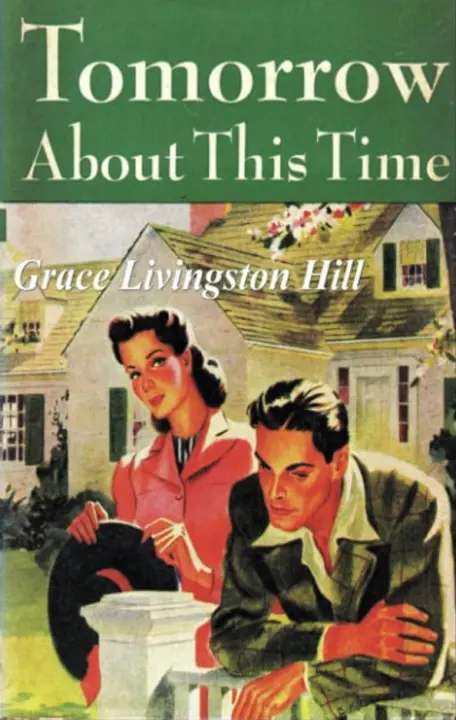
Tomorrow about this time
Grace Livingston Hill
THE CLASSIC COLLECTION · 1887
"A Chautauqua Idyl" by Grace Livingston Hill is a narrative written in the late 19th century that falls under the category of a philosophical allegory. The book centers around the Chautauqua movement, highlighting themes of education, spirituality, and community. It weaves a story through the perspectives of various flower and animal characters who discuss their desire for gathering and learning in a celebratory way that honors their creator. In the story, a group of flowers and creatures living near a brook yearn for something meaningful to do, leading to the idea of creating a Chautauqua gathering. They talk about the experiences of a new arrival, a bachelor button, who shares tales of a beautiful place where people come together to study and sing about God and nature. As they debate what their own Chautauqua should consist of, they explore topics such as theology, literature, and art. Each character brings their own unique contributions to the committee planning their event, culminating in a hopeful undertaking designed to celebrate their existence and the beauty of God's creation. The narrative illustrates the joy of collaboration, the importance of knowledge, and the power of collective praise.
Introduction adapted from the source catalogue; source summaries may be automatically generated.
Free to read · English · 10,364 words · No account needed
MAKE TIME FOR A GOOD BOOK
On by default. Untick to stop anonymous reading totals. Each page counts after 10 seconds in view. How this works.
Anonymous counting is on unless you have switched it off.
“What gates?” interrupted the eager daisies.
“Why, the gates of the grounds.”
“What grounds?”
“Why, the grounds of Chautauqua.”
“But who is Chautauqua?” asked the puzzled violets.
“Don’t you know? Chautauqua is a beautiful place in the woods, shut in from the world by a high fence all around it, with locked gates. It is on the shore of a lovely lake. Many people come there every year, and they have meetings, and they sing beautiful songs about birds and flowers and sky and water and God and angels and dear little babies and stars. Men come there from all over this world, and stand up and talk high, grand thoughts, and the people listen and wave their handkerchiefs till it looks like an orchard full of cherry trees in blossom.
“They have lovely singers—ladies who sing alone as sweet as birds, and they have great grand choruses of song besides, by hundreds of voices. And they have instruments to play on,—organs and pianos, and violins and harps.”
“How beautiful,” murmured the flowers.
“Tell us more,” said the brook; “tell us more, more, more,—tell, tell,
tell!”
“More, more,” said the wind.
“It lasts all summer, so the people who can’t come at one time will come at another, though my cousin said she thought that one day all the people in the world came at once. There must have been something very grand to bring so many that day. There were not enough rooms for visitors to sleep in, and Chautauqua is a large place, the largest I was ever in. Yes,” reflectively, “I think all the world must have been there.”
The little white violet looked up.
“There was one day last summer when no one came through the pasture, and no one went by on the road, and all day long we saw not one person. It must have been that day, and they were all gone to Chautauqua,” she said softly.
“I shouldn’t wonder at all,” said Bachelor.
Then they all looked sober and still. They were thinking. The idea that all the people in the world had come together for a day was very great to them.
At last one spoke:
“How nice it would be if all the flowers in the world could come together for a day,” said the little violet.
“And all the birds,” chirped a sparrow.
“And all the brooks and lakes and ocean,” laughed the brook.
“And all the trees,” sighed the tall elm.
“Oh! and all the winds. We could make as beautiful music as ever any
organ or piano made.”
“But what is it all for?” asked a bright-eyed daisy.
Your reading position is saved on this browser. Take it to another device with a library code. Reading pages adapt to text, rather than matching a printed edition.
Grace Livingston Hill
Grace Livingston Hill
Grace Livingston Hill
Grace Livingston Hill
BEHIND THE BOOK
This eBook is for the use of anyone anywhere in the United States and most other parts of the world at no cost and with almost no restrictions whatsoever. You may copy it, give it away or re-use it under the terms of the Project Gutenberg License included with this eBook or online at www.gutenberg.org. If you are not located in the United States, you will have to check the laws of the country where you are located before using this eBook. Read the source licence.
The original source file, including credits and licence, is retained by this library. Request an original-format copy at no charge. Please include the book title and Project Gutenberg identifier #51103.
KEEP YOUR CURIOSITY GOING

David Patterson (Spirit) Hatch

David Patterson (Spirit) Hatch

David Patterson (Spirit) Hatch
Coulson Kernahan

Maurice Baring
Frances Wright