THE CLASSIC COLLECTION✦In the Heart of a FoolCLASSIC FREE BOOKS
In the Heart of a Fool
William Allen White
THE CLASSIC COLLECTION · 1909
"A Certain Rich Man" by William Allen White is a novel written in the early 20th century. The story is set against the backdrop of a small town in Kansas during the tumultuous years leading up to and including the Civil War. The narrative focuses on young John Barclay, his childhood adventures, and the unfolding drama as his community grapples with issues of freedom and conflict, particularly through the relationships with key figures like Philemon Ward and the dynamics of the war. At the start of the novel, the reader is introduced to a group of boys at play in the woods, unaware of the historical significance surrounding their actions. John Barclay is depicted as a free-spirited child who enjoys imaginative games, evoking innocence amidst the larger conflicts brewing around him. The narrative quickly shifts to a pivotal moment in John’s life as he encounters a band of Indians, setting the stage for subsequent reflections on migration, freedom, and the personal cost of war. His experiences are colored by memories of his father’s abolitionist beliefs and the struggles faced by his mother, weaving a rich tapestry of familial bonds, community spirit, and the moral questions surrounding the Civil War.
Introduction adapted from the source catalogue; source summaries may be automatically generated.
Free to read · English · 159,948 words · No account needed
MAKE TIME FOR A GOOD BOOK
On by default. Untick to stop anonymous reading totals. Each page counts after 10 seconds in view. How this works.
Anonymous counting is on unless you have switched it off.
But the recollection of those days, so vivid and so sweet, is one of her choicest treasures. Of course things were not as she saw them. Jake Dolan was only in his forties then, and considered himself a young man. But the child remembers him as a tall, brown-eyed man whom she saw on state occasions in his faded blue army clothes, and to her he has always been the picture of a veteran. Some one must have told her--though she cannot remember who it was--that as Jake Dolan gently descended the social and political scale, he sloughed off his worldly goods, and as he moved about in the court-house from the sheriff's office to the deputy's office, and from the deputy's to the bailiff's, and from the bailiff's to the constable's, and from the constable's to the janitor's room in the basement, he carried with him the little bundle that contained all his worldly goods, the thin blue uniform, spotless and trim, and his lieutenant's commission, and mustering-out papers from the army. It is odd, is it not, that this prosaic old chap, who smoked a clay pipe, and whose only accomplishment was the ability to sing "The Hat me Father Wore," under three drinks, and the "Sword of Bunker Hill," under ten, should have epitomized all that was heroic in this child's memory. As for General Philemon Ward,--a dear old crank who, when Jeanette was born, was voting with the Republican party for the first time since the war, and who ran twice for President on some strange issue before she was in long dresses,--General Ward, whose children's ages could be guessed by the disturbers of the public peace, whose names they bore,--Eli Thayer, Mary Livermore, Elizabeth Cady Stanton, Frances Willard, Neal Dow, Belva Lockwood, and Helen Gougar,--General Ward, who scorned her father's offer of ten thousand dollars a year as state counsel for the National Provisions Company, and went out preaching fiat money and a subtreasury for the farmers' crops, trusting to God and the flower garden about his little white house, to keep the family alive--it is odd that Jeanette's childish impression was that General Ward was a man of consequence in the world. Perhaps his white necktie, his long black coat, and his keen lean face, or his prematurely gray hair, gave her some sort of a notion of his dignity, but whatever gave her that notion she kept it, and though in her later life there came a passing time when she hated him, she did not despise him. And what with the song that she heard the bands playing all over the country, the song that the bands sometimes played for Americans in Europe, very badly, as though it was being translated from English into broken French or Italian, what with Watts McHurdie's fame and with his verses that appeared in the Banner on formal occasions, the girl built a fancy of him as one of the world's great poets--some one like Shakespeare or Milton; and she was well into her teens before she realized the truth, that he was an excellent harness maker who often brought out of his quaint little dream world odd-shaped fancies in rhyme,--some grotesque, some ridiculous, and some that seemed pretty for a moment,--and who under the stress of a universal emotion had rhymed one phase of our common nature and set it to a simple tune that moved men deeply without regard to race or station. So she lived in her child world--a world quite different from the real world--a world gilded by the sunrise of consciousness; and because the angels loved her and kept her heart clean, the gilding never quite wore off her heroes. And nothing that Heaven gives us in this world is so blessed as to have the gilding stick to the images of our youth. In Jeanette's case even Lige Bemis--Judge Bemis, she had been taught to call him--never showed the tar under the gilding to her eyes. Her first memory of him was in her father's office in the big City. He was a tall man, with gray hair that became him well, with sharp black eyes, and enough flesh on his bones to carry the frock-coats he always wore and give him a corporosity just escaping the portly. She remembers seeing the name "E. W. Bemis" in gold letters on the door of his room, and not being able to figure out how a man whose name began with "E" or "W" could be called Lige. He was General Counsel of the Corn Belt Railroad in those days, when her father was president of the road, and she knew that he was a man always to be considered. And when, as a woman grown, she learned the truth about Lige Bemis, it was hard to believe, for all she could find against him was his everlasting smile.
Your reading position is saved on this browser. Take it to another device with a library code. Reading pages adapt to text, rather than matching a printed edition.
William Allen White
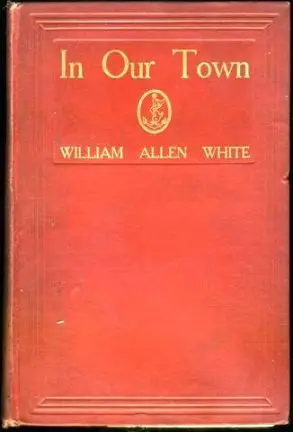
William Allen White
William Allen White
BEHIND THE BOOK
This eBook is for the use of anyone anywhere in the United States and most other parts of the world at no cost and with almost no restrictions whatsoever. You may copy it, give it away or re-use it under the terms of the Project Gutenberg License included with this eBook or online at www.gutenberg.org. If you are not located in the United States, you will have to check the laws of the country where you are located before using this eBook. Read the source licence.
The original source file, including credits and licence, is retained by this library. Request an original-format copy at no charge. Please include the book title and Project Gutenberg identifier #18684.
KEEP YOUR CURIOSITY GOING
Cécile Tormay

Moritz Busch
Coulson Kernahan
John L. Ransom

Maurice Baring
Frances Wright