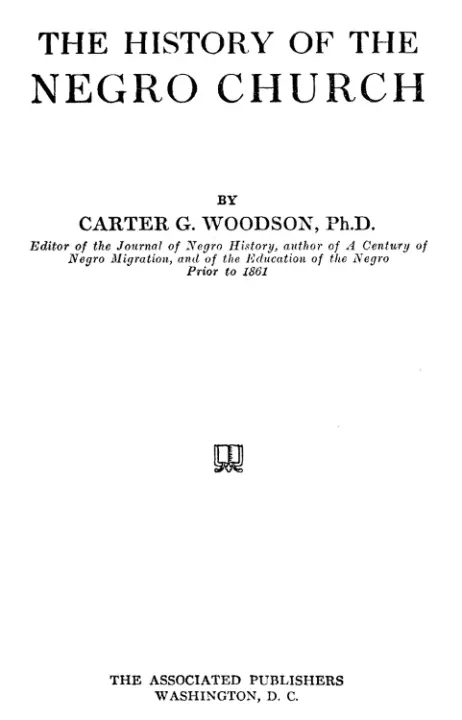
The History of the Negro Church
Carter Godwin Woodson
THE CLASSIC COLLECTION · 1918
"A Century of Negro Migration" by Carter G. Woodson is a historical account written during the early 20th century. The book explores the significant movements of African Americans, particularly their migration from the Southern States to the Northern regions of the United States, highlighting the socio-political context and motivations behind these movements. Woodson aims to provide a comprehensive overview of this migration phenomenon, connecting it with earlier migrations dating back to before the Civil War. At the start of the work, Woodson presents a preface noting that the migration of African Americans is a developing socio-historical event, emphasizing the newly acquired freedom that compels the population to seek better opportunities. He references the historical context of earlier migrations, the initial thoughts about the future of black Americans, and their ongoing struggles against oppression. The opening chapters outline how various external factors, such as the influence of Quakers and the challenges of acquiring asylum in the North, played pivotal roles in shaping the migratory patterns of black Americans. Woodson provides insight into the societal attitudes faced by migrants and the legacy of slavery that complicated their pursuit of freedom and equality.
Introduction adapted from the source catalogue; source summaries may be automatically generated.
Free to read · English · 52,803 words · No account needed
MAKE TIME FOR A GOOD BOOK
On by default. Untick to stop anonymous reading totals. Each page counts after 10 seconds in view. How this works.
Anonymous counting is on unless you have switched it off.
[Footnote 11: Mention was thereafter made of slaves as in the case of Captain Philip Pittman who in 1770 wrote of one Mr. Beauvais, "who owned 240 orpens of cultivated land and eighty slaves; and such a case as that of a Captain of a militia at St. Philips, possessing twenty blacks; and the case of Mr. Bales, a very rich man of St. Genevieve, Illinois, owning a hundred Negroes, beside having white people constantly employed."--See Captain Pittman's The Present State of the European Settlements in the Mississippi, 1770.]
[Footnote 12: Dunn, Indiana, chap. vi.]
[Footnote 13: Hinsdale, Old Northwest, p. 350.]
[Footnote 14: Tyrannical Libertymen, pp. 10, 11; Locke,
Anti-Slavery, pp. 31, 32; Brannagan, Serious Remonstrance,
p. 18.]
[Footnote 15: Washington edition of Jefferson's Writings, chap. vi, p. 456, and chap. viii, p. 380.]
[Footnote 16: Ford edition of Jefferson's Writings, III, p. 244;
IX, p. 303; X, pp. 76, 290.]
[Footnote 17: Brannagan, Serious Remonstrances, p. 18.]
[Footnote 18: Library edition of Jefferson's Writings, X, pp. 295,
296.]
[Footnote 19: Adams, Neglected Period of Anti-Slavery, pp. 129,
130.]
[Footnote 20: The Pennsylvania Gazette, July 31, 1746.]
[Footnote 21: The Maryland Gazette, March 20, 1755.]
[Footnote 22: Washington's Writings, II, p. 134.]
[Footnote 23: Brissot de Warville, New Travels, II, pp. 33-34.]
[Footnote 24: Harris, Slavery in Illinois, chaps. iii, iv, and v;
Dunn, Indiana, pp. 218-260; Hinsdale, Old Northwest, pp.
351-358.]
[Footnote 25: This code provided that all male Negroes under fifteen, years of age either owned or acquired must remain in servitude until they reached the age of thirty-five and female slaves until thirty-two. The male children of such persons held to service could be bound out for thirty years and the female children for twenty-eight. Slaves brought into the territory had to comply with contracts for terms of service when their master registered them within thirty days from the time he brought them into the territory. Indentured black servants were not exactly sold, but the law permitted the transfer from one owner to another when the slave acquiesced in the transfer before a notary, but it was often done without regard to the slave. They were even bequeathed and sold as personal property at auction. Notices for sale were frequent. There were rewards for runaway slaves. Negroes whose terms had almost expired were kidnapped and sold to New Orleans. The legislature imposed a penalty for such, but it was not generally enforced. They were taxable property valued according to the length of service. Negroes served as laborers on farms, house servants, and in salt mines, the latter being an excuse for holding them as slaves. Persons of color could purchase servants of their own race. The law provided that the Justice of the County could on complaint from the master order that a lazy servant be whipped. In this frontier section, therefore, where men often took the law in their own hands, slaves were often punished and abused just as they were in the Southern States. The law dealing with fugitives was somewhat harsh. When apprehended, fugitives had to serve two days extra for each day they lost from their master's service. The harboring of a runaway slave was punishable by a fine of one day for each the slave might be concealed. Consistently too with the provision of the laws in most slave States, slaves could retain all goods or money lawfully acquired during their servitude provided their master gave his consent. Upon the demonstration of proof to the county court that they had served their term they could obtain from that tribunal certificates of freedom. See The Laws of Indiana.]
Your reading position is saved on this browser. Take it to another device with a library code. Reading pages adapt to text, rather than matching a printed edition.
Carter Godwin Woodson
Carter Godwin Woodson
BEHIND THE BOOK
This eBook is for the use of anyone anywhere in the United States and most other parts of the world at no cost and with almost no restrictions whatsoever. You may copy it, give it away or re-use it under the terms of the Project Gutenberg License included with this eBook or online at www.gutenberg.org. If you are not located in the United States, you will have to check the laws of the country where you are located before using this eBook. Read the source licence.
The original source file, including credits and licence, is retained by this library. Request an original-format copy at no charge. Please include the book title and Project Gutenberg identifier #10968.
KEEP YOUR CURIOSITY GOING
Cécile Tormay

Moritz Busch
John L. Ransom
Frances Wright
Cécile Tormay

Mabel Potter Daggett