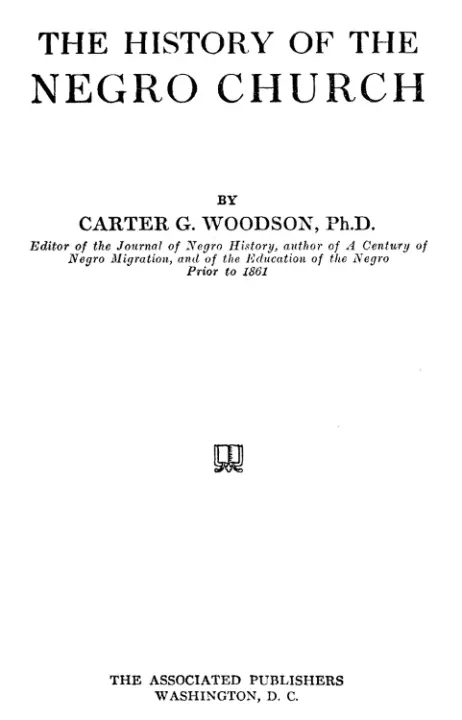
The History of the Negro Church
Carter Godwin Woodson
THE CLASSIC COLLECTION · 1918
"A Century of Negro Migration" by Carter G. Woodson is a historical account written during the early 20th century. The book explores the significant movements of African Americans, particularly their migration from the Southern States to the Northern regions of the United States, highlighting the socio-political context and motivations behind these movements. Woodson aims to provide a comprehensive overview of this migration phenomenon, connecting it with earlier migrations dating back to before the Civil War. At the start of the work, Woodson presents a preface noting that the migration of African Americans is a developing socio-historical event, emphasizing the newly acquired freedom that compels the population to seek better opportunities. He references the historical context of earlier migrations, the initial thoughts about the future of black Americans, and their ongoing struggles against oppression. The opening chapters outline how various external factors, such as the influence of Quakers and the challenges of acquiring asylum in the North, played pivotal roles in shaping the migratory patterns of black Americans. Woodson provides insight into the societal attitudes faced by migrants and the legacy of slavery that complicated their pursuit of freedom and equality.
Introduction adapted from the source catalogue; source summaries may be automatically generated.
Free to read · English · 52,803 words · No account needed
MAKE TIME FOR A GOOD BOOK
On by default. Untick to stop anonymous reading totals. Each page counts after 10 seconds in view. How this works.
Anonymous counting is on unless you have switched it off.
Pennsylvania,
effort in, to force free Negroes to support their dependents;
effort to prevent immigration of Negroes;
increase in the population of free Negroes of;
petitions to rid the State of Negroes by colonization;
era of good feeling in;
exterminated slavery;
the migration of freedmen from North Carolina to;
Negro suffrage in;
passed laws against Negro mechanics;
successful Negroes of,
Peonage,
a cause of migration,
Philadelphia,
Negroes rush to;
race friction of;
woman of color stoned to death;
Negro church disturbed;
reaction against Negroes;
riots in;
successful Negroes of;
property owned by Negroes,
Pierce, E.S.,
plan for handling refugees in South Carolina,
Pinchback, P.B.S.,
return of, from Ohio to Louisiana to enter politics,
Pittman, Philip,
account of West, of,
Pittsburgh,
friends of fugitives in;
Negro of, married to French woman;
kind treatment of refugees;
respectable mulatto woman married to a surgeon of Nantes;
riot in,
Platt, William,
a lumber merchant,
Political power,
not to be the only aim of the migrants;
the mistakes of such a policy,
Polities,
a cause of unrest,
Pollard, N.W.,
agent of the Government of Trinidad, sought Negroes in the United
States,
Portsmouth,
friends of fugitives of,
Portsmouth, Ohio,
mob of, drives Negroes out;
progressive Negroes of,
Prairie du Rocher,
slaves of,
Press comments on sending Negroes to Africa,
Puritans,
not much interested in the Negro,
Quakers,
promoted the movement of the blacks to Western territory;
in the mountains assisted fugitives,
Race prejudice,
the effects of;
among laboring classes,
Randolph, John,
a colonizationist;
sought to settle his slaves in Mercer County, Ohio,
Reaction against the Negro,
Reconstruction,
promoted to an extent by Negro natives of North,
Redpath, James,
interest of, in colonization,
Refugees assembled in camps;
in West;
in Washington;
in South;
exodus of, to the North;
fear that they would overrun the North;
development of;
vagrancy at close of war,
Renault, Philip Francis,
imported slaves,
Resolutions of the Vicksburg Convention bearing on the exodus to
Kansas,
Rhode Island,
exterminated slavery,
Richards, Benjamin,
a wealthy Negro of Pittsburgh,
Richard, Fannie M.,
a successful teacher in Detroit,
Riley, William H.,
a well-to-do bootmaker,
Ringold, Thomas,
advertisement of, for a slave in the West,
Rochester,
friends of fugitives in,
Saint John, Governor,
aid of, to the Negroes in Kansas,
Sandy Lake,
Negro settlement in,
Saunders of Cabell County, Virginia,
sent manumitted slaves to Cass County, Michigan,
Saxton, General Rufus,
plan for handling refugees in South Carolina,
Scotch-Irish Presbyterians,
favorable to fugitives,
Scott, Henry,
owner of a pickling business,
Scroggs, Wm. O.,
referred to as authority on interstate migration,
Segregation,
a cause of migration,
Shelby County, Ohio,
Negroes in,
Sierra Leone,
Negroes of, settled in Jamaica,
Simmons, W.J.,
returned from Pennsylvania to Kentucky,
Your reading position is saved on this browser. Take it to another device with a library code. Reading pages adapt to text, rather than matching a printed edition.
Carter Godwin Woodson
Carter Godwin Woodson
BEHIND THE BOOK
This eBook is for the use of anyone anywhere in the United States and most other parts of the world at no cost and with almost no restrictions whatsoever. You may copy it, give it away or re-use it under the terms of the Project Gutenberg License included with this eBook or online at www.gutenberg.org. If you are not located in the United States, you will have to check the laws of the country where you are located before using this eBook. Read the source licence.
The original source file, including credits and licence, is retained by this library. Request an original-format copy at no charge. Please include the book title and Project Gutenberg identifier #10968.
KEEP YOUR CURIOSITY GOING
Cécile Tormay

Moritz Busch
John L. Ransom
Frances Wright
Cécile Tormay

Mabel Potter Daggett