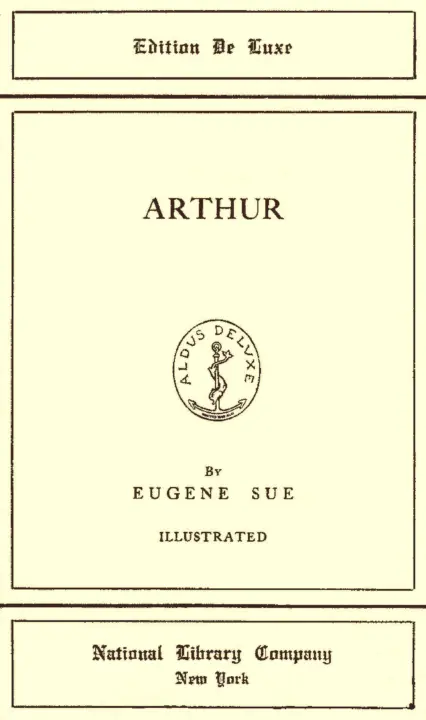
Arthur
Eugène Sue
THE CLASSIC COLLECTION · 1892
"A Cardinal Sin" by Eugène Sue is a novel written in the late 19th century. The story revolves around Mariette, a young girl facing poverty and hardship as she tries to care for her ailing godmother while dreaming of a life filled with love and happiness. The narrative highlights themes of love, sacrifice, and the struggles of the lower class in society. The opening portion introduces Mariette as she visits a public scribe to have a letter written to her beloved, Louis. Through their interaction, we learn of her life’s burdens, including her responsibilities towards her sick godmother and her longing for a better future. As Mariette dictates her heartfelt letter, she reveals her devotion and emotional turmoil, setting the stage for the complex interplay of love, social struggles, and sacrifice that will likely unfold in the novel. A parallel story emerges through the scribe’s furtive glances and apprehensions, hinting at deeper connections and potential conflicts as Mariette's love story develops amidst societal challenges.
Introduction adapted from the source catalogue; source summaries may be automatically generated.
Free to read · English · 43,164 words · No account needed
MAKE TIME FOR A GOOD BOOK
On by default. Untick to stop anonymous reading totals. Each page counts after 10 seconds in view. How this works.
Anonymous counting is on unless you have switched it off.
"I am completely disinterested in the matter, my dear duke," replied the young man, with a smile, "those eighteen hundred thousand francs belong to my creditors, and I shall therefore be horribly tenacious on the conditions. Moreover, as I have already told you, Lord Wilmot offers me that sum and urges me to accept it."
"That may be, but I am sure you would grant me a favor you would refuse Lord Wilmot. Come, Saint-Herem, don't be inflexible--give me a discount, and--"
"Monsieur de Saint-Herem," broke in the countess, "I shall take the house on the conditions you proposed."
"Heaven be praised!" exclaimed Florestan, extending his hand toward her. "My good star never deserts me, madame; the affair is settled."
"But, madame--" interposed the duke, surprised and annoyed at the liberality of his future wife, and still hoping to obtain a reduction on the price, "this is a matter involving considerable money! And at the point we have reached, it is impossible that you should act without my authority. When we are married--"
"Monsieur de Saint-Herem, you have my word," interrupted the countess, with a scornful glance at the duke. "This purchase is a personal matter; my steward will negotiate with yours to-morrow, at any time you may wish."
"Agreed, madam," assented Florestan; then turning to M. de Riancourt, he added gaily, "I hope you will bear me no ill-will, my dear duke; you should show yourself to be a real grand seigneur, and not bargain like a banker."
The orchestra; which had been silent for a quarter of an hour, now
struck up a new cotillion.
"Pardon me, countess," resumed the young man, "but I must leave you. I am to dance this cotillion with the charming daughter of one of the best workmen who assisted in the building of this mansion--or rather of your mansion, madame. And I cannot tell you how happy I am to carry away that thought in leaving you."
He bowed respectfully, and vanished in the throng.
"My dear Foedora," said the princess, who had remarked the long tete-a-tete of her niece and Saint-Herem with much impatient anxiety, "it is growing late, and we promised Madame de Sardaigne to come early."
"Allow me to observe, madame," put in the duke, addressing his fiancee in his turn, "that you were too hasty in this matter. Saint-Herem is forced to sell this house to pay his debts, and with a little perseverance we could have obtained a reduction of fifty thousand crowns at least, especially if you had requested it yourself--some things are very difficult to refuse a pretty woman!" he concluded with his most amiable smile.
Your reading position is saved on this browser. Take it to another device with a library code. Reading pages adapt to text, rather than matching a printed edition.
Eugène Sue
Eugène Sue
Eugène Sue
Eugène Sue
BEHIND THE BOOK
This eBook is for the use of anyone anywhere in the United States and most other parts of the world at no cost and with almost no restrictions whatsoever. You may copy it, give it away or re-use it under the terms of the Project Gutenberg License included with this eBook or online at www.gutenberg.org. If you are not located in the United States, you will have to check the laws of the country where you are located before using this eBook. Read the source licence.
The original source file, including credits and licence, is retained by this library. Request an original-format copy at no charge. Please include the book title and Project Gutenberg identifier #18832.
KEEP YOUR CURIOSITY GOING
Coulson Kernahan

Maurice Baring
Frances Wright
Cécile Tormay

Frederic Jesup Stimson

W. H. P. (William Henry Pope) Jarvis